
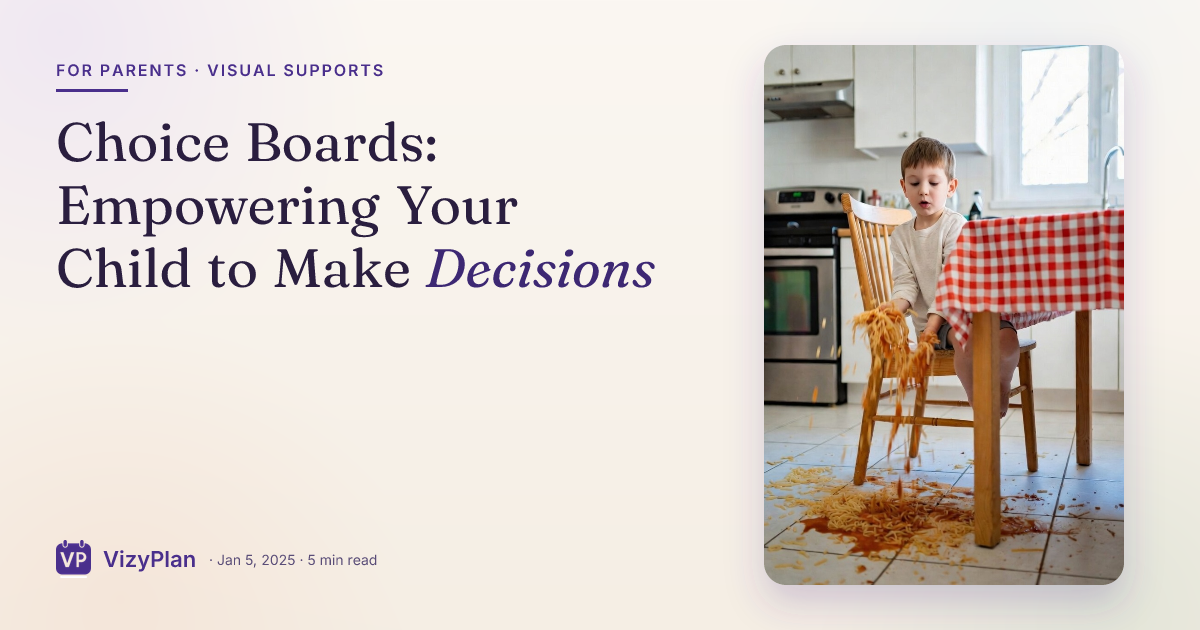
"What do you want for breakfast?" Silence. "Do you want eggs or cereal?" Still nothing. "How about pancakes?" A meltdown. You just asked a simple question, and somehow it became the hardest part of the morning.
For neurodivergent children, open-ended questions can feel paralyzing and even "this or that" verbal choices can overwhelm a brain already working overtime to process the day. Choice boards change the game entirely, replacing invisible verbal options with visible, concrete pictures your child can simply point to.
What Are Choice Boards?
A choice board is a visual display showing available options that a child can select from. Rather than asking "What do you want to eat?" and waiting for a verbal response, you present a board showing pictures of available foods, and the child points to, touches, or otherwise indicates their choice.
Choice boards can be physical or digital. Printed boards with pictures, boards with velcro attachments, or tablet-based systems all serve the same purpose.
They communicate what is actually available. Unlike asking an open question, choice boards show concrete options that the child can actually have.
They remove the language burden. Children who struggle with word retrieval, verbal expression, or processing verbal questions can still communicate preferences.
They provide visual processing time. Looking at options gives children time to think without the pressure of someone waiting for a verbal response.
Why Choice Boards Work
The effectiveness of choice boards stems from how they align with neurodivergent learning styles and needs.
Reduced demand for language processing. Receptive language challenges make verbal questions difficult. Visual options bypass this barrier.
Concrete rather than abstract. "What do you want?" is abstract. Pictures of specific options are concrete.
Lowered anxiety. Knowing the options are limited and defined reduces the stress of decision-making.
Increased sense of control. Having choices, even limited ones, gives children agency in their lives.
Reduced power struggles. When children feel they have a voice, resistance often decreases.
Types of Choice Boards
Different situations call for different choice board formats.
Simple two-choice boards work well for children just starting with choice-making or for quick decisions. "Red shirt or blue shirt?"
Category boards show options within a specific category, snack choices, activity choices, toy choices.
Schedule choice boards let children choose the order of activities or select preferred activities to include in their day.
Reward choice boards display options for reinforcers, letting children select what they are working toward.
Communication choice boards support children in expressing needs, feelings, or requests throughout the day.
Creating Effective Choice Boards
Design decisions significantly impact how well choice boards work for your child.
Use images your child understands. Photos, icons, drawings, or even words, whatever your child processes most easily.
Include actually available options. Never include an option you cannot or will not provide. This destroys trust in the system.
Limit the number of options. More is not better. Two to four options are often ideal. Too many choices overwhelms rather than empowers.
Consider the visual layout. Consistent placement helps children learn to scan and select efficiently.
Make them durable. Choice boards get handled frequently. Lamination, card stock, or digital formats prevent quick deterioration.
Using Choice Boards Throughout the Day
Choice boards can support decision-making in many daily situations.
Meal and Snack Time
Instead of asking what a child wants to eat, which may result in requests for unavailable items, verbal struggles, or "I don't know", present a board showing what is actually available.
Breakfast options might show cereal, toast, pancakes, or eggs.
Snack boards display the acceptable snack options for that time of day.
Drink choices help children select their beverage without verbal negotiation.
Restaurant prep can show menu items from a restaurant you are about to visit, allowing the child to decide before the pressure of ordering.
Activity and Play Time
Open-ended free time can be overwhelming. Choice boards provide structure.
Play activity boards show available toys, games, or activities.
Outdoor play options might include swinging, sandbox, bikes, or sidewalk chalk.
Screen time choices display allowed apps, shows, or games.
Art activity boards show available craft projects or art supplies.
.png)
Clothing and Getting Dressed
Morning battles over clothing often decrease when children have visual choices.
Outfit choice boards let children pick between two or three acceptable options.
Weather-appropriate options only show choices that suit the day's weather.
Pajama choices make bedtime smoother by offering selection within limits.
Emotional Expression
For children who struggle to verbally express how they feel, choice boards provide a way to communicate emotional states.
Feeling boards display emotion faces, allowing children to point to how they feel.
Need boards show options like "I need a break," "I need help," or "I need a hug."
Calm-down strategy boards present options for regulation activities the child can choose.
Common Implementation Challenges
Anticipating challenges helps you navigate them successfully.
Child always chooses the same thing. This is often fine, predictability is comforting. If variety is needed, rotate what appears on the board or use "one of these, then one of these" approaches.
Child wants something not on the board. Acknowledge the want, then redirect to available choices. "I know you want ice cream. These are the snacks we have right now. Which would you like?"
Child refuses to choose. Offer a "no choice" option, give more time, or make the choice for them with a cheerful "I'll pick this time." Remove pressure and try again later.
Child removes or destroys board. This may signal that choices feel overwhelming, the options are not motivating, or the child is not ready for this format. Simplify or pause and reassess.
Other family members do not use the board consistently. Everyone interacting with the child needs to use the same system. Inconsistency undermines effectiveness.
Teaching Choice-Making Skills
Some children need explicit teaching to use choice boards effectively.
Start with preferred vs. non-preferred. Offer a choice between something the child loves and something they would never choose. This teaches the concept that pointing gets the selected item.
Graduate to two preferred options. Once the connection is made, offer two options the child would both enjoy.
Add complexity gradually. Increase the number of options, introduce new categories, and add less-preferred options only after the skill is established.
Practice when stakes are low. Build the skill during calm, low-pressure times before relying on it during difficult moments.
Building Toward Greater Independence
Choice boards can be stepping stones to broader decision-making skills.
Self-selection eventually allows children to take choice boards themselves and make selections without adult presentation.
Verbal bridging may develop as children begin verbalizing their choices while pointing, building toward spoken requests.
Expanded options can gradually increase as children demonstrate the ability to handle more choices without overwhelm.
Generalization to new contexts happens as children learn that the skill of choosing applies everywhere, not just with familiar boards.
Digital Choice Board Benefits
Technology offers advantages for choice board creation and use.
Easy customization allows adding new options, swapping images, and updating choices quickly.
Portability means choice boards travel on a phone or tablet, available anywhere.
Audio support can include options that play a sound or speak the choice name when selected.
Data collection in some apps tracks choices over time, revealing patterns and preferences.
VizyPlan's customizable features help you create visual choice boards that grow with your child and adapt to your family's needs.
VizyPlan helps you create personalized choice boards that empower your child's voice. Start your free trial and reduce daily power struggles through the power of choice.