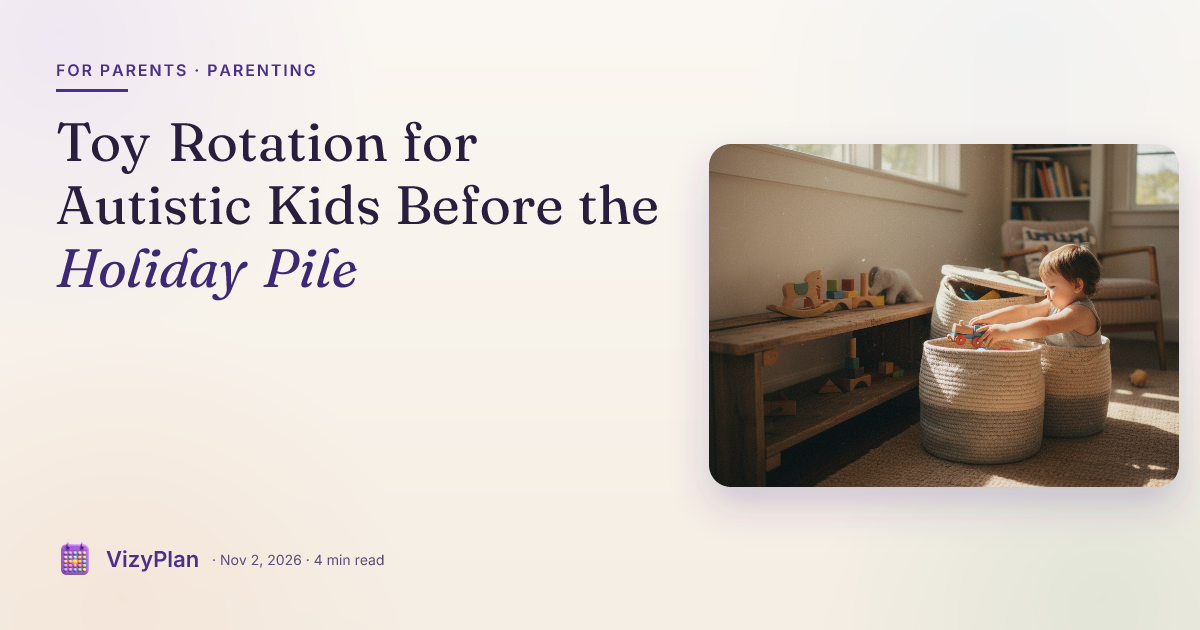
Your child goes to bed in a familiar living room and wakes up to a tree where the reading chair used to be, lights blinking in the window, and a snowman on the stairs that sings when someone walks past. For many families that morning is pure magic. For an autistic child who relies on sameness, holiday decorations can turn home, the one place that always stays the same, into somewhere new overnight.
The goal is not to skip the season. With a little planning, holiday decorations and autism can share the same house.
Why holiday decorations can feel so big
Autism researchers use the phrase insistence on sameness for a strong preference for routines, familiar places and predictable patterns. The CDC's summary of the DSM-5 criteria lists insistence on sameness and inflexible adherence to routines as one of the core autism characteristics, alongside hyper- or hyporeactivity to sensory input. A living room rearranged overnight touches both at once: the space changed, and the space now glows, blinks and plays music.
Sameness is often about safety, not stubbornness. In a 2019 study in the journal Autism, Hwang and colleagues surveyed 176 autistic adults and found that intolerance of uncertainty (discomfort with not knowing what comes next) helped explain the link between anxiety and insistence on sameness. A home that changes without warning adds a lot of not knowing.
Sensory differences matter too. In Tomchek and Dunn's study of 281 autistic children ages 3 to 6, 95% showed some degree of sensory processing difference on a parent questionnaire, with auditory filtering among the areas where they differed most from peers. A singing reindeer is a fun surprise for one child and a constant interruption for another.
Our son has always noticed when anything at home moves. We learned to decorate with him, not around him.
How to decorate in stages
Previewing changes with pictures is a form of visual support, and visual supports are on the list of evidence-based practices for autistic children from the National Clearinghouse on Autism Evidence and Practice. Here is a plan most families can adapt:
- Pick the dates and show them. Put "tree day" and "lights day" on a calendar or picture schedule a week ahead, so the change has a beginning your child can see coming.
- Preview with photos. Pull up last year's pictures of the decorated room, or snap a photo of the tree in its box. A child who has seen the finished room before it appears has less to absorb in the moment.
- Decorate one area at a time. Tree one weekend, window lights a few days later, the mantel after that. Small changes spread over a week or two are easier to take in than one big overnight reveal.
- Let your child help and choose. Offer real choices: which ornament goes on first, where a decoration sits, red lights or white. Helping turns a change that happens to your child into a change your child makes.
- Move furniture last, or not at all. If the tree needs the reading chair's spot, show your child where the chair is going before anything moves, and keep the chair together with its usual blanket or pillow.
Enjoying this article?
Get practical tips and insights delivered to your inbox — no spam, ever.
Choose holiday decorations with the senses in mind
A sensory-friendly approach to holiday decorations usually means fewer surprises, not fewer decorations.
- Skip or tame flashing lights. Most light strings have a steady setting. Set it once and leave it.
- Turn off the music. Remove batteries from motion-activated singing toys, or keep them out of main walkways.
- Watch smells. Scented candles, sprays and pine-scented cones can be a lot for a child who is sensitive to smell.
- Keep one room unchanged. Leave your child's bedroom, or another favorite space, exactly as it is all season. Every child benefits from a place to retreat to that looks the way it did yesterday.
Our guide to preparing for holidays and special events covers the rest of the season, and our post on why autistic kids resist transitions explains why a heads-up matters so much.
Plan the takedown too
Many families forget that taking holiday decorations down is a second big change. Some children grow attached to the tree within a few weeks, and one morning it vanishes. Put "decorations go away" on the calendar the same way you marked tree day, take things down in stages, and let your child pack a favorite ornament or choose the last decoration to come down. A photo of the box going back to the attic tells your child the decorations will return next year.
If family visits are coming too, our post on surviving family gatherings can help you plan the busiest days, and our guide to a sensory friendly Santa visit covers the trip to the mall.
VizyPlan was built by an autism dad and an autism mom who is a licensed speech-language pathologist so tree day, lights day and takedown day can live on a picture schedule your child sees coming.
Download VizyPlan and let your child see the house change before it does. Try it free for a week. If it helps, keep going for $6.99/month or $59.99/year.
VizyPlan was built by an autism dad and an autism mom who is a licensed speech-language pathologist who needed something that did not exist. Start your free trial.