
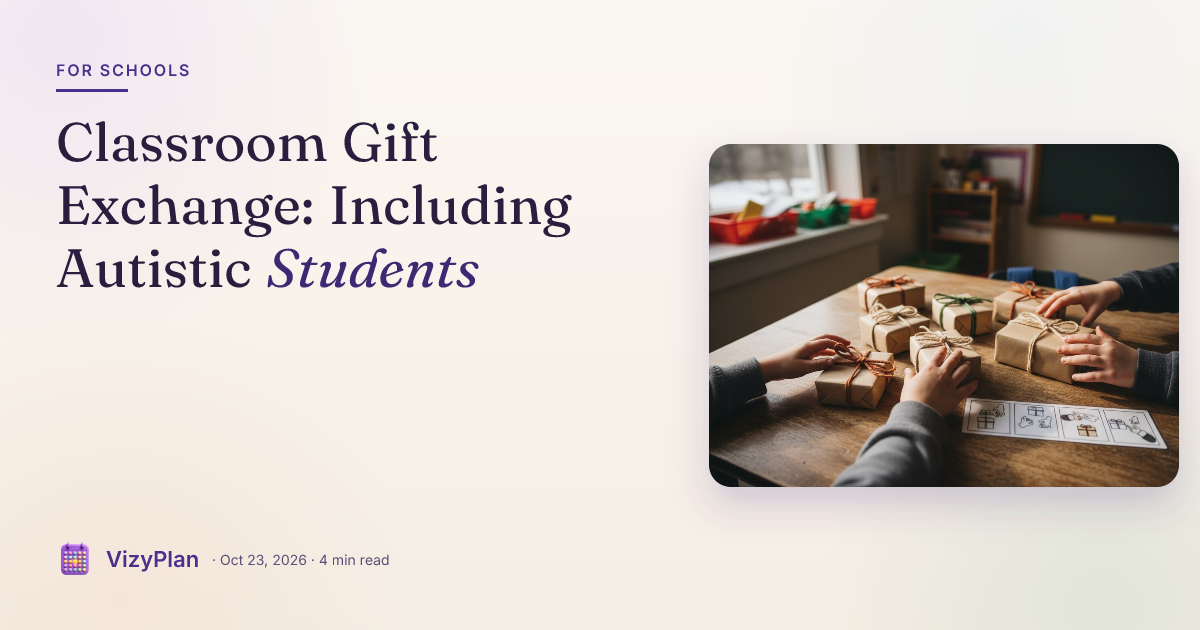
December brings a lot of fun into the classroom, and a classroom gift exchange is often near the top of the list. For many autistic students, though, Secret Santa, white elephant and surprise swaps stack up exactly the things that make a day hard: not knowing what is coming, long waits, a crowded circle, and an unspoken rule to look thrilled no matter what is inside the box.
None of that means skipping the classroom gift exchange. A few design choices can turn a stressful tradition into one every student can actually enjoy.
Why a classroom gift exchange can be hard for autistic students
Most gift games are built on surprise. A 2023 scoping review in Education Sciences by Emerson and Costley at the University of Nottingham links autistic pupils' difficulty predicting other people's behavior and understanding what a task requires to high rates of anxiety and intolerance of uncertainty. A wrapped box, a mystery giver and a game whose rules change mid-round all add uncertainty at once.
Social expectations are the second layer. Students are expected to open a gift in front of everyone, read the giver's face, and say something kind on the spot. In a study published in Autism, Halsall, Clarke and Crane interviewed adolescent autistic girls, their mothers and their educators about camouflaging, the effort of hiding autistic traits to fit in. Exhaustion was the consequence participants described as having the most impact, and educators saw it most clearly after busy mainstream lessons. A forced happy reaction is one more performance on an already full day.
Then there are the stealing games. White elephant and "steal or keep" formats ask a student to choose an object, get attached to it, and then possibly lose it to a classmate. For a student who finds unexpected change hard, losing a gift to a rule can feel like the whole activity went wrong.
Start with inclusion for every family
Not every family celebrates the same holidays, and some do not celebrate any. The Islamic Networks Group's winter holiday guide for educators recommends offering alternate activities so students whose families opt out do not feel left out. A neutral winter swap, such as a book swap, a cozy sock swap or a handmade card exchange, keeps the focus on generosity without tying the activity to any one holiday.
Cost matters too. A classroom gift exchange can quietly signal which families have extra money in December. Keep the budget low and stated, or skip purchases entirely.
Seven steps to an inclusive classroom gift exchange
- Drop the stealing games. Use a simple one-to-one swap where every student keeps the gift they receive. Predictable rules protect every student, not only autistic students.
- Use wish lists or a choice of gifts. Let students list three things they would like, or set out a table of wrapped gifts sorted into labeled categories (book, art supplies, small toy) so students choose a category instead of facing a total mystery.
- Set an equitable budget, or no budget. A small, fixed limit, a classroom fund families can contribute to privately, or a handmade-only rule all keep the swap fair. Tell families early so no one feels pressure.
- Preview the steps visually. Post a picture sequence a few days ahead: draw a name, bring the gift, sit in the circle, wait for your turn, open, say thank you, play. The 2020 report from the National Clearinghouse on Autism Evidence and Practice lists visual supports and social narratives among its evidence-based practices for autistic children and youth. Our visual schedule guide for classrooms covers how to build one.
- Practice a receiving script. Give every student a short, honest script: "Thank you for the gift," "I like the color," or "Thank you, I will try it." Make clear that a calm thank you is enough. No one has to act excited.
- Offer an opt-out or a helper role. Some students would rather pass out gifts, keep the turn order, run the timer or take photos for the class. A helper role keeps a student included while lowering the spotlight. A quiet corner should always be available.
- Shorten the wait. Open gifts in small groups or all at once instead of one at a time around a 25-student circle. Long waits with nothing to do are where many classroom parties fall apart.
Enjoying this article?
Get practical tips and insights delivered to your inbox — no spam, ever.
On the day of the classroom gift exchange
Keep the room calmer than a typical party. Turn music down, skip noisy poppers, and let students open gifts at their desks if the circle feels crowded. Tell students what happens right after the swap so the end of the activity is clear. If a student is disappointed, a script like "I can trade later with a teacher" gives the feeling somewhere to go.
Many of the same moves work for other December events. Our guides to the classroom Halloween party and a holiday concert autistic students can enjoy use the same preview, script and exit-plan approach.
Loop families in early
Send a short note home with the date, the budget, the steps and the pictures you will use. Families know which surprises their student handles well and which ones end in a hard afternoon. Families who want a home version can also look at our parent guide to gifts for autistic kids.
VizyPlan was built by an autism dad and an autism mom who is a licensed speech-language pathologist so a classroom gift exchange can be a set of steps students see before the day arrives.
Share VizyPlan with your families so the swap gets previewed at home before it happens at school. Families can try it free for a week. If it helps, they can keep going for $6.99/month or $59.99/year.
VizyPlan was built by an autism dad and an autism mom who is a licensed speech-language pathologist who needed something that did not exist. Explore VizyPlan.