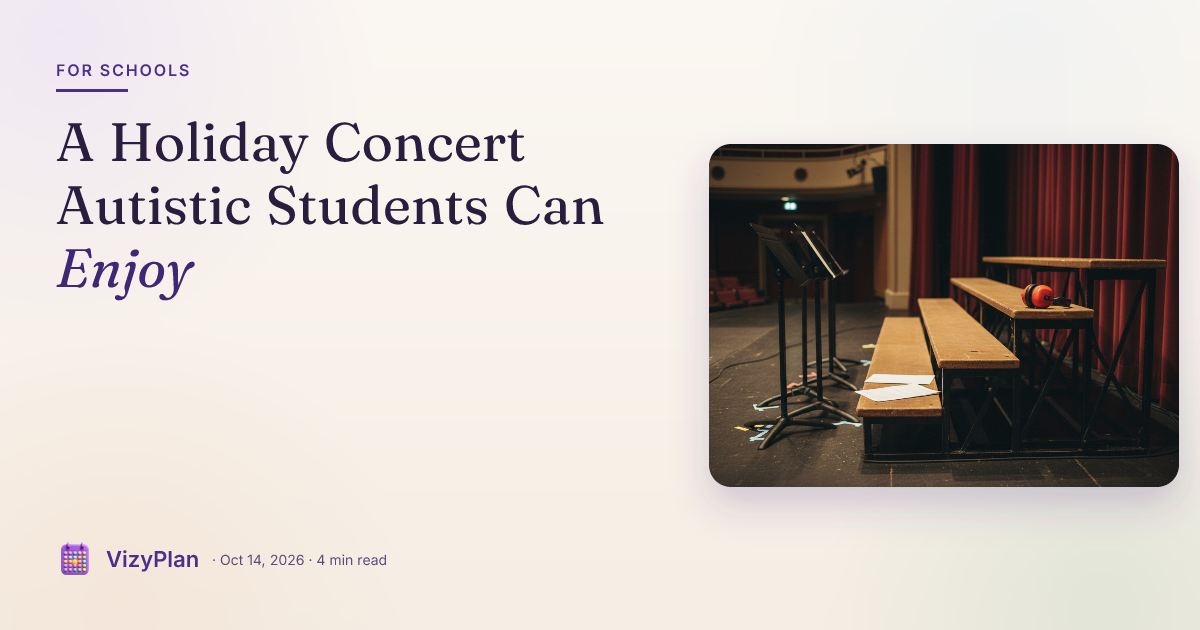
The December concert is one of the best nights of the school year for many families, and one of the hardest for many autistic students. A gym or auditorium full of parents, bright stage lights, a microphone that squeals once, applause that arrives all at once, and a long wait on the risers in an unfamiliar outfit. Planning a holiday concert autistic students can be part of starts now, about eight weeks out, not at the dress rehearsal.
Whether your school calls it the winter concert, the holiday program or the December sing, the same planning applies. The goal is a real role in the night for every student, not every student on the risers.
Why sound is the first thing to plan
Decreased sound tolerance is common in autism. A 2021 meta-analysis in Ear and Hearing estimated that about 41 percent of autistic people currently experience hyperacusis, a reduced tolerance for everyday sounds, and about 61 percent at some point in their lives. A concert stacks those sounds together: instruments, a sound system, a crowd, and clapping that starts without warning.
Hearing protection can help. In a small, promising study of six autistic children aged 8 to 16, noise-attenuating headphones were associated with lower physiological stress. A sensory toolkit from Derbyshire County Council suggests saving ear defenders for high-noise moments such as assemblies and keeping them within the student's reach, so the student stays in control of their own sound.
Seven steps to a holiday concert autistic students can be part of
- Talk to families in early November. Parents often know exactly which moment of the night will be hardest. A short note through your usual home and school communication channel opens that conversation.
- Rehearse in the real space, more than once. A classroom run-through does not prepare a student for the gym, the risers or the stage lights. Two or three short rehearsals in the actual room, with the lights and microphones on, make the space familiar.
- Make hearing protection part of the costume. Let students practice singing or playing in headphones or ear defenders during rehearsals, so wearing them on the night feels normal rather than noticeable. A line in the program noting that some performers wear hearing protection saves questions from the audience.
- Offer real alternative roles. Not every student needs to stand on the risers. Stage crew, holding cue cards, playing a hand drum or a single bell, signing a song alongside the choir, or introducing the next piece are all ways to be in the concert. NAfME guidance for music teachers recommends simplifying parts and adjusting volume and tempo so autistic students can contribute to an ensemble.
- Keep the order of events the same every time. Run every rehearsal in the exact sequence the concert will follow: walk in, sit, stand, sing, applause, sit. A predictable order tells a student what comes next without anyone having to ask.
- Send home a visual concert-day schedule. Pictures of the ride to school, the arrival door, the waiting room, the stage, the applause and pickup let a student preview the evening. Our visual schedule guide for teachers covers the format. Families can use the same schedule so the night looks the same at home and at school.
- Plan the exit before anyone needs it. Agree on a quiet room, a signal the student can use, and a staff member who will walk out with them. Leaving the stage early is part of the plan, not a failure, and knowing the exit exists can make staying feel possible.
Enjoying this article?
Get practical tips and insights delivered to your inbox — no spam, ever.
Applause, lights and the parts nobody rehearses
Applause is often the loudest moment of the night and the least practiced. Have the class clap at the end of each rehearsal song, and show students when to put headphones on. Consider inviting the audience to use silent applause, waving both hands, for part of the program. The approach that helps with fire drills works here too: warn before the loud part, practice it, and give a clear way to cope.
A holiday concert autistic students can enjoy rarely looks identical for every student. Some sing every song. Some ring one bell, wave to their family and head to the quiet room. Both students were in the concert.
VizyPlan was built by an autism dad and an autism mom who is a licensed speech-language pathologist so concert night can be a picture schedule a student has seen at home all week before it happens on stage.
Share VizyPlan with your families so concert night gets practiced at home before it happens at school. Try it free for a week. If it helps, keep going for $6.99/month or $59.99/year.
VizyPlan was built by an autism dad and an autism mom who is a licensed speech-language pathologist who needed something that did not exist. Explore VizyPlan.