
In August you promise a daily note home. By late September it has become a note on hard days. By November it has become an email when something goes wrong, which trains families to feel dread whenever your name appears in an inbox. Home school communication almost never fails because anyone stopped caring. It fails because the system was designed for a teacher with a free ten minutes at 2:50, and that teacher does not exist.
Why home school communication matters more for this group of students
For a student who can narrate their own day, the daily note is a nice extra. For a student who cannot, it is the only channel that exists. A parent asking "how was school" and getting one word is not being stonewalled; our post on getting a real answer about the school day covers why open-ended recall is genuinely hard, and what that means for the questions parents ask.
Research on family-school communication points the same direction. A study in the International Journal of Educational Research examining effective family-school communication for students with learning disabilities found it associated with greater parental involvement both at home and at school, while noting that special education populations remain understudied relative to general education.
Involvement is the mechanism worth caring about. A parent who knows what happened in period three can reinforce it, prepare for it, or ask about it. A parent who knows nothing can only react.
Three rules that keep a system alive
It has to take under sixty seconds to write. Any system that requires composing prose will be abandoned. Ratings, checkboxes, and one optional sentence survive a real week.
It has to be readable in thirty seconds on a phone in a parking lot. That is the actual reading environment. Design for it.
It has to carry good days, not just hard ones. A channel that only activates during problems becomes a channel parents avoid opening, and then you have lost it exactly when you need it.
A daily note that survives to June
- Rate three fixed things, every day. Regulation, participation, and one target skill. Same three, same order, on a five-point scale. Trends emerge without anyone writing a paragraph.
- Add one specific detail, not a summary. "Asked for a break with the card, unprompted" is worth more than "good day." One concrete detail gives the family something to talk about at dinner.
- Flag what tomorrow holds. Assembly, substitute, field trip, drill. A family who knows on Monday night can prepare, and our post on fire drills and autistic students covers why advance notice is the intervention rather than a courtesy.
- Make it two-way with a single prompt. One line on the form for the family: anything we should know about last night or this morning. That question turns a broadcast into a conversation and takes them fifteen seconds.
- Set a hard sending time and protect it. 2:40, every day, done. A note that goes out inconsistently gets read inconsistently.
- Review the trend once a month, with the family. Five minutes with four weeks of ratings tells you more than any single incident report, and it turns the log from paperwork into data.
Enjoying this article?
Get practical tips and insights delivered to your inbox — no spam, ever.
What to do when something hard happened
The hard-day note is where most home school relationships are won or lost. Three things make it land better. Lead with what the student did well before the difficult part. Describe behavior rather than interpreting motive, because motive is where families disagree with schools. And end with what the team is changing tomorrow, so the family is receiving a plan rather than a complaint.
If a hard day is going to require a real conversation, say so in the note and call. A long written account of a difficult incident is the fastest route to a defensive parent, and the second-fastest route to an advocate.
Share the sequence, not just the summary
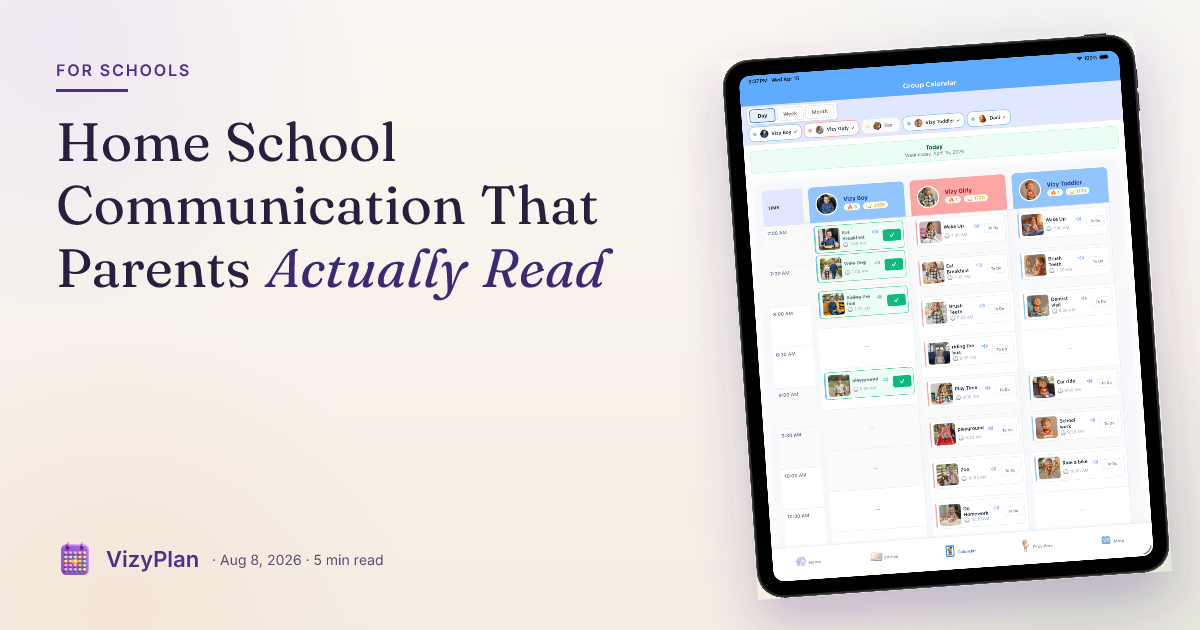
The most useful thing a school can send home is not a report of the day but the shape of it. A family that can see what their child's day actually looks like, in order, can prepare for the hard parts and reinforce the good ones without needing a paragraph from you.
VizyPlan was built by an autism dad and an autism mom who is a licensed speech-language pathologist so the same routine, in the same photos, can run in your classroom and in the family's kitchen. Our post on the shared visual system across home, clinic, and school covers how to set that up across the whole team.
Sixty seconds a day, five days a week, is roughly four hours across a school year. It is the highest-return four hours in the building.
Share VizyPlan with your families so home can see the same day you do. The 7-day free trial lets a family try it first. Just $6.99/month after, no credit card required upfront.
VizyPlan was built by an autism dad and an autism mom who is a licensed speech-language pathologist who needed something that did not exist. Explore VizyPlan.