A child with autism often runs three different systems before lunch. The clinic uses one set of picture cards, the classroom uses another, and home uses whatever the family cobbled together. Each setting is doing good work in isolation, and the child pays the tax at every border crossing. A shared visual system across home, clinic, and school is not a nicety. It is the mechanism that lets a skill you teach on Tuesday show up everywhere else by Friday.
Why fragmentation costs more than anyone bills for
Siloed care quietly erodes the gains each discipline works to produce. A standards paper in Behavior Analysis in Practice warns that when SLP, OT, and behavior teams do not truly collaborate, the result is an "eclectic buffet approach" of disconnected interventions that produces limited treatment gains and erodes family trust. The same paper notes that 65 percent of sentinel events causing serious harm in healthcare trace back to communication failures. A child crossing three settings with three different visual languages is absorbing that same communication gap in miniature, every single day.
Consistency is the active ingredient
The reason a shared visual system works is not branding; it is stimulus control. Visual supports are a recognized evidence-based practice for autism, and their power grows when the same supports appear across environments, because each setting reinforces the same cue instead of teaching a new one. When behavior analysts, SLPs, and OTs coordinate goals and use consistent strategies, clients show greater generalization across settings. Consistency is what turns three good sessions into one durable skill.
How to build one shared system
You do not need a shared employer to run a shared system. You need a shared vocabulary and a way to keep it in sync.
- Agree on a common visual vocabulary. Use the same symbols and wording for core routines so "all done" or "first, then" looks identical in every room.
- Use the same core supports in every setting. Pick a small set of anchor supports and commit to them across clinic, classroom, and home rather than reinventing per site.
- Put the family at the center. ASHA's autism practice portal frames caregiver-mediated intervention, where the clinician coaches the caregiver to run supports in natural settings, as core to care.
- Share notes across disciplines. A short shared summary of active targets and working prompts keeps everyone pointed the same direction.
- Let one tool travel with the child. Choose a single system that follows the child between settings so no one is rebuilding from scratch.
Enjoying this article?
Get practical tips and insights delivered to your inbox — no spam, ever.
The tool that crosses every border
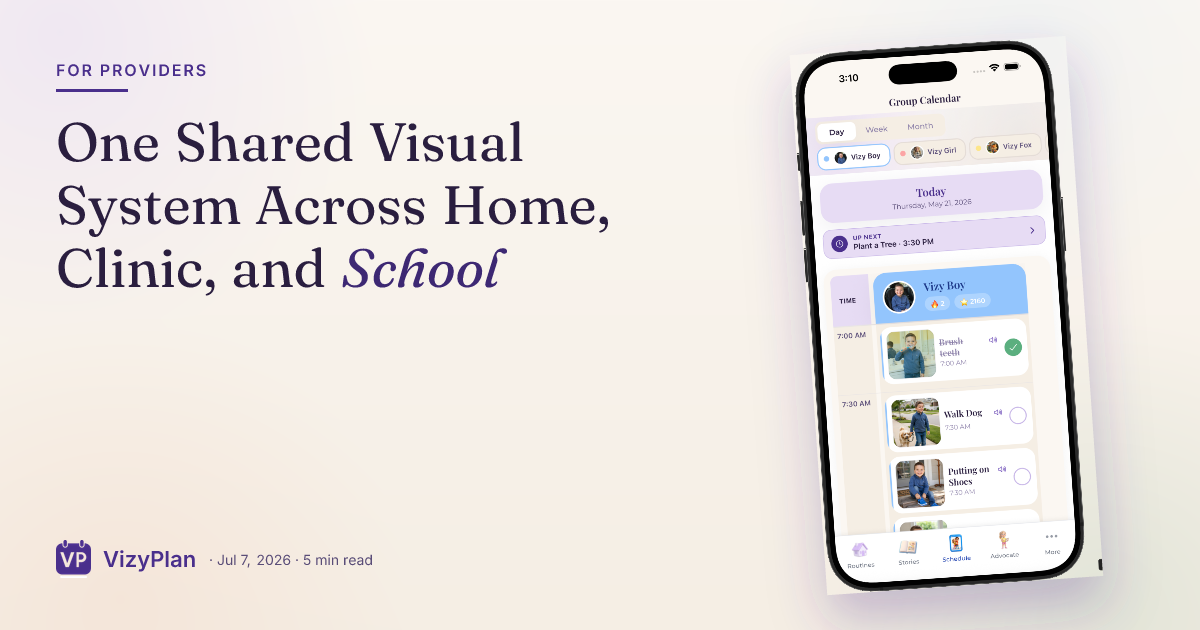
The hardest part of a shared system is keeping it in sync as the child moves. A visual routine that lives on the family's phone solves that by traveling with the child, so the clinic, the teacher, and the parent are all looking at the same steps and the same photos. Our posts on interdisciplinary collaboration and therapy carryover across the school handoff go deeper on aligning a team around one plan.
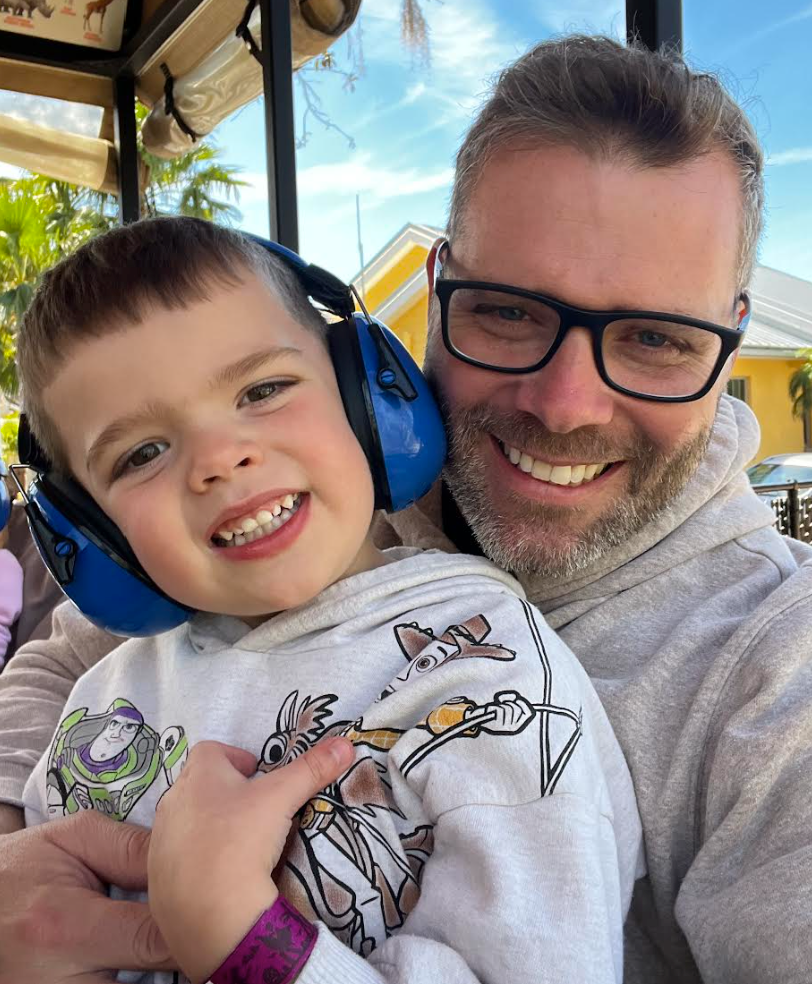
VizyPlan was built by an autism dad and an autism mom who is a licensed speech-language pathologist for exactly this problem. The routine lives on the family's phone with photos of the real child, so the same visual system shows up at home, in your clinic, and in the classroom.
Download VizyPlan and start your 7-day free trial today. Give every setting one shared visual system instead of three. If it helps, keep going for $6.99/month or $59.99/year.
VizyPlan was built by an autism dad and an autism mom who is a licensed speech-language pathologist who needed something that did not exist. Start your free trial.