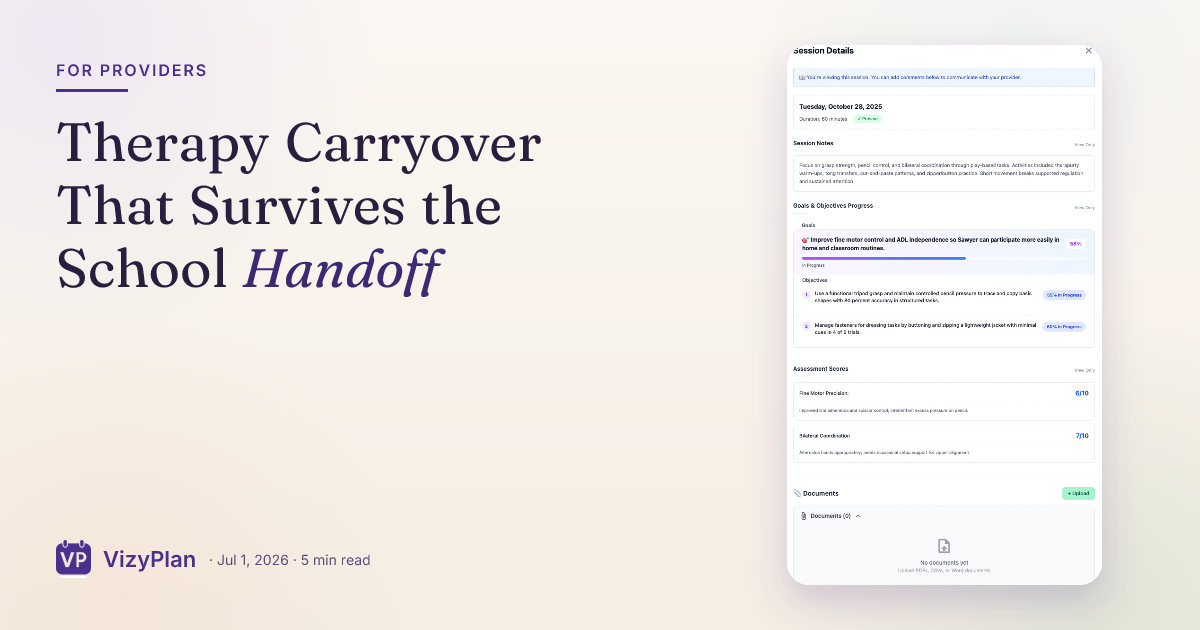
Every provider has watched it happen. A child nails a skill in your session, and by the time it needs to show up in a classroom or a new provider's room, it has vanished. Therapy carryover is not a bonus that happens on its own after a good session. It is a separate skill you have to plan for, and the clinic-to-school handoff is where it most often falls apart.
Why carryover fails at the handoff
Carryover fails because generalization is usually assumed rather than engineered. In their landmark review, Stokes and Baer argued that generalization "has remained a passive concept almost devoid of a technology," and coined the phrase "train and hope" for the common practice of teaching a skill and simply hoping it transfers. Hope is not a plan.
Generalization is also directional and uneven. A multi-site study of 248 autistic children found social communication skills generalized more strongly from home to school than the reverse, which means the setting a skill is taught in shapes where it shows up. And the field still under-measures the problem. A social competence study called generalization "the one persistent challenge," noting how few intervention studies even report whether gains transferred.
What the research says actually moves carryover
Stokes and Baer did not just name the problem; they laid out strategies that still hold up. Put them to work at the handoff.
- Program common stimuli. Use the same visual supports, cues, and vocabulary across settings so the skill has a familiar anchor in the classroom.
- Train with sufficient exemplars. Practice the target across enough people, materials, and contexts that it does not stay welded to your therapy room.
- Recruit the natural environment. Caregivers are the vehicle. A meta-analysis of 30 randomized trials found parent-mediated intervention produced clinically relevant gains in adaptive functioning.
- Write goals the receiving adult can run. A goal only a clinician can interpret does not survive a handoff to a teacher or a new provider.
- Plan for the summer gap. Extended School Year exists precisely because breaks in instruction risk regression and slow recoupment, as Autism Speaks explains.
Enjoying this article?
Get practical tips and insights delivered to your inbox — no spam, ever.
The handoff document nobody writes
Most of the loss happens in the silence between settings. The clinic knows what works, the school inherits a child and a stack of paperwork, and the connective tissue never gets written down. A one-page summary of the child's active targets, the exact prompts that work, and the visual supports in use closes more of the gap than another hour of direct therapy. Our posts on the speech therapy carryover gap and the in-clinic to home generalization gap go deeper on building that bridge.
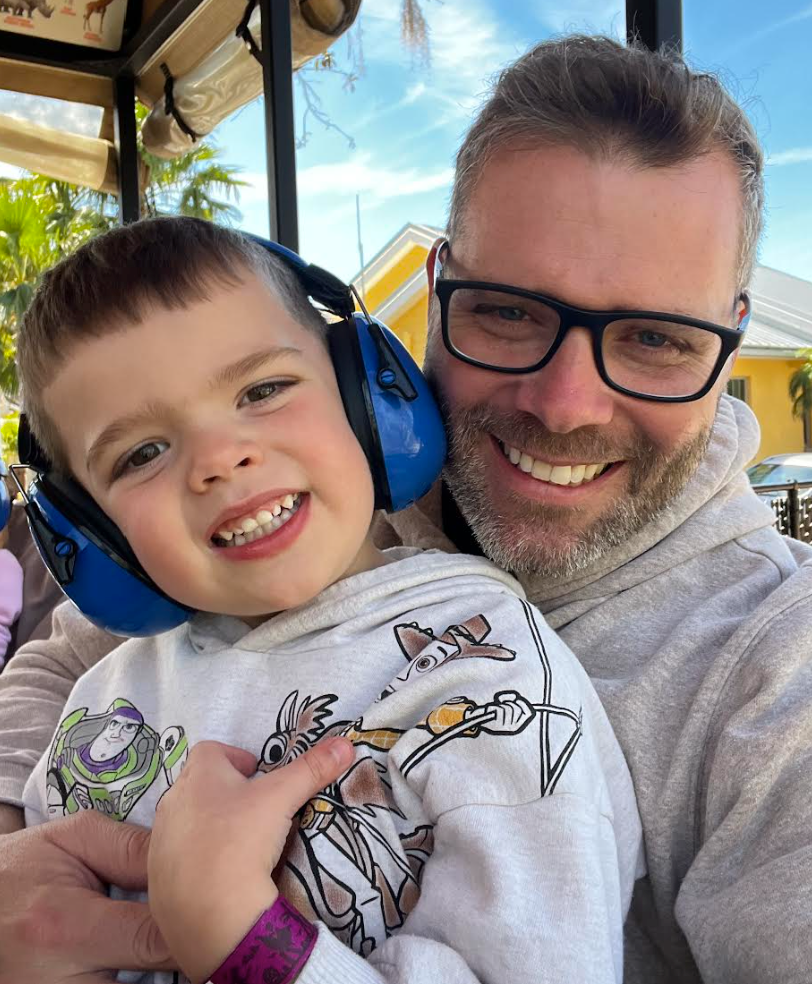
VizyPlan was built by an autism dad and an autism mom who is a licensed speech-language pathologist for exactly this gap. The routine lives on the family's phone with photos of the real child, so the supports you design travel with them into every setting. Your clinical work stays yours; the carryover finally has a vehicle.
Download VizyPlan and start your 7-day free trial today. See what your families could run between the clinic and the classroom. If it helps, keep going for $6.99/month or $59.99/year.
VizyPlan was built by an autism dad and an autism mom who is a licensed speech-language pathologist who needed something that did not exist. Start your free trial.