
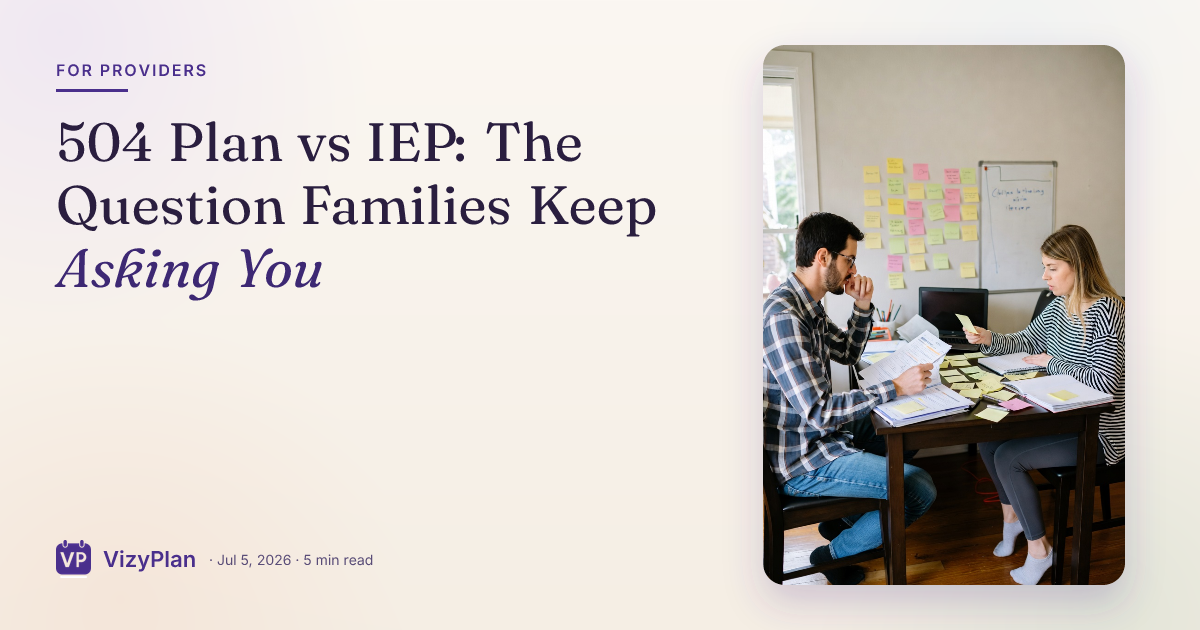
It comes up in the middle of a session, between a goal update and a scheduling question. Does my kid need a 504 or an IEP? Providers get asked the 504 plan vs IEP question constantly, and families trust your answer more than any pamphlet. You are not a special education attorney, and you should not pretend to be one, but you can explain the landscape accurately enough that a parent walks into the school meeting oriented instead of lost.
Two different laws, two different jobs
The whole 504 plan vs IEP distinction starts with the fact that they come from two different laws. An IEP is governed by IDEA, a federal special-education law, while a 504 plan comes from Section 504 of the Rehabilitation Act of 1973, a civil-rights law that prohibits disability discrimination. As Understood.org lays out, an IEP delivers specially designed instruction, and a 504 plan removes barriers so a student can access the standard curriculum. Instruction versus access is the cleanest way to hold the difference in your head.
Who qualifies for each
Eligibility is the other big divide, and it runs in an intuitive direction. The US Department of Education sets a broader bar for a 504 plan: a student must have a physical or mental impairment that substantially limits a major life activity, such as learning or concentrating. An IEP is narrower. The student must fall into one of IDEA's 13 disability categories, autism among them, and need specially designed instruction because the disability adversely affects educational performance. IDEA defines that instruction as adapting the content, methodology, or delivery to the child's needs, which a 504 plan does not provide.
How to explain it without overstepping
Your job is to orient, not to rule on eligibility. A calm, accurate framing does more good than a confident guess.
- Name the two laws plainly. Tell the family an IEP comes from IDEA and a 504 comes from the Rehabilitation Act, so they hear that these are different tracks.
- Frame it as instruction versus access. An IEP changes how a child is taught; a 504 changes the conditions so they can access what everyone else gets.
- Be honest about process differences. IEPs require written consent to evaluate, measurable annual goals, progress monitoring, and stronger dispute-resolution rights. A 504 plan is more flexible and often lighter on formal documentation.
- Note that an IEP can satisfy 504. As the Department of Education states, "one way to meet Section 504 requirements for a free appropriate public education is to implement an IEP," so an IDEA-eligible student does not need a separate 504.
- Route them to primary sources. Point families to the school's special-education team and the Office for Civil Rights 504 resource guide rather than offering a legal opinion.
Enjoying this article?
Get practical tips and insights delivered to your inbox — no spam, ever.
Where your clinical notes fit
The most useful thing you can hand a family is not an eligibility verdict; it is documentation of functional impact. Clear notes on how a child's challenges show up in daily tasks give the school team concrete evidence to work from, whichever plan they pursue. Our posts on collaborating with providers for IEP meetings and the parent-facing 504 plan vs IEP guide are worth sharing so families arrive prepared.
VizyPlan was built by an autism dad and an autism mom who is a licensed speech-language pathologist, and the visual routines it creates give families a concrete record of what supports actually work, useful evidence for either kind of plan.
Download VizyPlan and start your 7-day free trial today. Give your families a clear picture of what supports work before the school meeting. If it helps, keep going for $6.99/month or $59.99/year.
VizyPlan was built by an autism dad and an autism mom who is a licensed speech-language pathologist who needed something that did not exist. Start your free trial.