
Outdoor recess is hard for many autistic students. Indoor recess is often harder. When the weather turns in November, recess moves into the classroom, the space shrinks to the size of the room, the movement mostly disappears, and the noise of twenty-five kids stays exactly where it was.
For a student who uses recess to recover from a morning of demands, the classroom version can turn the one break in the day into the most draining twenty minutes of it.
Why indoor recess matters more than it looks
The CDC and SHAPE America recommend at least 20 minutes of recess daily for elementary students, advise schools not to withhold recess as discipline, and ask schools to designate spaces for both outdoor and indoor recess. The CDC lists recess benefits that include physical activity, attention, concentration, and social and emotional development. Those benefits do not pause when it rains.
Recess is also socially complicated for many autistic students. A University of Washington study led by Jill Locke observed 55 autistic elementary students and found they spent about a quarter of recess playing alone and about 30 percent with peers. On a playground, a student who needs space can find it. In a classroom, there is nowhere to go.
Seven steps to plan indoor recess before November
- Put indoor recess on the visual schedule as its own option. Teach it in October on a dry day so the first rainy morning is a known change, not a surprise. A student who has seen "indoor recess" on the schedule can prepare for it.
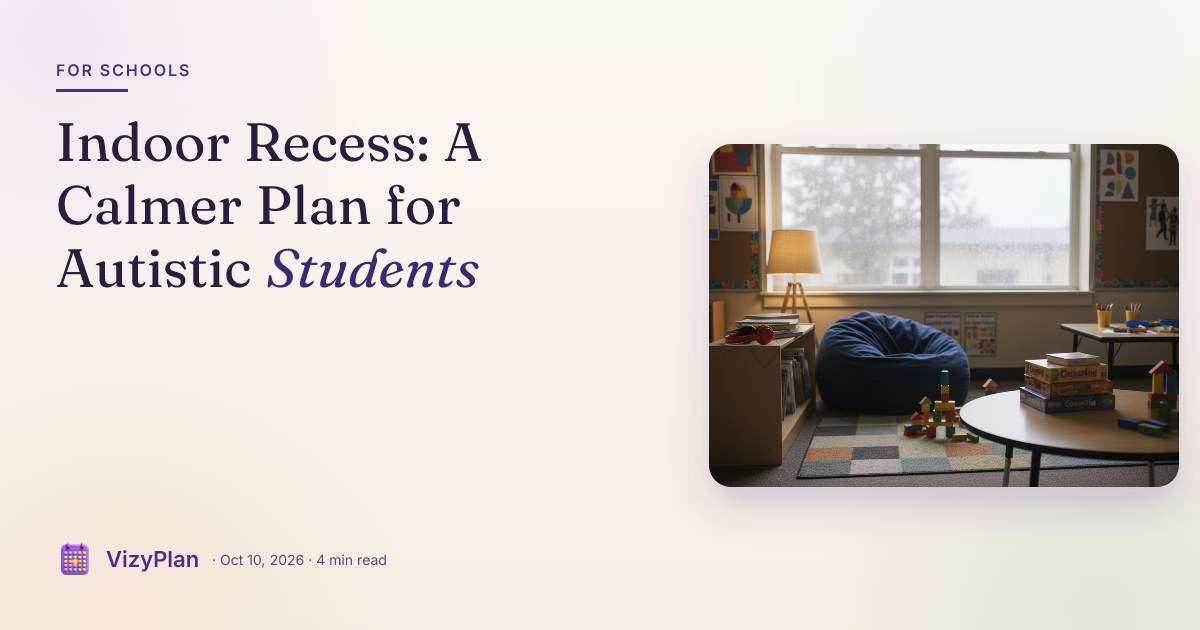
- Zone the room. Mark a movement area, a building or game area, and a quiet corner. Three clear spaces give every student a choice and keep the loud play from spilling over the quiet one.
- Protect a real quiet option. A beanbag, headphones, and a book or drawing basket in a corner that is not a consequence space. Students who choose quiet are still taking recess.
- Keep movement in the plan. Short movement videos, wall push-ups, animal walks, or a hallway walking loop with a staff member give bodies the input that outdoor play usually provides.
- Offer structured games alongside free play. Free play is the hardest format for students who struggle with unwritten social rules. A board game with clear turns or a building challenge gives a student a script to play inside.
- Lower the volume on purpose. Skip the background music and set a visual noise meter if the room uses one. Twenty-five voices in a classroom is already loud enough.
- Give a heads-up before recess ends. A visual timer or a two-minute warning helps the transition back to work, which is often harder after a classroom break than after the playground.
Enjoying this article?
Get practical tips and insights delivered to your inbox — no spam, ever.
Small cost, real difference
None of these steps take away from the students who love rainy day recess. The building corner stays busy, the games still happen, and one more student gets the break they actually need. The same thinking applies to lunch and other unstructured parts of the day, which our guide to recess and lunch for autistic students covers in more depth.
Families notice too. A student who got a real break at noon has more left at the end of the day, which matters for the after school collapse many parents see at home.
VizyPlan was built by an autism dad and an autism mom who is a licensed speech-language pathologist so indoor recess can be a picture on a schedule a student has seen at home before it shows up at school.
Share VizyPlan with your families so schedule changes at school get practiced at home. Families can try it free for a week. If it helps, they can keep going for $6.99/month or $59.99/year.
VizyPlan was built by an autism dad and an autism mom who is a licensed speech-language pathologist who needed something that did not exist. Explore VizyPlan.