
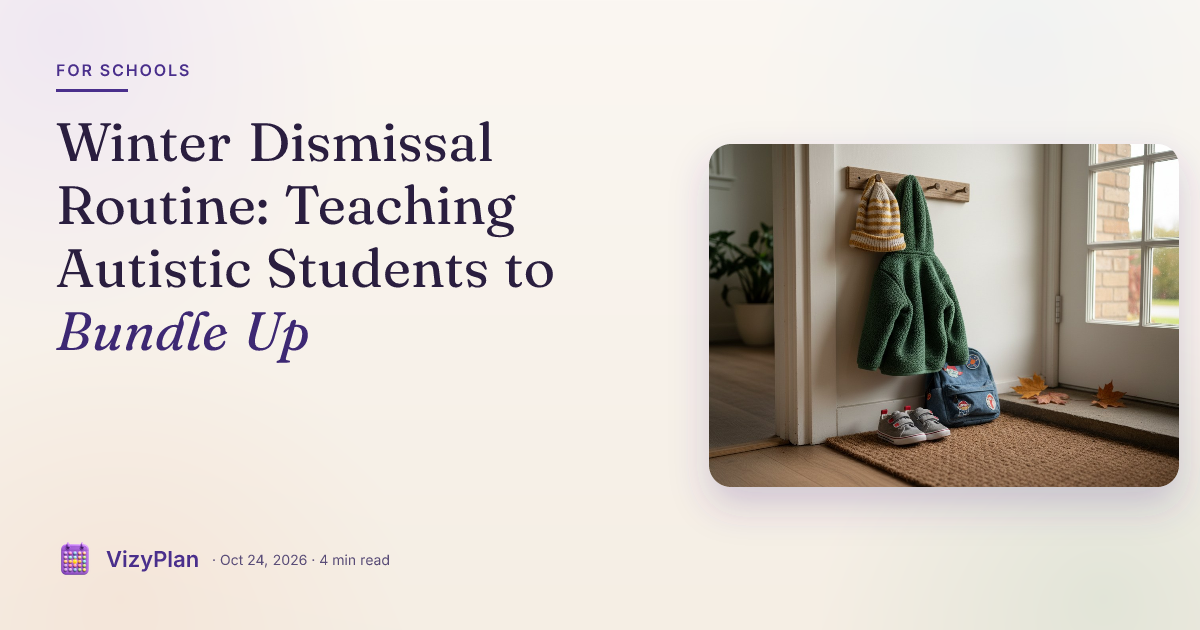
In September, the end of the school day is a backpack and a line. By December, the same ten minutes include snow pants, boots, a coat, a zipper, a hat and two mittens, all while buses idle outside and the hallway fills with noise. For many autistic students, a winter dismissal routine is the most rushed and least predictable part of the day, and the stress shows up right before families see them.
The good news is that bundling up is a teachable skill.
Why the winter dismissal routine falls apart
A summer dismissal might be four steps. Winter gear can push that past twenty, and the clock does not change. Zippers jam, mittens go missing, and adults start doing the steps to beat the bus.
Sensory load adds to the motor load. The CDC lists unusual reactions to the way things sound, smell, taste, look or feel among the possible signs of autism, while noting that no student will show every sign. A scratchy hat, a tight cuff or a puffy coat in a loud hallway can be a lot to process at once.
Two evidence-based practices that fit bundling up
The 2020 report from the National Clearinghouse on Autism Evidence and Practice identified 28 evidence-based practices for autistic children and youth, including task analysis and visual supports. According to the AFIRM Task Analysis module from the same UNC team, task analysis met evidence-based criteria with 13 single case design studies and has worked for learners from preschool through young adulthood.
AFIRM describes three ways to teach a chain:
- Forward chaining. The first step is taught first, and each next step is added once the earlier one is mastered.
- Backward chaining. The final step is taught first, and earlier steps are added one at a time, moving backward.
- Total task presentation. The learner does the whole chain with support at each step. AFIRM even uses putting on a coat as its example, pairing visual directions for each step with teacher prompts.
How to build a winter dismissal routine students can follow
- Write the task analysis first. List every step in the order your students actually do them, from "get gear from cubby" to "line up at the door." The University of Nebraska ASD Network breaks putting on a coat alone into 14 steps, so expect more steps than you think.
- Turn each step into a picture. One picture per action: snow pants, boots, coat, zipper, hat, mittens, backpack. Post the strip at student height next to the cubbies, not across the room.
- Teach it with backward chaining. Help with every step except the last one, such as pulling on the second mitten, and let the student finish. Each attempt ends with the student completing the routine, and you add the step before it once that last step is solid.
- Teach the coat flip. The Nebraska ASD Network task analysis lays the coat on the floor with the zipper facing up, has the student put both hands in the sleeves, then flip the coat over their head.
- Start earlier for students who need it. A student who needs more time is set up to fail when everyone gets ten minutes. Starting the winter dismissal routine five or ten minutes early for a small group gives them a quieter hallway and room to practice without the bus clock.
- Practice outside of dismissal. Run the routine before recess, or as a short drill mid-morning, when nobody is waiting.
- Fade your words before the pictures. Point to the next picture instead of naming the step, then wait. The goal is a student who checks the strip instead of an adult.
Enjoying this article?
Get practical tips and insights delivered to your inbox — no spam, ever.
Sensory-friendly options at the cubby
- Let gear be chosen for comfort. Tagless hats, soft mittens or gloves, and coats with larger zipper pulls can matter more than any prompt. A zipper ring or pull cord helps students with fine motor challenges grab the tab.
- Offer a quieter place to bundle up.
- Keep the order the same every day. Boots before coat, hat before mittens. Mittens go on last so fingers are free for the zipper.
- Give a heads up. A visual countdown before cleanup tells students when the switch is coming. Our guide to classroom transition warnings covers what the research says about timing.
The same picture-step approach powers a handwashing visual schedule, so students who already know that format will recognize it.
Coordinate with families
Some students refuse a coat entirely, and families are often fighting the same battle at home. Our parent guide to winter coat sensory issues is a useful one to share. Ask families which gear works, which steps the student already does at home, and what words they use, then send the same pictures home. A short note through home school communication channels families already read keeps the winter dismissal routine consistent across both places.
VizyPlan was built by an autism dad and an autism mom who is a licensed speech-language pathologist so a winter dismissal routine can be one set of pictures a student sees at school and at home.
Share VizyPlan with your families so bundling up looks the same at the cubby and the front door. Families can try it free for a week. If it helps, they can keep going for $6.99/month or $59.99/year.
VizyPlan was built by an autism dad and an autism mom who is a licensed speech-language pathologist who needed something that did not exist. Explore VizyPlan.