

Every teacher who has run a classroom with autistic students has been handed the same advice. Put up a visual schedule, give a five-minute warning, and transitions will get easier. Classroom transition warnings genuinely help, and that advice is not wrong. It is just incomplete in a way that sets teachers up to feel like they failed when the schedule goes up and the 10:15 handoff still falls apart.
The finding nobody quotes
Here is the study that deserves more airtime. In a single-case experiment in the Journal of Applied Behavior Analysis, researchers tested visual schedules by themselves with two six-year-old boys with autism. The schedules alone did not reduce transition-related problem behavior. What did the work was extinction plus differential reinforcement, which cut problem behavior 69 to 83 percent. Adding the visual schedule on top improved that only slightly, to 76 to 89 percent.
Two participants is a small study, so do not over-read it. But it matches a caveat running through the wider literature: visual schedules are almost always delivered inside a package with prompting and reinforcement, and few studies isolate the schedule itself. The honest summary is that the schedule is the scaffolding, not the intervention.
What classroom transition warnings do have behind them
None of that makes visual supports optional. The National Clearinghouse on Autism Evidence and Practice identified 28 evidence-based practices from research published between 1990 and 2017, and both Visual Supports and Antecedent-Based Interventions are on that list. A meta-analysis covering 24 children found visual activity schedules increased independence during transitions with a strong overall effect.
One popular claim does not survive checking. The study usually cited for the specific two-minute warning is repeated everywhere in secondary sources, but the primary article is not locatable. Give warnings, and skip the false precision about the exact number of minutes.
Enjoying this article?
Get practical tips and insights delivered to your inbox — no spam, ever.
Building the whole package
- Warn before the change, every time. Consistency matters more than the interval you pick.
- Make the next thing visible, not just audible. A student should be able to look and see what is coming.
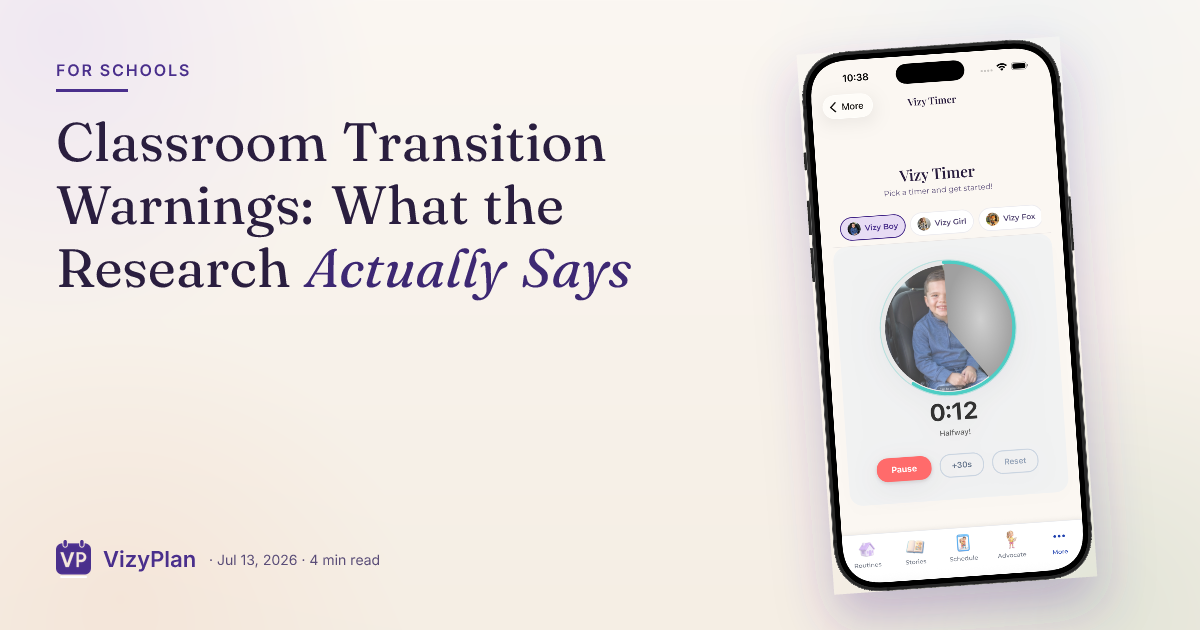
- Pair the warning with a timer they can watch. Time passing is abstract until it is visual.
- Plan the response, not just the antecedent. What you do when a transition goes badly is doing most of the work.
- Reinforce the transitions that go well. The easy ones are where the skill gets built.
Consistency across settings is the multiplier
A schedule that looks one way in your room and another way at home asks a student to learn two systems instead of one. Our post on why autistic kids resist transitions goes deeper.
VizyPlan was built by an autism dad and a licensed speech-language pathologist so the visual structure you build at school keeps its shape at home, using photos of the real child.
Share VizyPlan with your families so transitions look the same at school and at home. The 7-day free trial lets a family try it first. Just $6.99/month after, no credit card required upfront.
VizyPlan was built by an autism dad and a licensed speech-language pathologist who needed something that did not exist. Explore VizyPlan.