

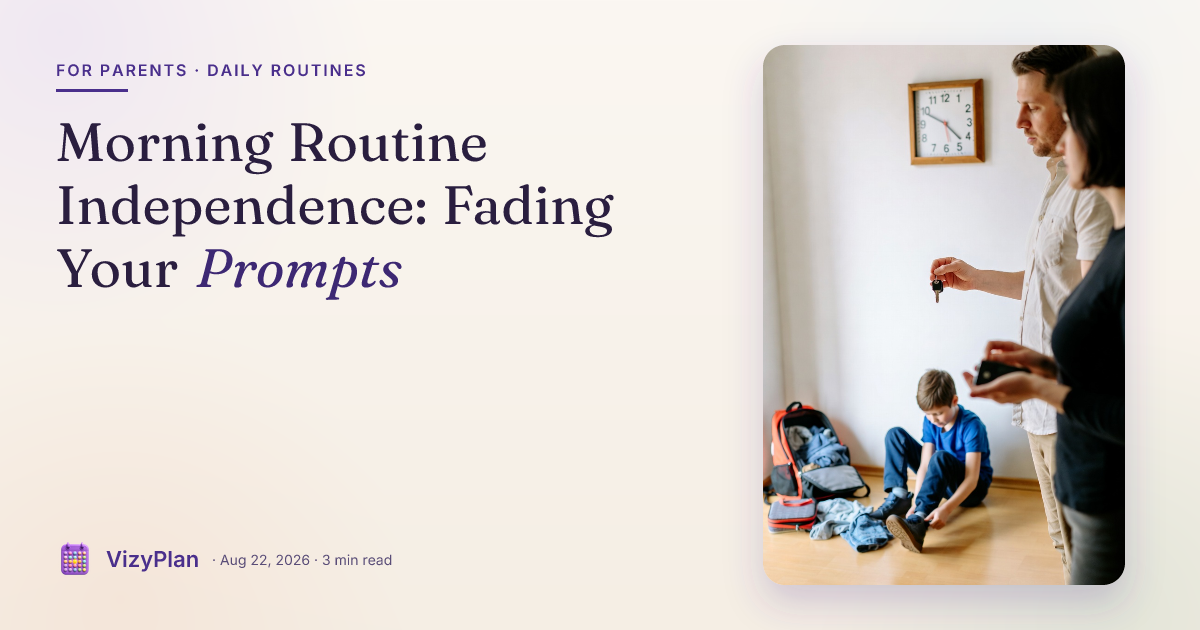
The morning works. Shoes are on, the bag is packed, nobody cried. It works because you said fourteen sentences to make it happen, and if you stop talking, it stops moving. Morning routine independence is the difference between a routine your child has and a routine you are personally running.
The help can become the thing they need
Constant adult help has a documented cost. A widely cited study of instructional assistant proximity published in Exceptional Children found that close, continuous adult support produced eight distinct effects on students with disabilities, including dependence on adults and separation from classmates. The support was well intentioned. The dependence was still real.
Home works the same way. When the prompt always arrives in a parent's voice, the voice becomes part of the step. Take it away and the step disappears, which is why so many mornings feel like they reset every time you get quiet.
Where morning routine independence comes from
The research on visual supports points at the same fix. In a study using visual activity schedules with embedded video models, students with autism transitioned independently within and between novel tasks, and their independence generalized to plain visual schedules after the video prompt was removed. The support faded and the skill stayed.
The principle is straightforward. A prompt your child can look at can be faded on a plan. A prompt you deliver out loud can only be faded by you going silent and hoping.
Enjoying this article?
Get practical tips and insights delivered to your inbox — no spam, ever.
Fading without losing the morning
- Write the steps down exactly as they happen now. Not the ideal morning, the real one. Most families find seven or eight steps where they assumed three.
- Move your words onto the list. Whatever you say at each step becomes a picture or a short line your child checks instead.
- Change your job from narrator to pointer. Instead of "socks next," point at the list. Same information, different source.
- Drop one prompt per week, starting with the easiest step. Fading everything at once is how families end up back where they started by Thursday.
- Hold the checkpoints even after the prompts go. A quick look at the list before leaving stays useful long after the step-by-step help is gone.
Expect a slower week before a faster month. A child doing a step themselves takes longer than a child being moved through it, and the trade is worth making in August rather than in November.
The first minutes at school follow the same logic, which our post on the first ten minutes of the school day covers, and the evening version shows up in protecting the weekend.
VizyPlan was built by an autism dad and an autism mom who is a licensed speech-language pathologist so the routine lives on a screen your child checks instead of in a voice they have to wait for.
Download VizyPlan and start your 7-day free trial today. Hand the morning back to your child one step at a time. If it helps, keep going for $6.99/month or $59.99/year.
VizyPlan was built by an autism dad and an autism mom who is a licensed speech-language pathologist who needed something that did not exist. Start your free trial.