
A day that makes sense to a kid includes the part where it ends. The fall equinox lands on September 22, and across most of the country we are now losing two to three minutes of daylight every single day. By Halloween there will be roughly two hours less light than there was on the first of September. Our son does not read a calendar, but his body noticed the change before we did, and a fall sleep schedule is the routine we rebuild every year around this week.
Why shorter days hit autistic kids harder
Sleep is already the fragile part. Reviews put sleep problems in 50 to 80 percent of autistic children, most often trouble falling asleep, and the research points to differences in how the body produces and times melatonin, the hormone that signals night. Light is the clock's main input, and light is exactly what fall removes. A 2024 study in the Journal of Sleep Research put wrist light meters on 247 children ages 11 to 13 and found that earlier bright light in the morning predicted faster sleep onset at night, while bright light close to bedtime delayed it. The lead author's summary: "it is not just light in the evening or at night, but the actual 24-hour light exposure profile that can affect sleep."
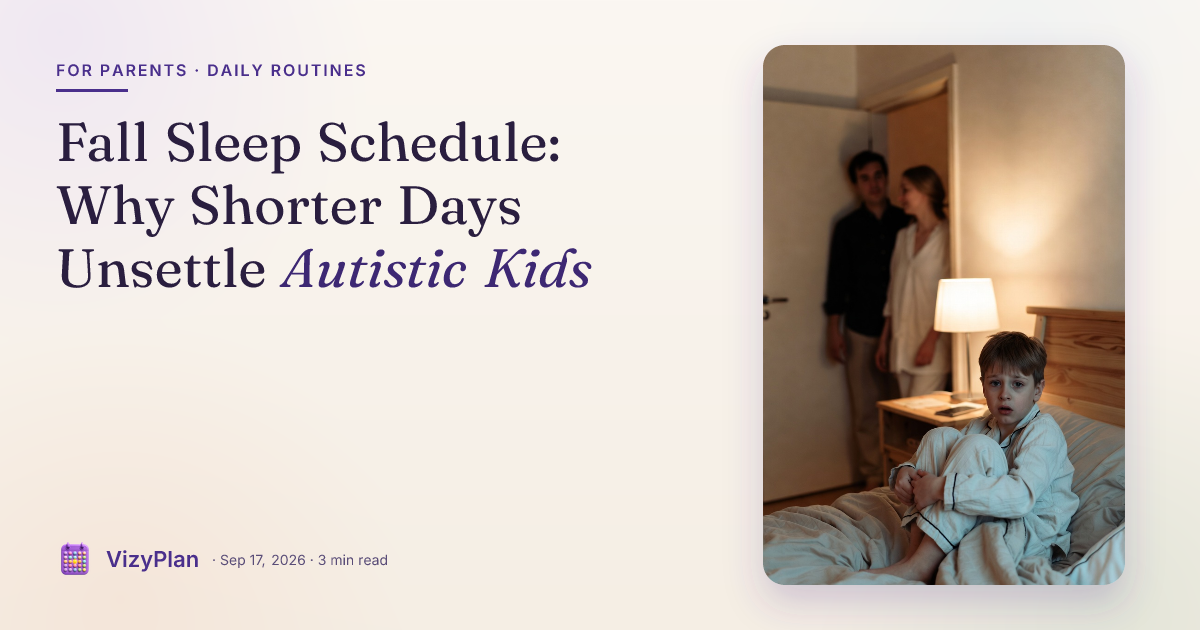
Here is what fall does to that profile. The after-school outdoor window shrinks, so the hour that used to be light and outside becomes dark and on a screen. Mornings get darker too, so the body's wake signal arrives later and weaker. The result is a kid who is wired at 8:30 and impossible at 6:45, which is the same kid, just with the clock drifting.
A fall sleep schedule that holds
- Move outside time to the morning. Ten minutes in the yard before the bus, or a walk to the stop, delivers the bright light that sets the clock. Research on teens shows weekend morning light can shift the body clock earlier within days.
- Hold the wake time, including weekends. A consistent wake-up is the anchor; bedtime follows it.
- Front-load the after-school outdoor block. Straight off the bus, before snacks and screens, while there is still light. Outdoor time right off the bus also softens the after-school collapse.
- Dim the house an hour before bed and park the screens. Bright evening light delays sleep onset in the study above. Our post on turning off devices without a meltdown covers the handoff.
- Keep the bedtime routine visible and identical. Same five pictures, same order, every night. When the daylight cues disappear, the visual ones carry the load. What actually helps autistic kids sleep has the full routine.
- Put November 1 on the calendar now. Clocks fall back that Sunday. Shift bedtime and wake time ten minutes every few days during the last week of October so the change is already done when it arrives.
If sleep is falling apart despite all of it, that is a conversation for your pediatrician, not a supplement aisle. Bring two weeks of bedtimes and wake times; the pattern says more than any single night.
VizyPlan was built by an autism dad and an autism mom who is a licensed speech-language pathologist so the bedtime routine looks exactly the same in September as it did in June, even when the sky does not.
Enjoying this article?
Get practical tips and insights delivered to your inbox — no spam, ever.
Download VizyPlan and start your 7-day free trial today. Keep bedtime visible when the daylight is gone. Just $6.99/month after your trial, no credit card required upfront.
VizyPlan was built by an autism dad and an autism mom who is a licensed speech-language pathologist who needed something that did not exist. Start your free trial.