
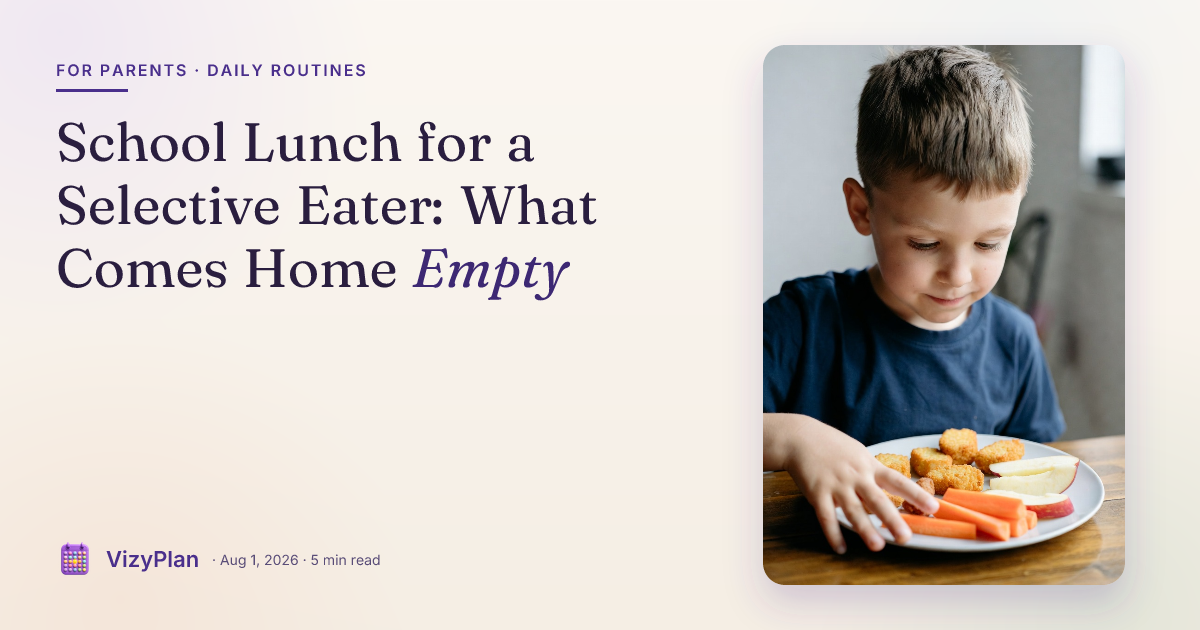
The lunchbox comes home with the sandwich untouched, the apple untouched, and the one snack you thought was safe untouched. Your first instinct is to change the food. School lunch for a selective eater usually fails for a different reason than the one on the menu, and if you only ever change the contents, you will keep solving the wrong problem all year.
School lunch for a selective eater is a room problem first
A cafeteria is one of the loudest places a child goes all day. Students in a Noisy Planet measurement project sponsored by the National Institute on Deafness and Other Communication Disorders measured their own cafeteria and found levels that regularly climbed toward the range where repeated exposure becomes a hearing concern, which is around 85 decibels. Typical peak lunch periods land somewhere between 75 and 85 decibels.
Now stack that on an autistic nervous system. Between 56 and 70 percent of autistic youth meet criteria for sensory over-responsivity, and in a sample of 4,104 autistic people, 60.1 percent currently experienced auditory over-responsivity. Eating requires a body that is at least somewhat regulated. A body in a room that loud is doing something else with its resources.
Add twenty-two minutes on a clock, an unassigned seat, smells from four other lunches, and the social work of a table, and the empty lunchbox stops being mysterious.
The food layer is real too
None of that means the food does not matter. Food selectivity is genuinely more common in autism: a meta-analysis of prevalence reported a mean prevalence of food selectivity in autism of about 63 percent, substantially higher than in typically developing comparison groups. And a 2025 meta-analysis in the International Journal of Eating Disorders pooling 21 publications and 7,442 participants found ARFID, avoidant restrictive food intake disorder, present in 11.41 percent of autistic groups, with autism present in 16.27 percent of ARFID groups.
The distinction that matters at 7am is whether you are packing for preference or for a genuinely restricted range. Our post on ARFID and extreme picky eating covers when it is worth involving a feeding therapist rather than a new lunchbox.
How to pack for the room your child is actually in
- Send safe foods, not stretch foods. School lunch is not the place to expand a range. Twenty-two minutes in a loud room is the worst available setting for trying something new. Do exposure work at home on a Saturday.
- Pack for one hand and no supervision. If it needs opening, unwrapping, or cutting, some of those calories will not be eaten. Test every container at home first.
- Cut the volume, not the calories. A smaller amount of a reliable food gets eaten. A large amount of anything looks like a demand and gets closed.
- Keep textures separate. A wet item touching a dry item can end a lunch. Compartments are not a nicety here.
- Ask about a quieter place to eat. Most schools have one, and most will say yes if asked directly. A corner, the library, the classroom, or lunch with two peers instead of two hundred.
- Add a real snack to the ride home. If lunch is going to be light on hard days, plan for it rather than discovering it at 4pm during a meltdown. Our post on after-school restraint collapse covers why the first hour home goes the way it does.
Enjoying this article?
Get practical tips and insights delivered to your inbox — no spam, ever.
Small asks that change the whole period
A few accommodations are worth putting in writing rather than hoping for. Permission to wear headphones or ear loops in the cafeteria. A consistent seat at the end of a table rather than the middle. Permission to eat before or after the main rush. Extra time, because twenty-two minutes includes lining up, finding a seat, and the social negotiation before the first bite.
None of these are unusual, and none of them are expensive. Our post on unstructured time at recess and lunch covers how school teams think about the same problem from the other side of the table.
Show the lunch before it happens
Uncertainty suppresses appetite in almost everyone, and a child who does not know what is in the box, where they will sit, or how long they have is carrying three unknowns into a twenty-minute window. Showing the actual lunch in the morning removes one of them for free.
VizyPlan was built by an autism dad and an autism mom who is a licensed speech-language pathologist so a child can see what is in the box, where lunch sits in the day, and what comes after it, in photos of their own world.
If the lunchbox keeps coming home full after all of that, believe your child rather than the menu. Something in that room is still too much, and finding it is faster than replacing the sandwich eleven more times.
Download VizyPlan and start your 7-day free trial today. Let your child see the lunch, the day, and what comes next before they are standing in it. Just $6.99/month after your trial, no credit card required upfront.
VizyPlan was built by an autism dad and an autism mom who is a licensed speech-language pathologist who needed something that did not exist. Start your free trial.