

When you tell your child "five more minutes" and they melt down at the four minute mark, you are not seeing defiance. You are seeing time blindness, the genuine difficulty many autistic and ADHD kids have with sensing time as it passes. Time blindness means the internal clock most of us rely on without thinking simply does not run on schedule. Your child is not ignoring the clock. Your child cannot feel the clock at all.
Why Time Blindness Happens
Time blindness is rooted in how the brain manages executive function, the set of mental skills that track, sequence, and estimate time. Time perception research consistently links time estimation to the same brain systems that govern attention and working memory, both of which work differently in autistic and ADHD children. When those systems are stretched, the felt sense of "how long has it been" goes quiet. A neurotypical adult might sense that twenty minutes have passed. A child with time blindness might experience the same twenty minutes as either two minutes or two hours, with no reliable middle.
Time blindness also explains why abstract warnings rarely land. "We leave soon" carries no meaning when soon is not a measurable unit your child can feel. Children with time blindness need time made visible, not just spoken.
What Parents Can Do About Time Blindness
The goal is not to fix your child's internal clock. The goal is to build external structure that does the timekeeping for them. Calm, predictable scaffolding paired with co-regulation helps far more than repeated verbal reminders.
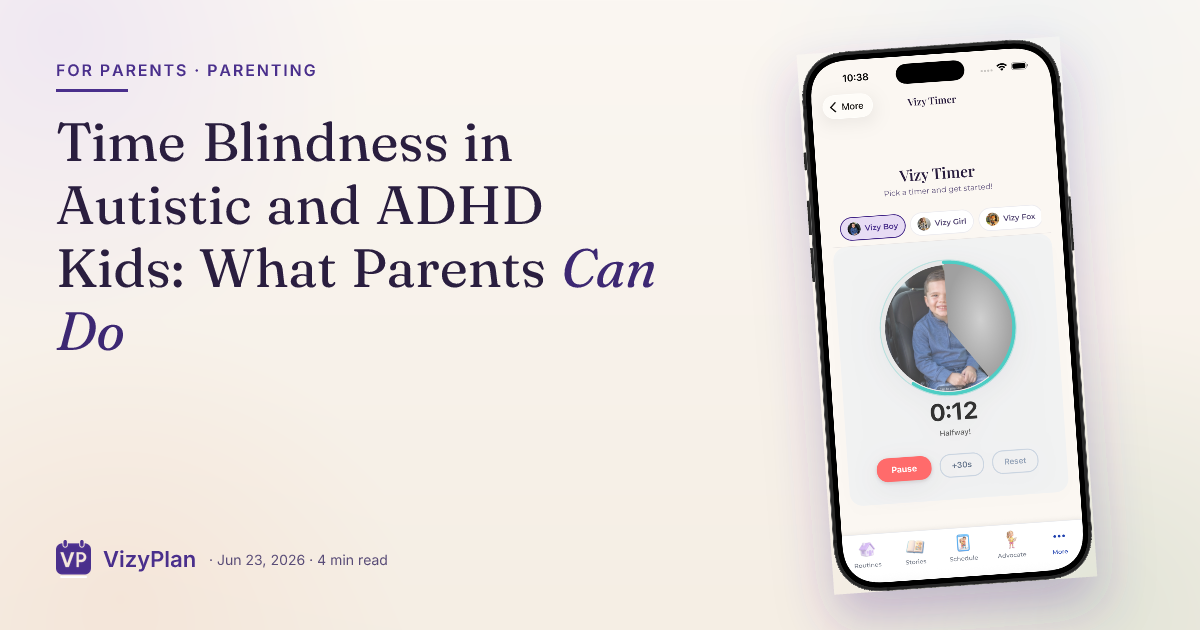
- Make time visible with a countdown. Use a visual timer that shrinks a colored block as time runs out, so your child sees time leaving instead of hearing about it.
- Anchor time to events, not numbers. Say "after this episode" or "when the timer turns red" instead of "in ten minutes," since events feel concrete and numbers do not.
- Build the same sequence daily. Predictable routines turn time into a familiar shape, and apps like VizyPlan map each step visually so your child knows what comes next.
- Narrate transitions early and gently. Give a calm heads up at the visual halfway point so the change never arrives as a surprise.
VizyPlan was designed around exactly this, turning invisible time into clear visual steps your child can actually follow.
Enjoying this article?
Get practical tips and insights delivered to your inbox — no spam, ever.
Download VizyPlan and start your 7-day free trial today. Help your child feel time instead of fighting it. If it helps, keep going for $6.99/month or $59.99/year.
VizyPlan was built by an autism dad who needed something that did not exist. Start your free trial.