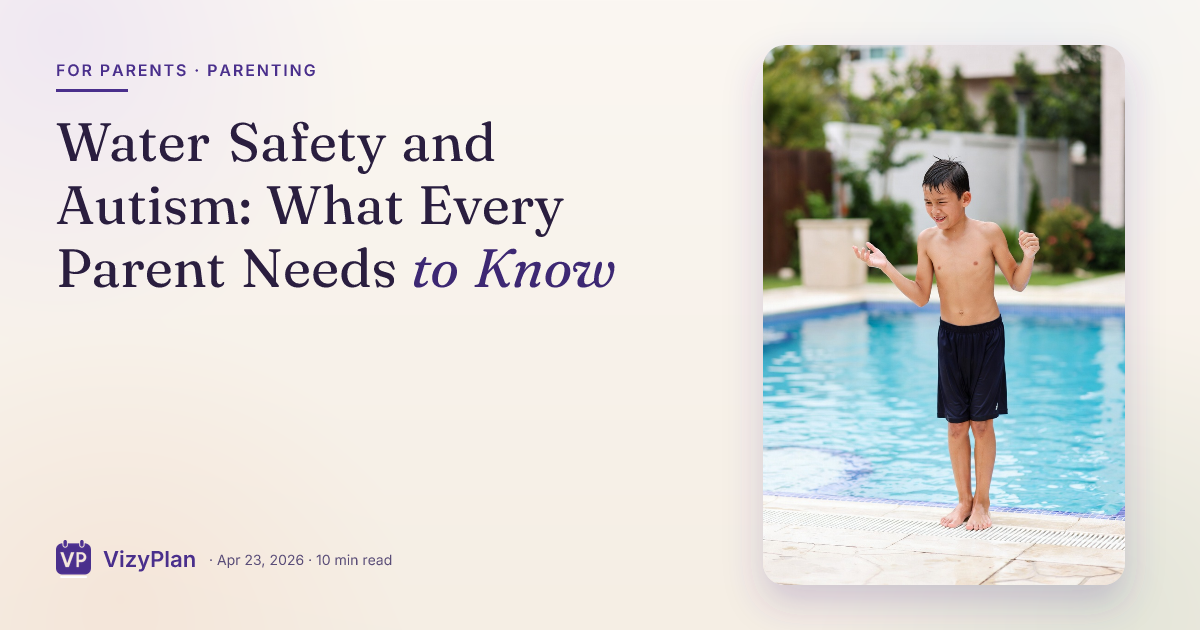
This is not the blog post I want to write. But it is the one I need to write, and the one you need to read. Especially with summer coming.
Drowning is the leading cause of death for children with autism who wander. Not a leading cause. *The* leading cause. According to data from the National Autism Association, children on the autism spectrum are 160 times more likely to die from drowning than the general pediatric population. That statistic should stop every parent in their tracks.
This post is not meant to scare you. It is meant to prepare you. Because the difference between a tragedy and a close call almost always comes down to layers of prevention that parents put in place before anything happens.
Why Autistic Children Are Drawn to Water
To protect your child, you first need to understand why water is so magnetic for many kids on the spectrum. It is not one reason. It is several working together.
Sensory fascination. Water provides intense, multi-sensory input. The visual shimmer of light on a pool surface. The sound of running water. The pressure of being submerged. The temperature change on skin. For a child with sensory processing differences, water can be irresistible in a way that neurotypical children do not experience with the same intensity.
Calming properties. Many autistic children find water deeply regulating. The hydrostatic pressure of being in water functions like a full-body compression, similar to a weighted blanket. For a child whose nervous system is frequently in overdrive, water feels like relief. They are not being reckless. They are seeking regulation.
Reduced danger awareness. Many children on the spectrum have difficulty assessing risk, particularly around situations they have not personally experienced as dangerous. A pool looks inviting. A pond looks interesting. The concept that water can be lethal is abstract, and abstract concepts are exactly the kind of information that can be hardest for autistic children to internalize.
The elopement connection. This is the factor that turns a risk into a crisis. If you have read about elopement and wandering prevention, you know that nearly half of autistic children wander from safe environments. When a child who is drawn to water also has a tendency to elope, every unsecured body of water within reach becomes a potential emergency. Research published in *Pediatrics* found that in cases of lethal drowning among autistic children, the majority occurred after the child wandered from a supervised setting and reached water within minutes.
The Layers of Protection Model
No single safety measure is enough. Water safety for autistic children requires what safety professionals call "layers of protection," multiple barriers so that if one fails, another catches the risk.
Layer 1: Physical Barriers
This is the most critical layer. Barriers between your child and water should be present at all times.
- Pool fencing: If you have a pool, it needs a four-sided fence with a self-closing, self-latching gate. The latch should be out of your child's reach. The American Academy of Pediatrics recommends fences at least four feet high with no footholds. This single measure reduces childhood drowning by more than 50%, according to a meta-analysis in *Injury Prevention*.
- Door and window alarms: Every door and window that leads to a yard, pool area, or any path to water needs an alarm. Inexpensive magnetic door alarms cost under fifteen dollars and provide an audible alert the moment a door opens.
- Pool alarms: Surface wave alarms and subsurface alarms detect when someone enters the water. They are not a substitute for fencing, but they add another layer.
- Locks: Deadbolts, chain locks, and childproof door covers on all exterior doors. Some families install locks at the top of doors where children cannot reach.
- Neighbor awareness: If your neighbors have pools, hot tubs, or ponds, have a direct conversation with them about your child's tendencies. Ask about their fencing.
Layer 2: Supervision Strategies
Barriers fail. Gates get left open. Doors get propped. Supervision is the layer that catches what barriers miss.
- Designated water watcher: At any gathering near water, assign one adult whose only job is watching the children in or near the water. No phone. No conversation. No food preparation. Just eyes on the water. Rotate every 15 to 20 minutes to prevent fatigue.
- Touch supervision for high-risk children: If your child is a known elopement risk and you are near any body of water, maintain touch supervision, meaning you are close enough to reach out and grab them at all times.
- Constant head counts: At pools, lakes, and beaches, count your children every 30 seconds. Drowning can happen in under two minutes and is almost always silent.
Layer 3: Technology and Tracking
Technology adds another safety net, and modern options have become remarkably effective.
- GPS tracking devices: Wearable GPS trackers designed for children with autism (AngelSense, Jiobit, and Apple AirTag attached to clothing or shoes) allow you to locate your child immediately if they wander. Some devices include geofencing alerts that notify you the moment your child leaves a designated safe zone.
- Smart home integration: Door sensors connected to your phone can alert you in real time when any exterior door opens.
- Wearable alarms: Some companies make wristbands that trigger an alarm when submerged in water.
Layer 4: Swim Lessons (With the Right Approach)
Teaching your child to swim does not make them drown-proof. But water competency adds a meaningful layer of protection, especially survival swimming skills.
What to look for in swim instruction for autistic children:
- Individualized instruction: Group lessons with six kids may not work. Look for programs that offer one-on-one instruction or very small ratios.
- Sensory-informed teaching: Instructors should understand that the feel of water on the face, the sound of splashing, and the echo of an indoor pool can all be overwhelming.
- Survival skills focus: Programs like ISR (Infant Swimming Resource) teach children to roll onto their backs and float if they fall into water.
- Visual supports in lessons: Bring visual schedules and social stories to swim lessons. Show your child what will happen step by step before they get in the water.
- Patience with progress: Autistic children may take significantly longer to become comfortable in water than neurotypical peers. Consistency matters more than speed.
Enjoying this article?
Get practical tips and insights delivered to your inbox — no spam, ever.
Layer 5: Teaching Water Safety Visually
Verbal rules ("Don't go near the pool without an adult") are necessary but insufficient for many autistic children. The abstract nature of danger makes verbal warnings easy to forget in the moment of sensory fascination.
Visual strategies that work:
- Social stories about water safety: Create a social story that walks through what water looks like, why it is dangerous, and what your child should do when they see water without an adult.
- Visual boundaries: Use VizyPlan to create visual rules with pictures. "I see water. I stop. I find a grown-up."
- Red zone marking: Some families use red tape or red paint on the ground around pool areas to create a visible "stop" zone.
- Video modeling: Record a short video of the correct behavior around water (stopping, finding an adult, waiting) and let your child watch it repeatedly. Video modeling is one of the most evidence-supported teaching strategies for autistic children.
- Practice, practice, practice: Teaching safety awareness is not a one-time conversation. It is ongoing, repetitive, and multi-modal.
What to Do in an Emergency
Preparation is prevention. But every parent near water should know what to do if the worst happens.
1. Call 911 immediately (or direct someone specific to call, "You in the blue shirt, call 911 now"). Do not assume someone else has already called. 2. Get the child out of the water. If you are not a strong swimmer, use a reaching aid (pool noodle, towel, stick) rather than jumping in. 3. Start CPR immediately if the child is not breathing. Do not wait for paramedics. Begin rescue breaths and chest compressions. Every parent and caregiver of a child with autism should be CPR certified. 4. Even if your child seems fine after a near-drowning event, go to the emergency room. "Dry drowning" and "secondary drowning" can cause respiratory distress hours after the incident.
Take a CPR course this month. Not next month. This month. The American Heart Association and Red Cross both offer courses that take less than four hours.
Community Awareness
Water safety is not a solo effort. The people around your child need to know about the risk.
- Notify your local fire department and police: Many departments keep voluntary registries of children with elopement risk. If your child goes missing, responders will know to check bodies of water first.
- Talk to your school: If your child's school is near any body of water, make sure their IEP or 504 plan addresses elopement prevention and water safety.
- Brief babysitters, family members, and neighbors: Anyone who supervises your child needs to know about the water attraction and elopement risk.
- Create an elopement profile: Organizations like the National Autism Association offer downloadable elopement information forms. Fill one out. Keep copies in your car, at home, and in your child's school file.
The Balance: Safety Without Fear
It is tempting to read a post like this and decide your child will never go near water again. That is not the goal. Water can be therapeutic, joyful, and regulating for autistic children. Swimming can become a lifelong skill and source of exercise.
The goal is not avoidance. The goal is layers of protection that allow your child to experience water safely, on your terms, with barriers, supervision, skills, and plans in place.
You cannot eliminate every risk. But you can reduce it dramatically. Every barrier you add, every skill you teach, every conversation you have with a neighbor or first responder tilts the odds in their favor.
Start today. Check your barriers. Sign up for swim lessons. Take a CPR course. Brief your circle. Build the layers.
Your child deserves to enjoy water. And you deserve to breathe while they do.
Download VizyPlan and start your 7-day free trial today. Build visual social stories for water safety, create step-by-step safety routines your child can follow, and track behavioral patterns to stay ahead of elopement risks. Just $6.99/month after your trial, no credit card required upfront.
VizyPlan was built by an autism dad who sat on his living room floor and needed something that did not exist. Now it does. Start your free trial and give your child the tools to see their day and navigate it with confidence.