

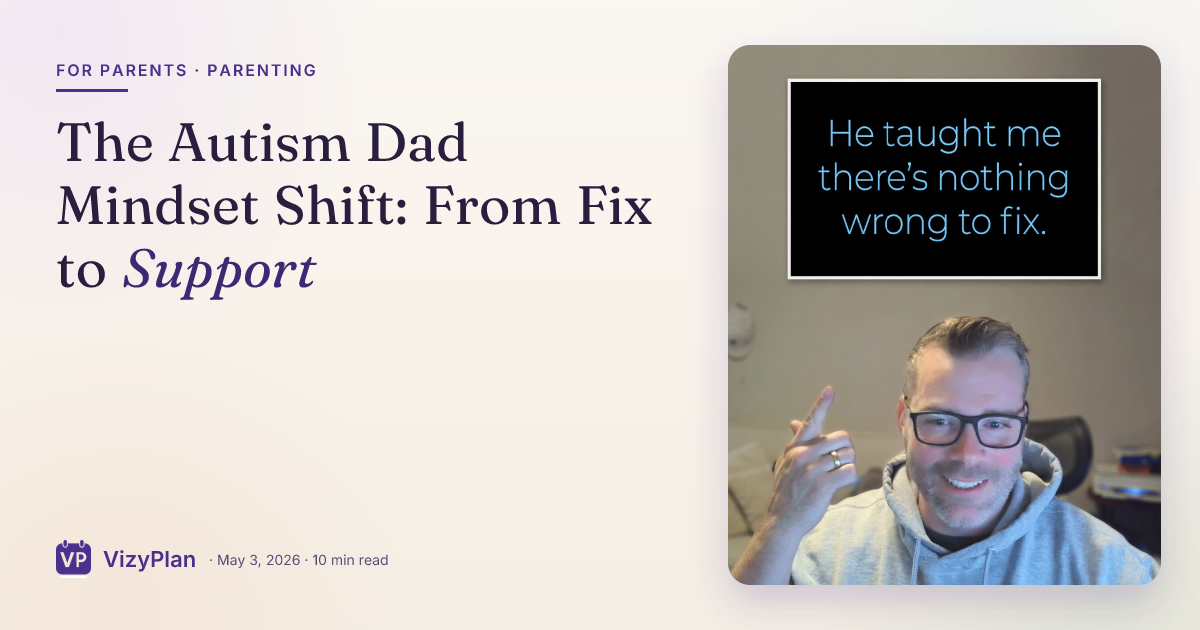
The first time my son lined up his cars, I rearranged them. He had them perfectly spaced along the edge of the rug, in a precise order I did not understand, and I, in dad mode, scooped them into a pile and said, "Let's play crash up." I thought I was teaching him how to play. He looked at the pile, looked at me, and walked out of the room. That moment was the start of an autism dad mindset shift I did not know I needed.
It took me a long time to understand that the lineup was not a problem. The pile was. I had taken something he was doing beautifully and turned it into something he had to escape.
This post is about that shift. The move from trying to fix your child, to supporting the child who is already there. And what happens, on the other side of it, when you finally see how beautiful his mind actually is.
The Wiring You Did Not Choose
Dads come pre-loaded for fix mode. Not all dads, and not in the same way, but most of us walked into fatherhood carrying a script we did not write. Provider. Protector. Problem solver. The car will not start, you fix the car. The faucet leaks, you fix the faucet. The kid is struggling, you fix the kid.
The fix-the-kid script is where the wiring breaks.
Research on fathers of autistic children describes a real conflict between two strands of traditional masculinity, the ability to provide and the ability to protect. A 2021 study in the British Journal of Learning Disabilities found that those two roles get forced into conflict when a child has additional needs, because you cannot always work the hours and also be the parent who is home doing the heavy lifting at 6 p.m. Dads feel that conflict in their bones, even when nobody names it for them.
Underneath the provider script is something more primal, the urge to remove suffering from someone you love. Your child is overwhelmed at the grocery store, and every cell in your body wants to make it stop. Your child cannot make eye contact at the family party, and you feel the eyes of your in-laws on the back of your neck. Your child melts down at bedtime for the third night in a row, and you think, there must be a way to fix this. There must be a thing I have not tried yet.
There usually is. But the thing you have not tried yet is almost never another fix. It is a shift.
What Fixing Costs
Here is what nobody tells you about fix mode.
Fix mode treats your child as a problem set. It scans for what is wrong and grades it. The flapping is a problem. The lining up is a problem. The echolalia is a problem. The clothes that have to be the same texture, the foods that cannot touch, the way he covers his ears at the school assembly. Problems. All of them. Things to be reduced.
Your child feels that. He may not be able to name it, but he feels it. A 2020 study in Frontiers in Psychology on parental attunement and acceptance found that children whose parents have not yet resolved or accepted the diagnosis show worse parent-child relationship quality and higher attachment insecurity. Fix mode is not invisible to the child. It travels through tone, body language, and the small sigh you make when he starts to stim.
A 2022 systematic review in Frontiers in Psychiatry put it plainly. Lack of resolution about a child's autism diagnosis is associated with higher parenting stress, poorer parental mental health, and insecure attachment with the child. Acceptance, by contrast, is a protective response. It correlates with lower depressive symptoms in parents, both at any given moment and over time. The dads who keep grinding in fix mode are the dads who keep getting more depressed. The data is not subtle.
Fix mode also costs you. There is no version of this where you outwork autism. There is no schedule, no diet, no protocol that turns your autistic son into a neurotypical son. So if your worth as a father is hooked to fixing, your worth becomes unreachable. You will work and work and never feel like you are succeeding, because you are graded on an outcome that was never on the table.
The trap closes around dads quietly, and most of us do not notice until we are exhausted.
The Autism Dad Mindset Shift, in One Word
In a 2022 narrative inquiry of fathers of autistic children, published in SAGE Open, researchers asked dads to tell the story of their journey in their own words. Across the interviews, one moment kept showing up. The fathers described a turning point. They described it differently, but the shape of it was the same. There was a before, and there was an after. Before, they were fighting their child's autism. After, they were not.
The researcher's word for that moment was acceptance.
Acceptance, in the way fathers used the word, was not resignation. It was not giving up on growth. It was a change in the question. The question went from "how do I fix this," to "how do I support this child as he is, while also helping him build the skills he needs."
The second question is workable. The first one is not.
That single change in question is the heart of the autism dad mindset shift, and it does not happen on a Tuesday because you read a blog post. It happens slowly, in moments. It happens the night you let the lineup stay on the rug instead of scooping it into a pile. It happens the morning you stop demanding eye contact and start watching where his eyes actually go. It happens the afternoon you sit on the floor next to him while he rocks, and you realize, for the first time, that he is not in distress. He is in his body. And you do not need to interrupt that.
What Support Looks Like When Fix Steps Aside
Support is not passive. That is the part most dads misunderstand at first. We hear "stop trying to fix him" and we worry that means do nothing, accept everything, drift. The research describes the opposite. Support is active. It is engineering the world around your child so that his nervous system has a fighting chance.
Here are five moves that turn fix energy into support energy.
- Lower the demands you can lower. A 2024 systematic review of parent-focused interventions found that mindfulness-based and acceptance and commitment therapy approaches were the optimal interventions for reducing parental stress and improving family outcomes. The mechanism is not magic. When you stop pushing against every difficult moment, the moments shrink. Your child has fewer demands to fight, you have fewer power struggles to lose, and the day calms down.
- Build the predictability his brain needs. Autistic brains do not handle uncertainty the way neurotypical brains do. A visual schedule is not a fix. A visual schedule is a support. It does not change who your child is. It changes the world around him so who he is can show up. When you switch from fix to support, personalized visual routines stop being a tool for compliance and start being a tool for safety.
- Co-regulate before you correct. A child who is dysregulated cannot learn. The research on co-regulation before self-regulation is clear. If your son is melting down and you come in with logic, lecture, or consequence, you are pouring water on a grease fire. Support means lowering your voice, slowing your body, and giving him your nervous system to borrow until his comes back online. Teaching can happen later. Always later.
- Read what the behavior is telling you. Stimming, scripting, lining up, covering ears, refusing the new shirt. Each of those is communication. Fix mode treats them as bugs to remove. Support mode treats them as data. Our piece on stimming walks through when stimming is a need being met and when it is a sign your child has hit his limit. The behavior is not the problem. The behavior is the report.
- Track what is actually happening. In fix mode, you remember the meltdowns and forget the calm afternoons. You build a mental case against your own child without meaning to. Tracking emotions and patterns gives you real data instead of a feed of frustration. Most dads I have talked to are stunned the first time they see a real week of their child's data and realize the bad days are not as common as the bad days felt.
None of those five moves is fixing. All of them are supporting. The difference is who has to change. In fix mode, the child has to change. In support mode, the parent and the environment do most of the changing, and the child is freed up to grow at his own pace.
What You Start to See
Enjoying this article?
Get practical tips and insights delivered to your inbox — no spam, ever.
This is the part nobody can quite prepare you for.
When you stop trying to fix your son, you start to see him.
You notice that the lining up was never random. There was a system, a sequence, a logic he was working out, and once you watch instead of intervene, the logic becomes visible. Researchers call this monotropism. The framework was first described in the late 1990s by a small group of autistic researchers, Dinah Murray, Wenn Lawson, and Mike Lesser, and it has become one of the most useful lenses for understanding the autistic mind. Monotropism describes a tendency for attention to flow deeply into a small number of interests at a time, instead of spreading thinly across many. It is not a failure of attention. It is a different shape of attention.
Inside that shape, the child you thought you were watching becomes a different child. The kid who could not be torn away from his train sequence is not stuck. He is in flow. The kid who has memorized every dinosaur name is not "obsessing." He is doing the deep work that monotropic minds are built for. The hours he spends on a single thing are not wasted. Those hours are how his brain actually learns, and it learns at a depth most adults will never touch.
Beyond monotropism, the research on autistic cognition keeps surfacing the same word: pattern. A 2021 paper titled "Pattern Unifies Autism" argued that autism is fundamentally an enhancement of pattern perception, pattern generation, and pattern processing. Tests of visual pattern recognition repeatedly find autistic children performing at or above neurotypical peers. They see things in the noise. They notice the thing the rest of us missed. They remember a sequence three months after they saw it once.
Those abilities are not a deficit. They are a different operating system. And the system, when you finally let yourself see it, is beautiful.
The Day I Stopped Fixing
Here is the moment for me.
My son was nonverbal until he was two. For most of those two years I lived in fix mode, all the way under the surface. Every milestone we missed, I added to a list of things to outwork. Every echolalia phrase he repeated, I tried to redirect into "real" language. Every time he flapped, I noticed myself looking around to see who was watching. I thought I was being a good dad. I was being an exhausted one.
One night, I sat on the bedroom floor while he was building. He had a long row of small wooden animals lined up, perfectly spaced. He was humming a phrase from a show, the same eight syllables, over and over. I had a lecture half-loaded in my head about how to make this look more like "play."
And then I stopped. I just watched him.
The phrase he was humming was the part of the show where the character feels safe. The animals were arranged in pairs, biggest to smallest. He looked over at me, briefly, with the kind of glance you only get when you have not interrupted someone in the middle of something they love. And he kept going.
I had spent two years trying to get him to look me in the eye. That night, I stopped trying, and he looked.
The shift was not a method. It was not a system. It was a look.
The Mind I Almost Missed
Sitting on that floor, I realized something I had been too busy to see for two years. My son has a beautiful mind. Not in the soft, parental way you say it on a hard day to feel better, but in the way you mean it when you finally notice something that has been in front of you the whole time. His world is amazing. It is encapsulating. It is methodical in a way most adult minds never get to be. There is order in it, and care, and a quiet logic that holds together if you stop interrupting it.
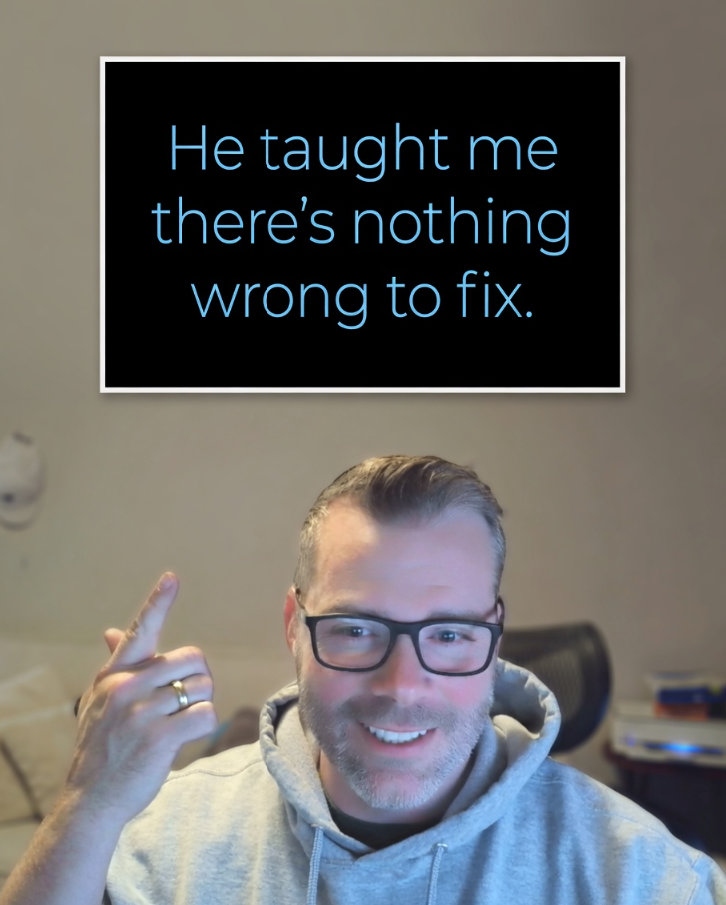
And the moment I let him be inside that world, instead of pulling him into mine, I realized I was the one who needed fixing. Not him. For two years I had been trying to make him more like me. The work was always the opposite. The work was to let him be more like him, and to support that instead of correct it.
I am a sports dad. I love coaching. I love playing. Part of supporting him, the real version and not the version where I am still secretly trying to fix, is accepting that the field may never be his place. And that is perfectly fine. I would much rather be in his world with him than spend his childhood teaching him to do something that does not work for him. That is not a sacrifice. It is a trade I would make every time.
This is not every autistic kid. Plenty of them love sports. Plenty love sitting on the couch watching the game with their dad. I am only telling you about my son, what I have noticed, and what I expect to keep noticing, because I am always learning from him. I think I always will be.
A Permission Slip
If you are an autism dad reading this and you can feel the fix reflex still running in the background, you are not failing. You are doing the same thing every dad I know has done at some point, and most of us did not have anyone telling us to stop. We figured it out by getting tired enough to try something else.
So consider this a permission slip.
You have permission to let the lineup stay on the rug. You have permission to let the script play out. You have permission to skip the family event, or leave it early, or eat the same dinner he eats because it is the only meal that works tonight. You have permission to put down the protocol, the new diet, the latest miracle technique you saw at midnight on Instagram. You have permission to stop reading articles that make you feel like you are losing, and start reading the small ones your child is writing all over your house every day.
You have permission to support, not fix.
You will still teach him. You will still help him build skills. You will still, on plenty of days, be exhausted in ways nobody warned you about. The work does not get easier. The work gets right-sized. You stop fighting the wrong fight, and the right fight, the one that is actually winnable, the one where you build a life that fits him, comes into view.
His mind is not broken. His mind is monotropic, pattern-hungry, deep, loyal to the things it loves. His mind is exactly the mind he was always going to have. Your job is not to give him a different one. Your job is to clear the road in front of the mind he already has, and walk next to him while he uses it.
When you do that, you stop being a dad in a long fight with autism. You start being his dad. That is the autism dad mindset shift. And it is the only one I have ever found that actually works.
Download VizyPlan and start your 7-day free trial today. Build visual routines that support your child's brain instead of trying to override it, track emotions and patterns so you see the real picture instead of the worst day, and create social stories that prepare him for what is coming next without forcing him to mask through it. Just $6.99/month after your trial, no credit card required upfront.
VizyPlan was built by an autism dad who sat on his living room floor and needed something that did not exist. Now it does. Start your free trial and give your child the tools to see their day and navigate it with confidence.