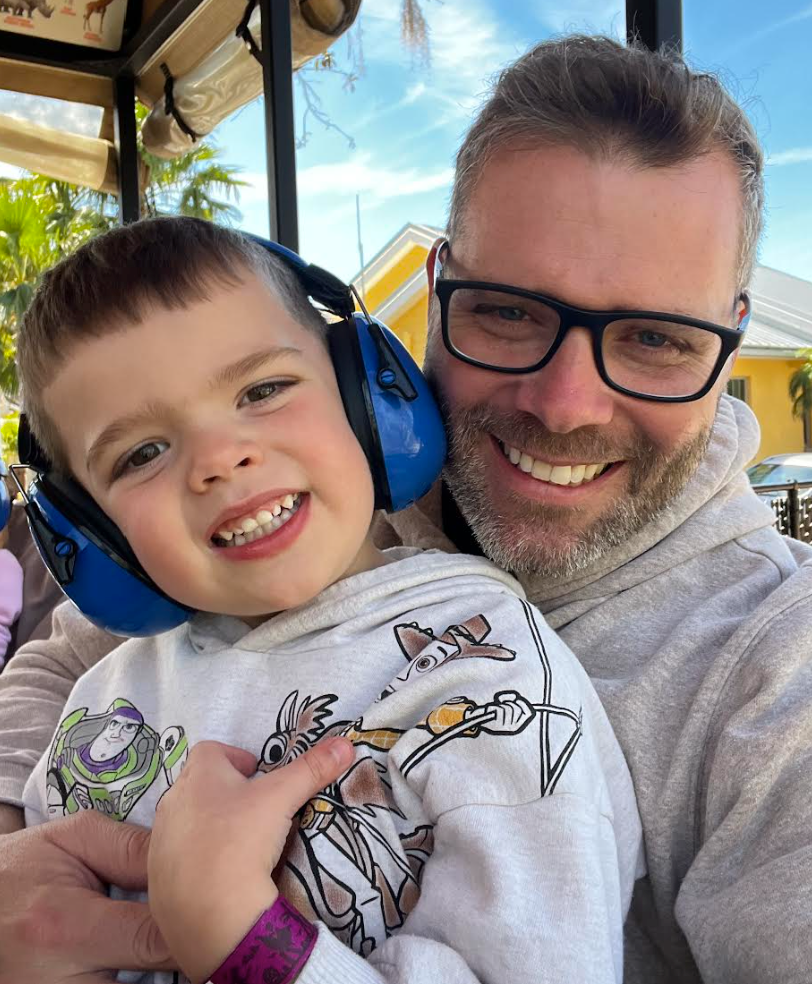
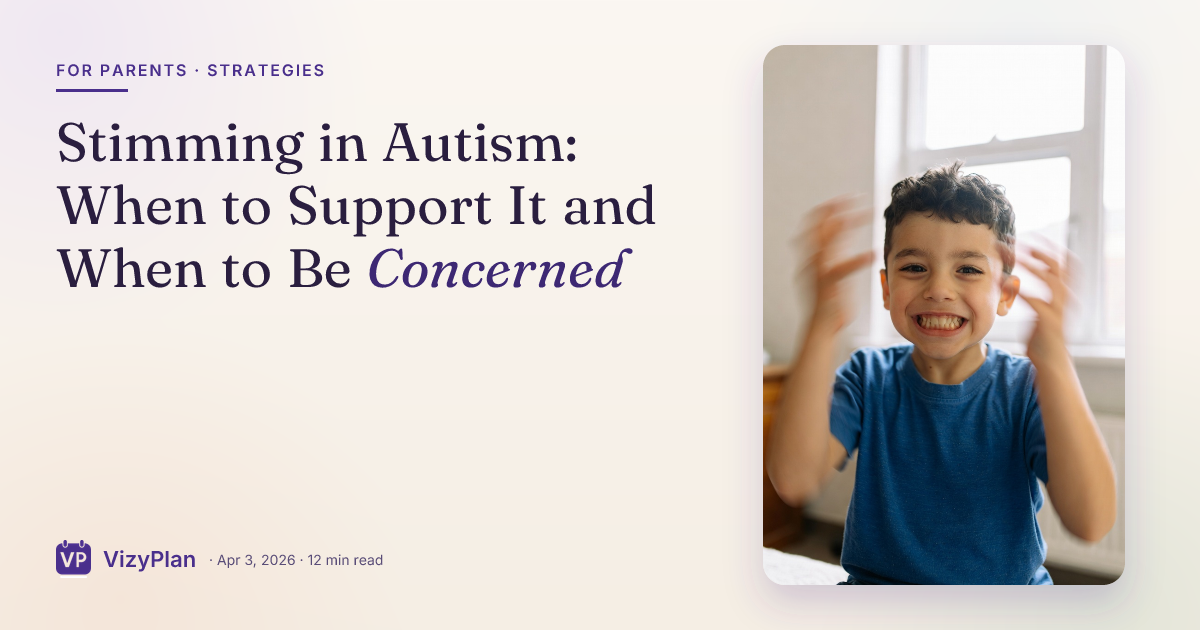
Your child is flapping their hands again. Maybe they are rocking back and forth while watching their favorite show. Maybe they hum the same three notes on repeat during dinner. Maybe they spin in circles at the park while every other child plays on the swings.
You have watched this happen a hundred times. And every time, the same questions surface: Is this okay? Should I stop it? Is this helping them or hurting them? When do I step in, and when do I step back?
These are not simple questions. And the answers you find online often swing between two extremes. One side says all stimming is beautiful and should never be touched. The other side treats every repetitive behavior as a problem to eliminate. Neither extreme serves your child.
The truth, backed by a growing body of research, is more nuanced. Most stimming is not just okay. It is essential. But some stimming crosses into territory that genuinely warrants concern. Knowing the difference is one of the most important skills you can develop as a parent of a neurodivergent child.
What Stimming Actually Is
Stimming is short for self-stimulatory behavior. It refers to repetitive movements, sounds, or actions that serve a neurological purpose. Everyone stims to some degree. Tapping your foot during a meeting, twirling your hair while reading, clicking a pen while thinking. These are all stims. The difference with autistic children is that their stims tend to be more visible, more frequent, and more essential to their daily functioning.
Research published in Frontiers in Integrative Neuroscience in 2024 found that stimming helps regulate brain rhythms and improve sensory processing and attention. The movements are not random. They are the brain's way of organizing itself, either through rhythmic motor commands or sensory feedback generated by the movements themselves.
Think of it this way: when your child flaps their hands, their brain is not malfunctioning. It is functioning. The flapping is the regulation, not the problem.
An estimated 88% of autistic individuals engage in at least three different forms of stimming regularly. Among those who stim, 84% report that stimming increases during periods of heightened emotion, both positive and negative, and 67% describe it as their primary strategy for emotional regulation.
The Seven Types of Stimming
Stimming is not one behavior. It is an entire category of behaviors that span every sensory system in the body. Understanding which type your child uses tells you what their nervous system is seeking.
Visual Stimming
Your child watches ceiling fans spin for extended periods. They stare at lights, blink rapidly, or flick their fingers in front of their eyes. They turn light switches on and off. They watch the same three seconds of a video over and over.
Visual stims provide predictable, controlled visual input. For a child whose visual processing is easily overwhelmed by a chaotic environment, a single spinning object offers simplicity and predictability.
Auditory Stimming
They hum constantly. They snap their fingers, click their tongue, or tap objects to hear the sound they make. They repeat the same word or phrase. They listen to the same song on an endless loop.
Auditory stims create predictable sound patterns that can block out unpredictable environmental noise. If the cafeteria overwhelms your child with layered sounds, their humming creates a consistent auditory anchor.
Tactile Stimming
They rub fabrics between their fingers. They scratch surfaces. They pick at skin or scabs. They run their hands along walls as they walk. They fidget with anything they can reach.
Tactile stims provide grounding through touch. The consistent pressure or texture input helps the brain orient to the body's position and state. This is closely related to why sensory-friendly clothing choices matter so much for neurodivergent children.
Vestibular Stimming
They spin in circles. They rock back and forth in their chair. They swing for extended periods. They pace the same path repeatedly.
Vestibular stims engage the balance system and provide a rhythmic, organizing input. Rocking, in particular, activates the same neural pathways used in early infant development, which is why it remains soothing across the lifespan.
Proprioceptive Stimming
They jump repeatedly. They crash into furniture or cushions. They seek tight hugs or squeeze themselves into small spaces. They stomp their feet or clap forcefully.
Proprioceptive stims provide deep pressure input that tells the brain where the body is in space. For children who struggle with sensory processing, this deep input is genuinely calming at a neurological level.
Vocal Stimming
They repeat words or phrases (echolalia). They make sounds, grunts, or squeals. They clear their throat repeatedly. They script dialogue from shows or movies.
Vocal stimming appears in approximately 53% of autistic individuals, with rates as high as 75% among those with language differences. These vocalizations serve multiple purposes: self-regulation, processing information, expressing emotion, and sometimes pure sensory enjoyment.
Olfactory Stimming
They smell objects, people, or food before interacting with them. They chew or lick non-food items. They seek out specific scents.
Olfactory stims are often the least understood by parents, but they serve the same regulatory function as every other type. Smell is one of the most direct sensory pathways to the brain's emotional centers, which is why certain scents can be powerfully calming.

Why Your Child Stims: The Science
Understanding the why behind stimming transforms how you respond to it. Research from the past two years has significantly expanded what we know.
Emotional Regulation
This is the most well-documented function. When your child is overwhelmed, anxious, frustrated, or overstimulated, stimming helps bring their nervous system back to a manageable state. It works the same way deep breathing works for you, except your child's brain discovered its own version independently.
A 2025 study by Morris and colleagues published in SAGE Journals found that autistic adults identified stimming as serving functions far beyond basic self-regulation. Participants described stimming as essential for processing emotions, managing anxiety, and navigating overwhelming situations.
Sensory Regulation
Your child's brain may process sensory input differently. Too much input in one channel, not enough in another. Stimming creates controlled, predictable sensory input that helps the brain calibrate. A child who rocks is giving their vestibular system consistent input. A child who flaps is giving their proprioceptive system feedback. The brain uses this self-generated input to organize the flood of external information.
Joy and Excitement
Not all stimming is a response to distress. Many children stim when they are happy, excited, or deeply engaged with something they love. The hand flapping when a favorite character appears on screen, the jumping when a parent comes home, the spinning when music plays. These are expressions of positive emotion through movement, and they deserve celebration, not correction.
Communication
A 2024 study in Frontiers in Integrative Neuroscience examined "interactive stimming" between non-speaking autistic children and their parents. The researchers found that stimming serves as a powerful mode of communication, and they advocated for a shift from focusing exclusively on speech toward recognizing the foundational role of the body in autistic communication.
When your child increases their rocking as you describe tomorrow's schedule, they may be telling you something. When their hand flapping intensifies around a specific person or activity, that is information. Learning to read your child's stims as communication, not just behavior, opens an entirely new channel of understanding.
Focus and Cognitive Processing
A 2024 paper in Educational Psychology Review, titled "Stimming as Thinking," argued that stimming is an intrinsic part of adaptive functioning, interaction, and cognitive dynamics. The researchers proposed that when educational environments build from students' own sensorimotor patterns rather than suppressing them, those behaviors can be embraced as genuine mental activity.
In practical terms: your child may think better when they move. The rocking during homework, the fidgeting during reading, the pacing while processing a question. These movements are not distractions from thinking. For many neurodivergent children, they are thinking.
When Stimming Crosses the Line: Red Flags
Here is where the conversation gets harder. Most stimming should be supported. But not all of it. There are clear situations where stimming becomes a genuine concern, and parents need to know what those look like.
Self-Injurious Behavior
This is the most serious red flag. A meta-analysis published in the Journal of Autism and Developmental Disorders analyzed data from 14,379 participants across 37 studies and found that approximately 42% of autistic individuals engage in some form of self-injurious behavior. Population-based studies from the CDC place the estimate at 27.7%.
Self-injurious stims include:
- Head banging against walls, floors, or hard surfaces
- Self-biting, particularly hands, wrists, or arms
- Hair pulling (trichotillomania)
- Skin picking or scratching that creates wounds
- Eye poking or pressing
- Hitting or slapping themselves
If your child's stimming is causing tissue damage, bruising, bleeding, hair loss, or calluses, this is not a behavior to accommodate. It is a behavior that needs professional intervention, not because stimming itself is wrong, but because your child's body is being harmed in the process.
Self-injurious behavior often signals that a child's distress has exceeded what their safer stims can manage. It frequently indicates unaddressed pain, sensory overload, communication frustration, or anxiety that has escalated beyond their coping capacity.
Interfering with Daily Life
A stim that prevents your child from eating meals, sleeping, learning, or participating in activities they want to participate in warrants attention. There is an important distinction here: the question is not whether the stim looks unusual to other people. The question is whether it is preventing your child from doing things that matter to them.
A child who rocks during class but still absorbs the lesson is fine. A child whose rocking has become so intense that they cannot engage with anything else for hours at a time needs support. The threshold is functional impact, not social acceptability.
Enjoying this article?
Get practical tips and insights delivered to your inbox — no spam, ever.
Escalating Intensity
When stims that were previously mild become significantly more intense, frequent, or urgent, something has changed. Maybe a new source of stress has entered your child's life. Maybe a sensory environment has shifted. Maybe an underlying medical issue is causing discomfort. Tracking these patterns over time helps you identify what changed and when.
Escalating stimming is your child's nervous system raising its voice. It does not mean the stimming itself is the problem. It means the stimming is no longer sufficient to manage whatever is driving it.
Replacing Communication
For some children, stimming can become the default response to every need, replacing attempts to communicate. If a child who was previously using words, signs, or an AAC device begins relying exclusively on stimming to express hunger, discomfort, or wants, this regression in communication warrants evaluation.
The goal is not to eliminate the stimming but to ensure that stimming and communication coexist. A child should be able to stim and communicate, not have to choose one over the other.
How to Support Healthy Stimming
Supporting stimming does not mean doing nothing. It means creating an environment where your child's natural regulatory behaviors are welcomed while also building skills and structures that expand their toolkit.
Create Stim-Friendly Spaces
Designate areas in your home where your child can stim freely without judgment or interruption. A corner with a rocking chair, a mini-trampoline, textured objects, and noise-cancelling headphones gives them a physical space that says "your body's needs are welcome here."
This does not have to be elaborate. A beanbag in the corner of their bedroom with a fidget basket nearby is enough. The message matters more than the setup.
Join the Stim
Research on interactive stimming shows that when parents participate in their child's stimming, it can strengthen the parent-child bond and open communication channels. If your child is rocking, sit beside them and rock together. If they are humming, hum along. If they are tapping, tap a complementary rhythm.
You are not mocking their behavior. You are entering their world through their preferred sensory language. Many parents report that these moments of shared stimming produce eye contact, smiles, and connection that verbal interaction alone does not achieve.
Track Patterns to Understand Triggers
Stimming does not happen in a vacuum. It increases and decreases in response to specific environments, emotions, times of day, and social demands. Keeping a record of when stimming intensifies, what type of stim your child uses, and what was happening beforehand reveals patterns that are invisible in the daily chaos.
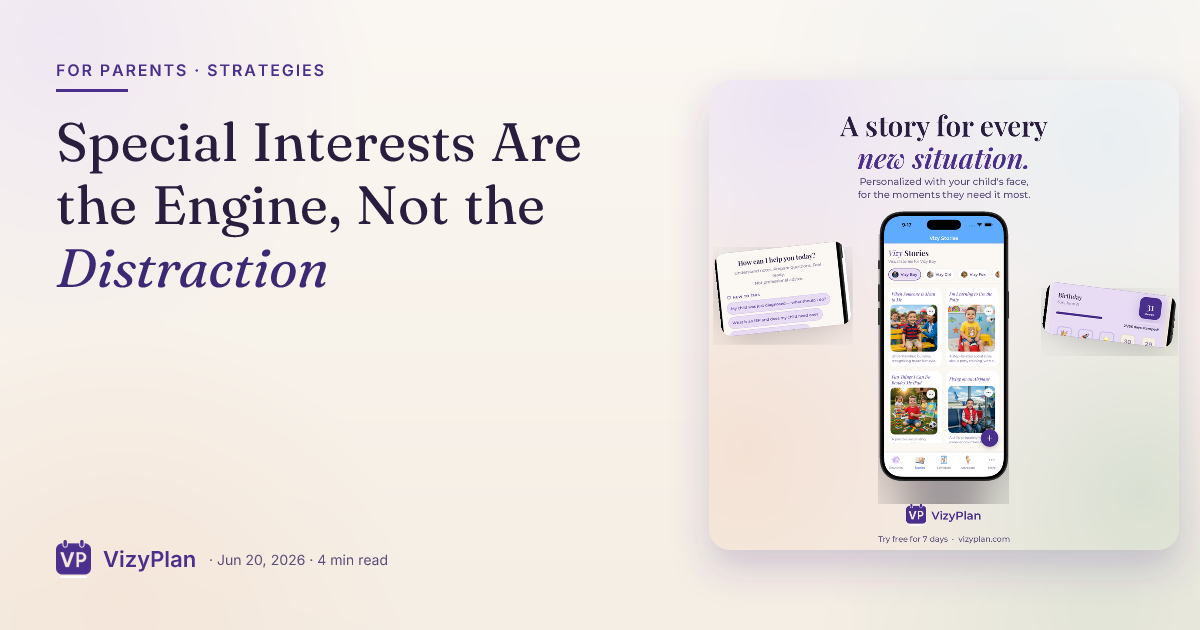
VizyPlan lets you track your child's emotional states and behavioral patterns visually over time. When you can see that your child's rocking triples after school every day, you have concrete data pointing to the school environment as a sensory stressor. That data is worth more than any guess.
Teach Self-Advocacy
As your child grows, help them understand and articulate their own stimming needs. "I need to rock right now because I am feeling overwhelmed" is a powerful statement that builds self-advocacy skills. It transforms stimming from something that happens to them into something they understand and can communicate about.
This language also helps teachers, peers, and other adults understand what they are seeing. A child who can say "I listen better when I fidget" has just given their teacher the information needed to support rather than correct them.
Build a Sensory Diet
An occupational therapist can help you develop a "sensory diet," a planned schedule of sensory activities throughout the day that proactively meets your child's sensory needs before they escalate to the point of intense stimming. This might include:
- Heavy work activities in the morning (carrying books, pushing a laundry basket)
- Movement breaks between seated activities
- Tactile play during transitions
- Deep pressure input before high-demand situations
- Calming vestibular input before bed
A sensory diet does not replace stimming. It reduces the pressure on stimming to be the only regulatory tool your child has.
When a Stim Is Harmful: Redirecting Safely
If your child has a stim that is causing physical harm, the goal is never to eliminate the need behind the behavior. The goal is to meet the same need through a safer channel.
Identify the Sensory Function
Before redirecting, figure out what sensory input the harmful stim provides. A child who bangs their head may be seeking deep proprioceptive input to the skull. A child who bites their hands may be seeking intense oral-tactile pressure. A child who scratches their skin may be seeking sharp tactile stimulation.
Once you know the function, you can offer alternatives that deliver similar input without causing harm.
Offer Safer Alternatives
- For head banging: A vibrating pillow, a weighted hat, gentle head squeezes, or a helmet during acute periods while you work on alternatives
- For self-biting: Chewable jewelry (chew necklaces, chew bracelets), vibrating teethers, crunchy or chewy snacks
- For skin picking: Textured fidgets, peeling activities (stickers, tape, dried glue on hands), putty or clay
- For hair pulling: Textured wigs or doll hair to pull, resistance bands, sensory brushes
- For hitting self: Weighted lap pads, compression vests, pillow punching, clapping games
The alternative must genuinely satisfy the same sensory need. If it does not, your child will return to the harmful behavior because their body still needs what the original stim provided.
Address the Root Cause
Harmful stimming often escalates when something deeper is wrong. Before focusing exclusively on the behavior, investigate whether your child is experiencing:
- Unaddressed pain or medical issues (ear infections, dental problems, GI distress are common in autism and often go unreported)
- Environmental stressors (a new teacher, a schedule change, bullying)
- Communication frustration (needing something they cannot express)
- Sleep deprivation (sleep challenges dramatically increase self-injurious behavior)
- Sensory environments that have changed (new lighting at school, construction noise near home)
Treating the root cause often reduces the harmful behavior more effectively than any behavioral intervention targeting the stim itself.
Know When to Call for Help
Some situations require professional support. Reach out to your child's pediatrician, occupational therapist, or behavioral specialist if:
- Self-injurious stimming is causing visible physical damage
- The intensity or frequency of harmful stims is increasing over time
- Your child seems distressed or in pain during the stimming
- Stims are preventing sleep, eating, or participation in wanted activities
- You have tried safer alternatives and your child consistently returns to the harmful behavior
- The stimming started suddenly with no obvious trigger
For guidance on finding the right therapist who understands neurodivergent children, our dedicated guide walks you through the evaluation process.
What to Tell Other People
One of the hardest parts of supporting stimming is managing other people's reactions. The stares at the grocery store. The comments from family members. The teacher who insists your child "sit still and pay attention."
For Family Members
"This is how their brain regulates itself. It is like deep breathing for you. When they rock or flap, their nervous system is doing exactly what it needs to do. Please do not tell them to stop or draw attention to it. If you want to connect with them, try sitting near them and being calm."
For Teachers
"My child stims to regulate and focus. Research shows that for many neurodivergent children, movement supports rather than hinders learning. Please allow fidget tools, movement breaks, and stimming that does not disrupt others. If their stimming escalates significantly, it usually means something in the environment is overwhelming them, and a sensory break will help more than a correction."
For Other Children
"Everyone's body works a little differently. Some people need to move their body to help their brain feel calm. That is what you are seeing. It is not weird or scary. It is just their way."
Your Child's Body Knows What It Needs
Here is what the research keeps pointing back to: your child's stimming exists for a reason. It is not a malfunction. It is not a behavior problem. It is the nervous system's built-in solution to the challenge of existing in a world that was not designed for the way their brain processes information.
A 2025 study found that stimming is only experienced as negative when it causes self-injury or when other people stigmatize it. That second part is important. Much of the distress around stimming comes not from the behavior itself but from the social response to it.
You cannot control how the world responds to your child. But you can control what happens at home. You can create a space where their strengths are celebrated, where their body is trusted, and where the message is clear: you do not need to hold still to be accepted here.
And when a stim is harmful, you can address it from a place of understanding rather than shame. Not "stop doing that" but "I see your body needs something. Let me help you find a safer way to get it."
That is the difference between managing behavior and supporting a whole child. And your child can feel the difference.
VizyPlan helps you track your child's stimming patterns and emotional states over time, build sensory-friendly visual routines that reduce overwhelm, and share documented patterns with occupational therapists and providers. Start your free trial and give your child the structure and understanding they deserve.