
You have the bedtime routine down. The visual schedule is posted. The weighted blanket is in place. Your child falls asleep at a reasonable hour. And then, at 2 AM, they are wide awake. Or they wake screaming from a nightmare. Or they appear at your bedside for the third time, unable to settle. Or they are up at 4:30 AM, fully alert and ready to start the day while the rest of the household desperately needs more sleep.
Sleep challenges in neurodivergent children extend far beyond the difficulty of falling asleep at bedtime. Research consistently shows that 50 to 80% of children with autism and up to 70% of children with ADHD experience significant sleep disturbances. These are not just bedtime resistance issues. They include night waking, sleep anxiety, nightmares, early morning rising, and fragmented sleep patterns that leave both children and parents exhausted.
The good news is that understanding why these specific sleep challenges occur opens the door to targeted strategies that address the root causes rather than just managing symptoms.
Why Sleep Is Different for Neurodivergent Brains
The neurology behind sleep difficulties goes deeper than behavioral habits.
Melatonin production is often atypical. Research has found that many autistic children produce melatonin on a delayed or irregular schedule compared to neurotypical peers. Studies in the Journal of Clinical Sleep Medicine have shown that autistic children may produce peak melatonin levels later in the evening, making it harder to fall asleep, and may see melatonin levels drop earlier in the morning, leading to premature waking. This is a biological difference, not a behavioral one.
Circadian rhythm differences are common in ADHD. Children with ADHD frequently show delayed circadian rhythms, meaning their internal clock is shifted later than typical. Their body wants to fall asleep later and wake later, which conflicts with school schedules and family routines. This mismatch between internal clock and external demands creates chronic sleep debt.
Arousal regulation affects sleep maintenance. The ability to transition smoothly between sleep stages and to return to sleep after brief natural awakenings depends on arousal regulation systems that function differently in neurodivergent brains. Where a neurotypical child briefly wakes between sleep cycles and falls back asleep without fully rousing, a neurodivergent child may wake fully and be unable to return to sleep.
Sensory sensitivities do not stop at night. The hum of a refrigerator, the feel of sheets, the temperature of the room, shadows on the wall, or a sibling's breathing can all be enough to rouse a sensory-sensitive child. Sensory processing differences that create challenges during the day continue operating during sleep.
Anxiety peaks at night. The absence of daytime distractions allows anxious thoughts to dominate. For neurodivergent children prone to anxiety, bedtime and middle-of-the-night waking can trigger worry spirals that make returning to sleep impossible.
Addressing Night Waking
Night waking is one of the most exhausting sleep challenges because it disrupts everyone in the household.
Identify the cause before choosing a strategy. Night waking can stem from sensory triggers, anxiety, hunger, the need for the bathroom, nightmares, or simply an inability to self-soothe back to sleep. The intervention depends entirely on the cause. Track your child's night waking patterns using VizyPlan's emotion and activity tracking. Note the time, what preceded the waking, and how your child presents. Patterns usually emerge within one to two weeks.
Address sensory triggers in the sleep environment. A white noise machine masks inconsistent nighttime sounds. Blackout curtains eliminate light that can trigger waking. Temperature control (many neurodivergent children sleep better in slightly cooler rooms) reduces discomfort. Weighted blankets provide proprioceptive input that promotes deeper sleep for some children.
Create a visual "night waking" routine. If your child wakes at night and comes to find you, having a simple visual posted by their bed showing what to do can build independent re-settling skills. The sequence might include: stay in bed, hug your stuffed animal, take three deep breaths, close your eyes, and try again. Having the steps visible removes the cognitive demand of remembering what to do in a groggy, anxious state.
Build a gradual independence plan. If your child currently requires your physical presence to fall back asleep, gradually reduce your involvement over weeks. Start by sitting beside their bed, then move the chair further from the bed, then sit in the doorway, then stay in your room with the door open. Each step is small enough to be tolerable while building the skill of independent re-settling.
Managing Sleep Anxiety
For many neurodivergent children, the fear of sleeping is the biggest barrier to sleep itself.
Validate the fear. "I can see nighttime feels scary for you" is more effective than "There is nothing to be afraid of." Dismissing fear does not reduce it. Validation makes your child feel heard and opens the door to problem-solving.
Create visual calm-down sequences for nighttime. A simple visual card by the bed with calming strategies: deep breathing pictures, a body scan instruction, or a progressive muscle relaxation sequence gives your child something to do with the anxiety rather than lying in the dark with it.
Address specific fears concretely. If your child is afraid of the dark, experiment with different night light options. If they fear something in the closet, check together and close the door as part of the routine. If they worry about being alone, a two-way monitor with a visual indicator showing that you are nearby provides reassurance.
Use social stories about nighttime. A personalized social story about what happens while your child sleeps (the house is safe, the family is nearby, nighttime is for resting bodies) provides cognitive reassurance that reduces anxiety. VizyPlan's social story feature creates these narratives with images your child recognizes, making the reassurance more concrete and personal.
Consider a worry journal or worry box. Before bed, have your child draw or write their worries and place them in a designated box. The physical act of externalizing the worry can reduce its power. You can promise to "keep the worries safe" until morning, giving your child cognitive permission to set them aside.
Early Morning Waking
When your child wakes hours before the alarm and cannot fall back asleep, the entire family suffers.
Use a visual "okay to wake" system. A clock that changes color at the acceptable wake time, or a simple sign that flips from "sleep time" to "awake time," gives your child a concrete signal for when it is okay to get up. This removes the ambiguity of "too early" versus "early enough."
Create an independent morning activity kit. If your child wakes early and truly cannot fall back asleep, having a designated bin of quiet activities (books, drawing supplies, simple puzzles) they can access independently gives them something to do without requiring your involvement. A visual card can show the rule: "If the clock is still red, choose a quiet activity from the bin."
Address biological causes. Early waking can be caused by blood sugar drops, light exposure, room temperature changes at dawn, or melatonin cycles ending too early. Consult with your child's pediatrician about whether melatonin timing adjustments or other interventions might help.
Adjust bedtime strategically. Counterintuitively, a later bedtime does not always produce later waking. For some children, being overtired at bedtime leads to restless sleep and earlier waking. For others, shifting bedtime thirty minutes later genuinely helps. Track the data and adjust based on what actually works for your child.
Supporting the Whole Family
Sleep challenges affect every family member. Protecting everyone's rest is essential.
Create a family sleep plan. Discuss and agree on how nighttime disruptions will be handled. Who responds to night waking? How are siblings protected from disruption? What backup plans exist for nights that go badly? Having a plan reduces the stress of in-the-moment decision-making at 3 AM.
Protect your own sleep. A parent running on chronic sleep deprivation cannot provide the patient, consistent support their child needs. Take turns with a partner, accept help from family, or adjust expectations for daytime productivity when nights are disrupted. Your rest matters too.
Communicate with school. If your child's sleep challenges are affecting their daytime functioning, their teachers need to know. Accommodations like movement breaks, a quiet resting space, or modified expectations on days following poor sleep can prevent the compounding effect of sleep deprivation plus academic demands.
Sleep challenges are among the most physically and emotionally draining aspects of raising a neurodivergent child. They are also among the most responsive to targeted intervention. With the right environmental adjustments, visual supports, and consistent strategies, most families see meaningful improvement over time.
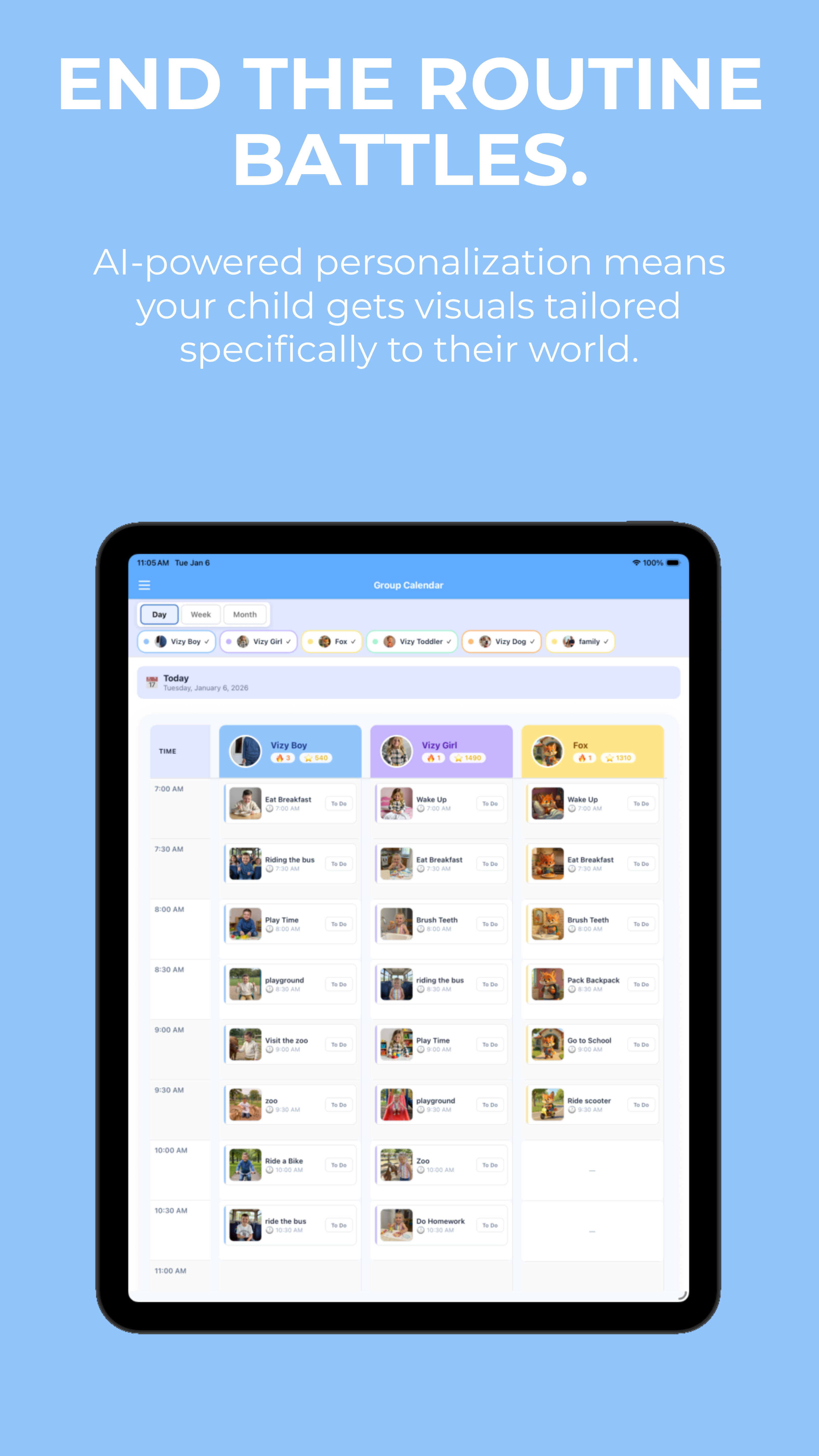
Download VizyPlan and start your 7-day free trial today. Build bedtime and nighttime visual routines, track sleep patterns and emotions, and create calming sequences that help your child navigate the overnight hours. If it helps, keep going for $6.99/month or $59.99/year.