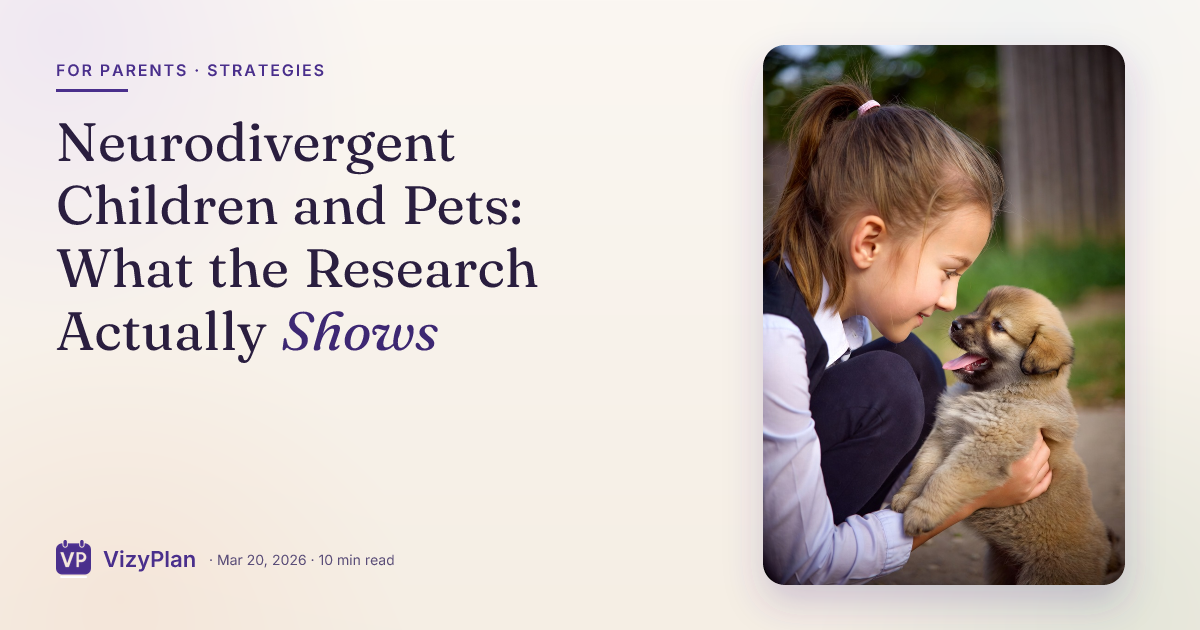
Your child does not make eye contact with the new neighbor. She will not answer questions from the cashier at the grocery store. She melts down when plans change and retreats to her room when guests come over. But when she sits on the floor next to the family dog, something shifts. She talks to him. She rests her head against his side. She tells him about her day in full sentences that she would never offer a person.
If you have seen this happen, you are not imagining it. Research confirms what parents of neurodivergent children have noticed for years: animals reach children in ways that people sometimes cannot.
The Science Behind the Bond
The research on animals and neurodivergent children is not anecdotal. It is measurable.
A 2010 study published in *Psychoneuroendocrinology* tracked cortisol levels in 42 children with autism before, during, and after living with a service dog. The cortisol awakening response, a biological marker for stress, dropped from a 58 percent morning spike to just 10 percent when the dog was present. When the dog was temporarily removed, cortisol jumped back to 48 percent. That is not a placebo effect. That is physiology.
Research from the National Institute of Child Health and Human Development found that children had significantly higher levels of oxytocin when playing with the family dog compared to playing alone with toys. Oxytocin is the hormone linked to bonding, trust, and emotional regulation. For children with autism, whose oxytocin systems may function differently, the simple act of petting a dog can activate calming pathways that social interaction alone does not reach.
A systematic review published in *Frontiers in Veterinary Science* in 2024 analyzed the full body of animal-assisted therapy research for autism and found consistent improvements across multiple domains: quality of life, communication, social development, cognitive skills, and anxiety reduction. Across 22 studies reviewed in a separate analysis, increased social interaction was significant in every single one.
How Pets Help with Social Skills
One of the most consistent findings in the research is that animals serve as what researchers call a "social lubricant." Children who struggle to connect with peers will often engage freely in the presence of an animal.
Marguerite O'Haire, a researcher at Purdue University, studied what happened when guinea pigs were placed in classrooms with autistic children for eight weeks across 14 Australian schools. The children became significantly more talkative and cheerful. They were more likely to look at faces, make physical contact with peers, and respond to social approaches from classmates. The guinea pig gave them a shared focus, something to talk about that felt safe and predictable.
Gretchen Carlisle at the University of Missouri put it simply: "For children with autism who struggle with communication, having something to talk about and share about that is in common with their peers is very important, and animals can fill that role."
This matters beyond therapy sessions. When your child walks the family dog through the neighborhood, other children approach. They ask the dog's name. They want to pet it. These are organic social interactions that require no coaching, no social skills group, and no script. The dog creates the bridge.
Emotional Regulation and Stress Reduction
Emotional regulation is one of the biggest daily challenges for neurodivergent families. Research consistently shows that pets help.
Families who acquired a dog saw significant reductions on the Parenting Stress Index, with 20 percent of parents moving from clinically high stress to normal levels. OCD-related anxiety scores showed a 26 percent greater decrease in families with pets compared to those without. Children reported feeling calmer, having fewer meltdowns, and sleeping better with a pet in the home.
The mechanism is partly biological and partly relational. Stroking a dog or cat activates the parasympathetic nervous system, which lowers heart rate and reduces muscle tension. But there is also the unconditional nature of the relationship. A 2022 study published in the *Journal of Autism and Developmental Disorders* found that autistic individuals described their pets as companions who "ask no questions and pass no criticism." For children who spend their days navigating social expectations they do not fully understand, that acceptance is not trivial.
Sensory Benefits That Might Surprise You
Many neurodivergent children seek sensory input throughout the day. Pets provide it naturally.
A large dog lying against a child provides deep pressure therapy, the same calming input that weighted blankets deliver. Temple Grandin, the renowned autistic researcher and animal behavior expert, demonstrated decades ago that deep touch pressure calms the nervous system. A 70-pound Labrador draped across a child's lap delivers that pressure in a warm, breathing, responsive form that no blanket can replicate.
Cats offer a different sensory profile. Their purring produces low-frequency vibrations that many children find deeply soothing. The rhythmic nature of a cat's purr can function as a sensory regulation tool, providing consistent, predictable input that helps a child's nervous system settle.
Even fish can serve a sensory role. The rhythmic movement of fish in an aquarium and the gentle sound of water provide visual and auditory regulation for children who are easily overwhelmed by unpredictable sensory environments. For children with significant sensory sensitivities who cannot tolerate fur, noise, or sudden movement, an aquarium is a meaningful starting point.
Which Animals Work Best
Not every pet is the right fit for every child. The research points to clear strengths for different animals.
Dogs are the most studied and offer the broadest range of benefits: social facilitation, deep pressure, emotional bonding, and routine structure through daily walks and feeding schedules. Trained service dogs can also provide safety benefits for children who elope or wander. The tradeoff is that dogs are loud, active, and require significant daily commitment.
Cats may be preferred by some autistic children because cats naturally avert their gaze quickly. For children who find sustained eye contact uncomfortable, a cat's communication style can feel less intrusive. Cats are also lower-maintenance and their calm, independent nature suits families who need a less demanding companion.
Guinea pigs are backed by strong research as effective companions in structured settings. O'Haire's classroom studies specifically validated their impact. They are active during the day, generally enjoy being held, rarely bite, and are small enough for a child to manage independently. They can be an excellent low-pressure first pet.
Rabbits offer a safe, non-threatening presence with soft fur that provides pleasant tactile input. They are a good option for children who are afraid of dogs.
Fish require the least interaction but still provide visual sensory regulation and teach basic responsibility through feeding schedules. They are ideal for families who want to introduce the concept of pet care without the complexity of a furry animal.
Horses deserve mention because the research on equine-assisted therapy is compelling. A randomized controlled trial found that 10 weeks of therapeutic horseback riding produced significant improvements in irritability, hyperactivity, social skills, and word fluency. Children who continued for a full year showed lasting gains in behavior, academic performance, and communication. Equine therapy is typically accessed through programs rather than pet ownership, but many grants and funding sources cover it.
Enjoying this article?
Get practical tips and insights delivered to your inbox — no spam, ever.
Building Routines and Responsibility Through Pet Care
For children with ADHD, executive function challenges make daily structure difficult. Pets create what researchers describe as non-negotiable time anchors. The dog needs to be fed at 7:00 AM. The cat's litter box needs to be cleaned after school. The fish need food before bedtime. These tasks are concrete, visual, and immediate in their consequences, which makes them easier to internalize than abstract expectations like "clean your room."
Giving your child specific, age-appropriate pet care jobs builds independence and self-confidence. A visual schedule showing who is responsible for which pet chores turns vague expectations into clear steps. A first-then board that shows "First feed the dog, then breakfast" creates a predictable sequence that an ADHD brain can follow without repeated verbal reminders.
The routine benefits extend to the whole family. Parents of children with autism who acquired a pet dog reported significantly improved family functioning. The shared responsibility creates connection points and natural opportunities for cooperation.
How to Introduce a Pet to Your Neurodivergent Child
Preparation matters more than the day itself. Here is what the research and clinical practice recommend.
Start with exposure, not ownership. Visit friends who have pets. Spend time at petting zoos. Watch videos of the specific breed or type of animal you are considering. Gauge your child's sensory responses: does the barking bother them? Do they reach for the fur or pull away? These observations will guide your decision.
Use social stories before the pet arrives. Create a simple story that covers what to expect: "Our new cat will live in our house. She might hide at first. That is okay. We will use gentle hands and quiet voices." Social stories reduce anxiety by making the unfamiliar feel predictable.
Create visual supports for pet interactions. Visual cue cards for "gentle hands," "quiet voice near the pet," and "when the pet walks away, let them go" give your child clear behavioral expectations they can reference in the moment.
Build a visual pet care schedule. Before the pet arrives, walk through the daily routine together. Morning feeding, after-school play time, evening walk, bedtime check. Making the routine visible and predictable helps your child feel ownership and competence from day one.
Set up the environment thoughtfully. Designate a safe space for the pet that is separate from your child's calm-down area. Establish pet-free zones if your child needs spaces that are entirely predictable. Remove or secure items that could be knocked over during initial excitement.
Let your child set the pace. Never force interaction. Short, supervised sessions that end on a positive note are more effective than prolonged exposure. If your child retreats, let them. The animal will still be there when they are ready.
Challenges to Consider Honestly
Pets are not a treatment for autism or ADHD. They should not be acquired with the sole goal of addressing symptoms. That framing sets up both the child and the animal for failure.
Nearly 20 percent of families who owned dogs reported that their child experienced sensory hypersensitivity related to the animal. Loud barking, sudden movements, and strong smells can cause sensory overload. A large, energetic dog might overwhelm a child while a quiet cat or small guinea pig would thrive in the same household.
Some children develop intense attachment to their pet that manifests as separation anxiety or excessive worry about the animal's health. When a pet rejects affection or does not want to play, this can cause emotional distress that neurodivergent children may struggle to process.
Time and cost are real factors. Parents often absorb the majority of pet care regardless of the child's age. Be honest about your family's capacity before adding another living being to the household.
And consider the animal's welfare. Pets living with children who have intense behavioral patterns need their own safe spaces, patience during adjustment, and an owner who will advocate for their needs alongside the child's.
The Bottom Line
The research is clear that animals can provide measurable benefits for neurodivergent children across social skills, emotional regulation, sensory processing, and daily routine building. But the key word is "can." The right animal in the right environment with the right preparation creates something powerful. The wrong match creates stress for everyone, pet included.
Start with honest assessment. Consider your child's sensory profile, your family's daily capacity, and the level of preparation you can invest before the animal arrives. Use visual supports, social stories, and gradual exposure to set everyone up for success.
When it works, the bond between a neurodivergent child and their pet is one of the most genuine, uncomplicated relationships they will experience. No judgment. No social scripts. No expectation to perform. Just connection, on their terms.
Download VizyPlan and start your 7-day free trial today. Build visual schedules for pet care routines that teach responsibility and independence, create social stories to prepare your child before a new pet arrives, track emotional and behavioral patterns to see how your child responds to animal interaction over time, and use first-then boards to build predictable sequences around daily pet care. If it helps, keep going for $6.99/month or $59.99/year.