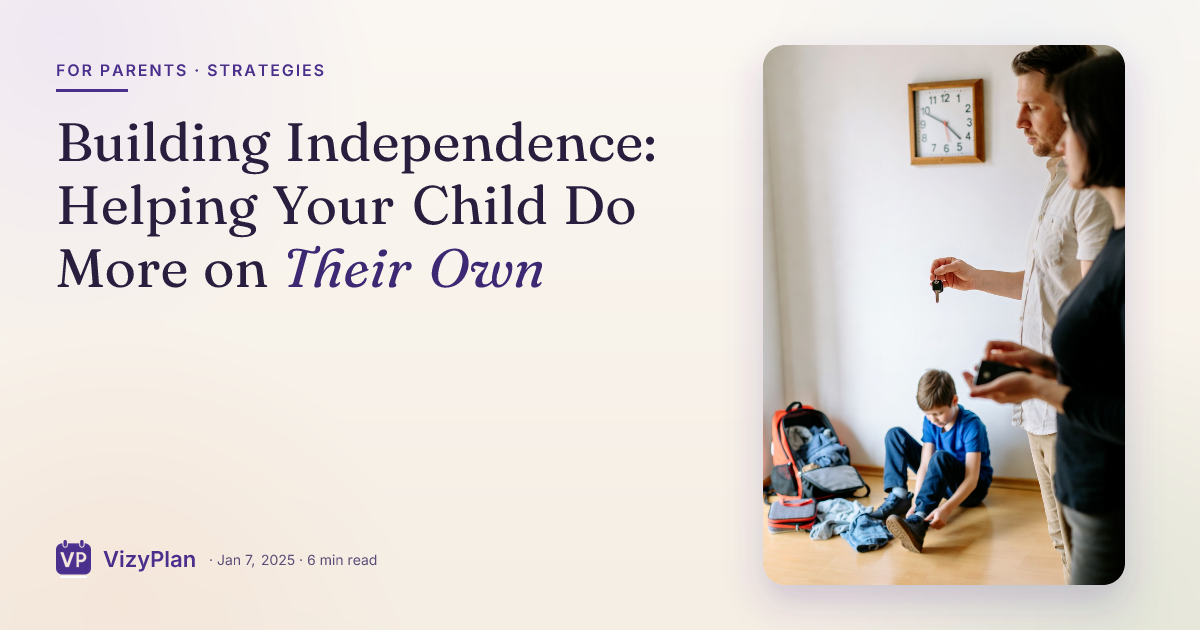
Your seven-year-old still needs you to walk them through every step of getting dressed. Your ten-year-old cannot make a sandwich without forgetting half the steps. You catch yourself doing things for your child that their peers do alone, and you wonder: will they ever be able to do this on their own?
They will. But the path to independence for neurodivergent children looks different. It requires more explicit teaching, more visual supports, and more patient scaffolding than the parenting books describe. The reward, a child who manages parts of their day with genuine confidence, is worth every step.
Why Independence Matters
Independence is about more than convenience for parents. For children, developing independence builds self-esteem, reduces anxiety, and prepares them for the increasing demands of school, community, and eventually adult life.
Confidence grows with capability. Every skill a child masters becomes proof that they can learn and succeed. This builds a foundation for tackling future challenges.
Anxiety decreases with competence. Children who know they can handle tasks feel less anxious about facing them. Dependence on others, conversely, can increase anxiety.
Self-advocacy develops. Children who practice independence learn what they can do, what they need help with, and how to communicate about both.
Future success is built now. The independent skills children develop in childhood become the foundation for adult functioning.
Common Barriers to Independence
Understanding what stands in the way of independence helps target interventions effectively.
Executive function challenges make it hard to initiate tasks, remember sequences, and manage the multiple steps that independence requires.
Processing differences may mean children can do tasks but take longer or need information presented differently.
Sensory sensitivities can make certain independent tasks uncomfortable or overwhelming without accommodations.
Anxiety about failure may lead children to avoid trying things independently, preferring the safety of adult help.
Well-meaning over-helping from adults who do things for children rather than teaching them to do things themselves.
The Power of Visual Task Analysis
Breaking tasks into small, visual steps is fundamental to building independence.
Task analysis means identifying every step. What adults do automatically involves many small steps. Brushing teeth includes getting the toothbrush, getting the toothpaste, removing the cap, applying toothpaste, wetting the brush, and more.
Visual representation removes memory burden. When steps are visible, children do not have to hold the sequence in working memory, they just follow what they see.
Consistent sequences build automaticity. When the same steps happen in the same order every time, the routine eventually becomes automatic.
Self-checking becomes possible. Children can compare what they have done to what the visual shows, rather than depending on adult feedback.
Starting Points for Building Independence
Choose starting points strategically rather than trying to build independence in everything at once.
Start with motivated tasks. Independence in getting a snack or starting a preferred activity often comes more easily than independence in non-preferred tasks.
Choose tasks with clear endpoints. Tasks that have an obvious "done" are easier to master than ongoing or ambiguous tasks.
Select developmentally appropriate targets. Match expectations to your child's current capabilities plus a small stretch.
Consider safety and natural consequences. Some tasks allow natural learning from mistakes; others require more supervision during the learning process.
Creating Effective Visual Supports for Independence
Not all visual supports are equally effective. Design matters.
Use images your child understands. Photos, drawings, or icons, whatever your child processes most easily.
Show one step per image. Combining multiple steps in one image creates confusion and defeats the purpose.
Place visuals where tasks happen. The handwashing visual belongs at the sink, not across the room.
Make them durable and accessible. Laminated cards, waterproof materials, or digital displays that will not be destroyed with use.
Update as skills develop. As children master steps, supports can be simplified or combined.
The Prompting Hierarchy
Moving from dependence to independence requires systematic fading of support.
Physical prompts involve hand-over-hand guidance through a task. This is the most supportive and should be faded first.
Modeling shows the child what to do without physical contact. "Watch me do it, then you try."
Gestural prompts point or gesture toward what comes next without modeling the entire action.
Verbal prompts tell the child what to do. These are often overused and hard to fade.
Visual prompts (the schedule or task analysis) should be the last prompt standing, children can use these independently.
Independence means completing the task with only the visual support, which they access themselves.
Fading Support Systematically
Moving down the prompting hierarchy requires intentional practice.
Fade from most intrusive to least. Physical prompts fade before verbal, verbal before gestural, gestural before visual.
Fade within prompt types. Full hand-over-hand fades to light touch, which fades to touch at the elbow, which fades to no touch.
Wait before prompting. Give children processing time. Jumping in too quickly creates prompt dependence.
Celebrate independence at each level. Recognition of progress motivates continued effort.
.png)
Building Independence in Morning Routines
Morning routines offer an excellent opportunity for independence building.
Create a visual sequence showing every step from waking to leaving. Position it where your child can see and access it independently.
Prepare the night before. Clothes laid out, backpack packed, and breakfast items ready reduce the cognitive load of morning decisions.
Build in extra time. Rushing undermines independence. Children doing things themselves take longer than adults doing things for them.
Start with one section. Perhaps just getting dressed independently, then expand from there.
Resist the urge to help. It is faster to tie shoes yourself, but every time you do, you delay your child learning to do it.
Building Independence in Self-Care
Hygiene and self-care tasks involve many steps that can be systematically taught.
Break down bathroom routines into component parts. Handwashing alone might be six or more steps.
Address sensory barriers. If tooth brushing is difficult because of the toothpaste flavor, find an acceptable alternative. Solve sensory problems before expecting independence.
Use timers for tasks with duration. Visual timers show how long to brush teeth or wash hands when "long enough" is too abstract.
Check but don't redo. If your child washes their hands independently but imperfectly, resist the urge to rewash. Acknowledge the independence and work on thoroughness separately.
Building Independence in Household Tasks
Contributing to household tasks builds competence and family belonging.
Match tasks to abilities and interests. A child who loves organizing might excel at sorting laundry. A child who enjoys water might be your dish-rinsing expert.
Teach explicitly. Demonstrate, practice together, then gradually step back. Do not assume children will figure out how to do tasks they have never been taught.
Accept imperfection. A child-folded towel may not be perfect. A child-made bed may be lumpy. Prioritize independence over perfection.
Make tasks routine. The same chore at the same time each day or week builds automaticity.
Using Technology to Support Independence
Digital tools offer unique advantages for building independence.
Visual schedules on tablets are always available and can include audio or video supports.
Timers and alarms provide cues without parent involvement.
Video modeling shows tasks being completed, which children can watch and rewatch.
Progress tracking makes growth visible and celebrates achievement.
VizyPlan's visual routine builder creates customizable, accessible supports that travel with your child and grow with their developing independence.
Common Mistakes to Avoid
Certain approaches undermine independence rather than building it.
Over-prompting creates children who wait for instructions rather than initiating.
Impatience leads to adults taking over, which teaches children that if they wait, help will come.
Inconsistency confuses children about what they are expected to do independently versus what will be done for them.
All-or-nothing thinking expects full independence rather than celebrating partial independence.
Negative feedback about imperfect attempts discourages future effort.
Celebrating Progress
Recognition and celebration reinforce independent behavior.
Notice and name independence. "You got dressed all by yourself this morning, that's independence!"
Track progress visually. Charts showing growth over time motivate continued effort.
Share successes. Telling grandparents or teachers about new independent skills builds pride.
Connect independence to benefits. "Because you got ready so fast by yourself, we have time to play before school."
VizyPlan helps you create visual supports that build your child's independence one step at a time. Start your free trial and watch your child's confidence grow.