
The meltdown is building. You can see it in their eyes, the overwhelm rising like a wave. You are in the middle of a grocery store, or a classroom, or a family dinner, and there is no calm-down corner, no weighted blanket, no escape route. But what if your child could close their eyes and go somewhere safe in an instant?
That is the power of a "Happy Place," a personalized mental sanctuary that neurodivergent children can access anywhere, anytime, no tools required. It is one of the most portable self-regulation strategies that exists, and it can be taught at any age.
What Is a Happy Place?
A Happy Place is a personalized mental sanctuary, a calm, safe space that a child can visualize and mentally "visit" when they need to regulate their emotions. Unlike physical calm-down corners (which are also valuable), a Happy Place exists in the imagination and is therefore always accessible.
The Happy Place might be:
- A favorite real location (grandma's house, a beloved beach, their bedroom)
- An imaginary space (a cloud castle, an underwater world, a magical forest)
- A fantasy environment based on interests (inside a favorite video game, on a spaceship, in a dinosaur world)
The key is that it feels safe, calm, and personally meaningful to the child.
Why Visualization Works for Neurodivergent Children
While mindfulness and visualization are sometimes assumed to be difficult for neurodivergent children, with proper adaptation, they can be remarkably effective.
Visual thinking is a strength. Many autistic children are highly visual thinkers. Visualization leverages this strength rather than fighting against it.
Concrete imagery helps abstract concepts. The abstract idea of "calming down" becomes concrete when associated with a specific visualized place.
Special interests provide engagement. When the Happy Place incorporates a child's intense interests, engagement and motivation increase significantly.
It provides control. Children who feel out of control in the real world can have complete control over their imaginary space.
Portable regulation. Unlike physical tools that might not always be available, a Happy Place travels with the child.
Building the Happy Place
Creating a Happy Place is a process best done during calm moments, not during distress. Take time to build it thoughtfully with your child.
Start with what feels safe. Ask your child where they feel most calm, safe, and happy. This might be a real place or somewhere imagined.
Add sensory details. What do they see in their Happy Place? What colors? What sounds? What does it feel like? What do they smell? Building rich sensory details makes the visualization more immersive.
Include comfort elements. Are there favorite toys, pets, people, or characters in the Happy Place? Who or what would help them feel calm?
Let them have control. In their Happy Place, they make the rules. They decide what exists there and what happens.
Create a visual representation. Draw, paint, or create a digital image of the Happy Place. This physical representation helps cement the concept and can serve as a reminder.
Teaching the Visualization Process
Once the Happy Place is established, children need to learn how to access it.
Practice when calm. The first many times visiting the Happy Place should happen during relaxed moments, not crises. This builds the neural pathways.
Guide the journey. Walk through the visualization with your child: "Close your eyes. Take a deep breath. Now imagine you're walking toward your Happy Place. What do you see as you get closer?"
Engage all senses. Prompt them to notice what they see, hear, feel, and smell in their Happy Place. Multi-sensory engagement deepens the experience.
Establish an entrance ritual. Having a consistent way to "enter" the Happy Place creates a helpful routine, maybe three deep breaths, or a specific phrase, or imagining opening a door.
Keep initial sessions short. One to two minutes is plenty at first. Duration can increase as the skill develops.
Adapting for Different Needs
Not every child will connect with traditional visualization approaches. Adaptations make this tool accessible to more children.
For children who struggle to close their eyes: They can look at a picture of their Happy Place instead of visualizing with eyes closed.
For children who need movement: The Happy Place can include imagined movement, flying, swimming, swinging, that provides mental proprioceptive input.
For children who are highly concrete: The Happy Place can be a real location they know well, with minimal imagined elements.
For children with limited language: Build the Happy Place primarily through drawing, crafting, or pointing at pictures rather than verbal description.
For children who resist adult direction: Let them lead the entire process, creating their Happy Place with minimal input from you.
Complementary Calm Strategies
The Happy Place works best as part of a broader toolkit of calm strategies. Consider combining it with:
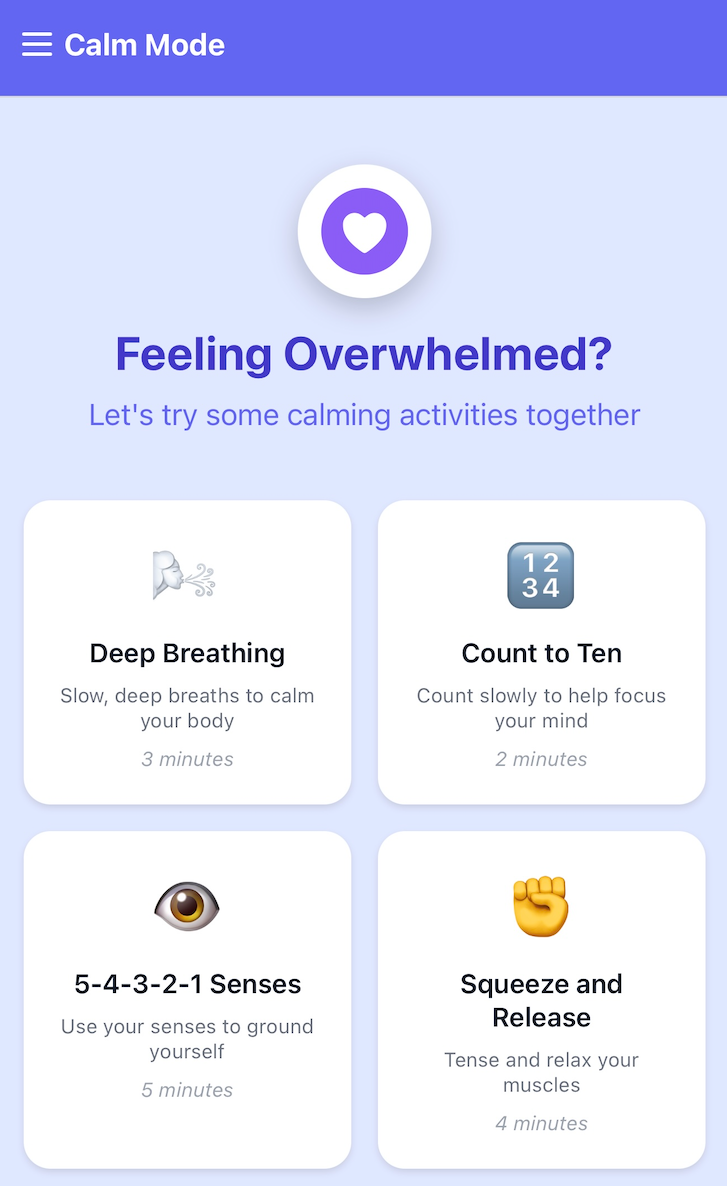
Breathing exercises. Simple breathing techniques can serve as the "entrance" to the Happy Place or complement it during use.
Sensory tools. Physical fidgets, weighted items, or comfort objects can be used while mentally visiting the Happy Place.
Movement breaks. For children who need to move, gentle stretching or rocking while visualizing combines physical and mental regulation.
Counting and grounding. Techniques like counting objects or using the 5-4-3-2-1 senses exercise can precede or follow Happy Place visits.
Music or sounds. Some children benefit from calm music or nature sounds while practicing visualization.
Using the Happy Place During Distress
Once the Happy Place is well-established through practice, it can be accessed during difficult moments.
Catch early signs. The Happy Place is most effective when accessed before full dysregulation. Help your child recognize early warning signs.
Offer it as an option. "Would you like to visit your Happy Place?" is better than "Go to your Happy Place!" Demands rarely help during distress.
Provide scaffolding as needed. Some children can self-guide; others need you to talk them through it even after much practice.
Do not force it. If the child is too dysregulated to visualize, try other strategies first and return to the Happy Place later.
Debrief afterward. Once calm returns, briefly acknowledge: "Your Happy Place helped you feel better." This reinforces the tool.
Building Independence
The ultimate goal is for children to access their Happy Place independently when needed.
Create reminders. A small picture of the Happy Place in their pocket, on a keychain, or in their desk reminds them this tool exists.
Practice in different settings. Practice using the Happy Place at home, at school, in the car, anywhere they might need it.
Role-play scenarios. "Imagine you're at school and feeling overwhelmed. What could you do?" Practice makes access more automatic.
Celebrate independent use. When your child uses their Happy Place without prompting, acknowledge it: "I noticed you took a breath and got calm. Did you visit your Happy Place?"
Fade your support gradually. Move from guiding the visualization to simply prompting it to simply noticing when they use it independently.
Beyond the Happy Place
The skills learned through Happy Place visualization transfer to other areas.
General visualization skills can help with test anxiety, performance situations, and imagining successful outcomes.
Body awareness developed through sensing the calm of the Happy Place helps with recognizing stress earlier.
Self-advocacy grows as children learn to say "I need a moment" and use their internal tools.
Resilience builds as children experience repeatedly that they can move from distress to calm through their own actions.
Digital Tools for Happy Place Creation
Technology offers new ways to build and access Happy Places.
Digital design tools let children create visual representations of their Happy Place that can be viewed on any device.
Guided meditation apps designed for children can support visualization practice.
Personalized image generation can create images of the Happy Place that match what the child imagines.
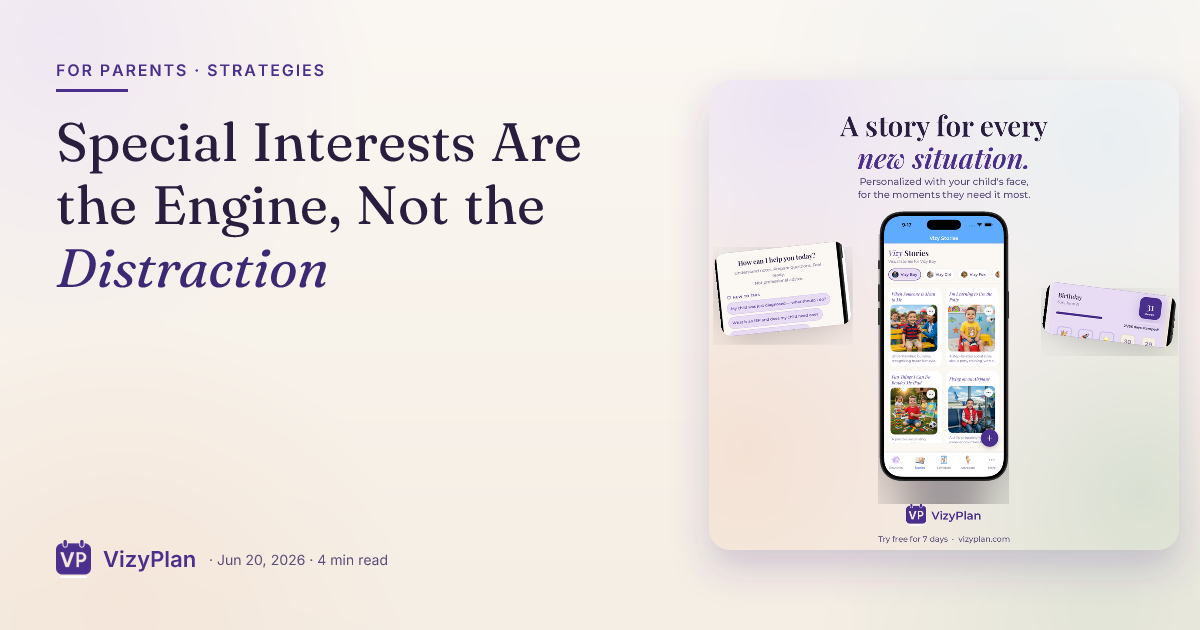
VizyPlan's Happy Place feature lets children create personalized calm spaces with images, colors, and elements they choose, available anytime they need to reset.
VizyPlan helps your child build a personalized Happy Place and access calming tools whenever they need them. Start your free trial and bring more calm to your family's daily life.