
You downloaded the free visual schedule printable. You laminated it, hung it on the wall, and waited for the magic to happen. Your child glanced at it once and never looked at it again. The generic clip art kid brushing their teeth looked nothing like your child. The cartoon bedroom looked nothing like their room. And somewhere in the gap between those stock images and your child's actual life, the whole system fell apart.
You are not imagining the disconnect. Research consistently shows that personalized visual supports outperform generic ones, and now AI-generated images are closing that gap in ways that were impossible just a few years ago.
The Limitation of Generic Visual Supports
Traditional visual supports typically rely on stock images, clip art, or generic illustrations. While these can be helpful, they often have significant limitations.
They may not look like your child. A visual schedule showing a generic cartoon child brushing teeth may not resonate with a child who looks nothing like that image.
They may not show your actual environment. Images of a generic bathroom or kitchen do not prepare a child for their specific surroundings.
They may not match your routines. Stock images of breakfast might show foods your family never eats, creating disconnect between the visual and reality.
They may not represent your child's interests. Generic images cannot incorporate the specific characters, themes, or interests that motivate your particular child.
For children who are concrete thinkers, as many autistic children are, these disconnects can significantly reduce the effectiveness of visual supports.
What AI Image Generation Offers
AI image generation technology creates custom images based on text descriptions. For visual supports, this means the ability to create images that:
Match your child's appearance. Create images featuring a child who looks like your child, similar hair, skin tone, and features.
Show your actual spaces. Generate images that represent your home, your child's school, or specific locations you visit.
Depict your specific routines. Create images of exactly what your family does, how you do it, and in what order.
Incorporate your child's interests. Add favorite characters, colors, themes, or objects that increase engagement and motivation.
Illustrate any scenario. Whether you need an image for going to a new doctor, visiting grandma's house, or handling a fire drill, AI can create it.
Why Personalization Matters
The research on visual supports consistently shows that personalization increases effectiveness. When children see themselves in the images, engagement and understanding improve.
Recognition is easier. A child more quickly recognizes and connects with an image that looks familiar rather than abstract.
Abstract concepts become concrete. Seeing themselves in an image makes the instruction feel real and achievable rather than theoretical.
Emotional connection increases. Children care more about visual supports that feel personal to them.
Generalization is supported. When images match real environments, skills learned through visual supports transfer more easily to actual situations.
Self-identity is affirmed. Seeing themselves represented in their tools sends a message that they matter and belong.
Practical Applications of AI-Generated Visuals
The possibilities for AI-generated visual supports extend across many areas of daily life.
Morning and bedtime routines can feature images of your child's actual bedroom, bathroom, and the specific steps in your family's routine.
School preparation might include images of your child's school building, classroom, teacher, and school-day activities.
New experience preparation can show the specific doctor's office, restaurant, or vacation destination your child will visit.
Emotional regulation tools can feature your child using specific coping strategies in situations where they typically struggle.
Social stories come alive when the child in the story looks like your child and the settings match their world.
First-Then boards become more motivating when both the "First" and "Then" images feel relevant and real.
Getting the Best Results
When using AI image generation for visual supports, several strategies improve outcomes.
Be specific in descriptions. Rather than "a child eating breakfast," describe "a 7-year-old girl with brown curly hair eating pancakes at a round wooden table."
Include relevant details. If your child always wears glasses, mention that. If they have a favorite shirt they wear constantly, include it.
Consider the background. The setting matters. Describe whether the scene is indoors or outdoors, what room it is in, and any relevant details.
Match the style to your child's preferences. Some children respond better to realistic images, others to cartoon-style or illustrated looks. Experiment to find what works.
Keep it clear and simple. Busy, complex images can be overwhelming. Request clean, simple images that clearly communicate one idea.
Enjoying this article?
Get practical tips and insights delivered to your inbox — no spam, ever.
Integrating AI Images Into Your Visual Systems
Once you have custom images, integrate them thoughtfully into your visual support systems.
Replace generic images gradually. You do not need to overhaul everything at once. Start with the visual supports your child uses most frequently.
Maintain consistency. Once you establish a visual style that works, maintain it across different supports so your child has a cohesive visual language.
Update as needed. As your child grows, their appearance changes, their interests shift, and their needs evolve. Update images to keep them current and relevant.
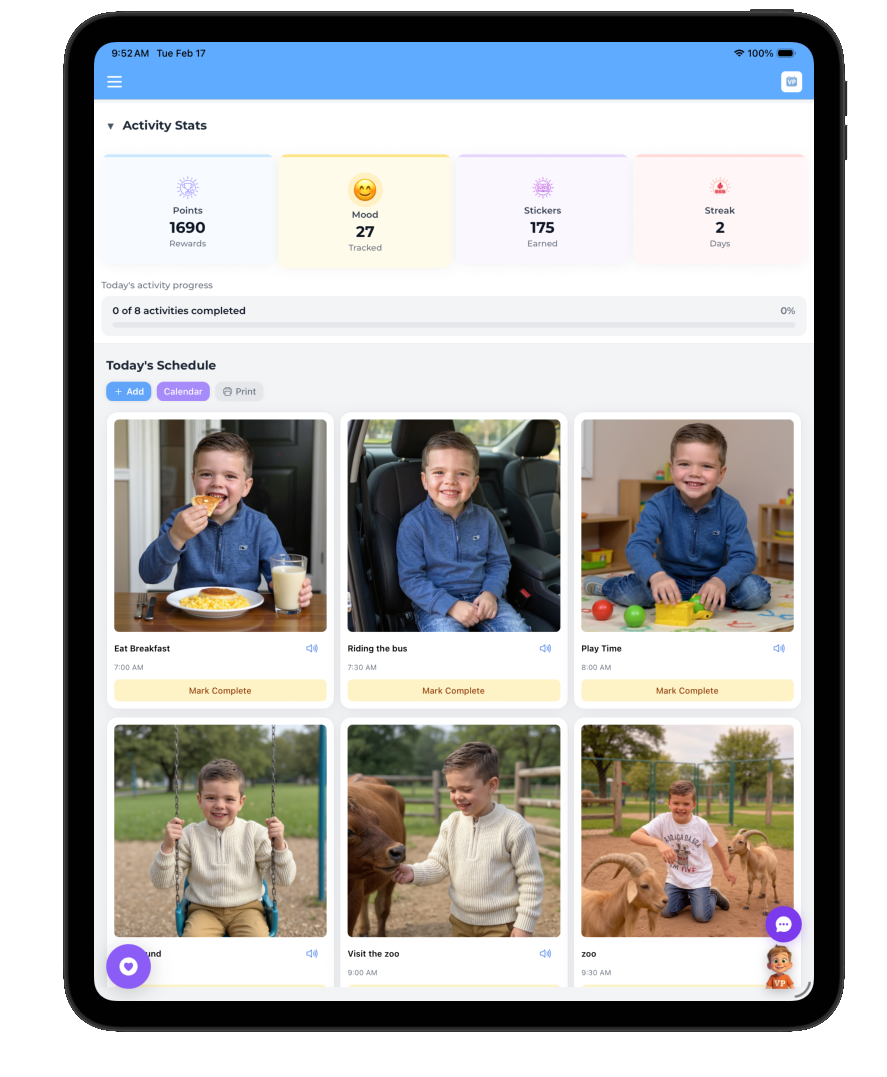
Create a library. Build a collection of custom images that can be reused across different visual supports, the same image of your child brushing teeth can appear in morning routine charts, bathroom visuals, and dental preparation stories.
Beyond Individual Images
AI image generation enables not just individual images but comprehensive visual systems.
Sequential routine images can show your child at each step of a multi-step routine, creating a visual narrative they can follow.
Emotion scales can feature your child's face showing different emotions, helping them identify their own feelings.
Choice boards can show actual options available to your child, their real toys, their real snack options, their real activity choices.
Social narratives can tell complete stories with consistent characters that look like the people in your child's life.
Accessibility and Equity
AI-generated images address a long-standing problem in visual supports: representation.
Diverse representation. Children from all backgrounds can now see themselves in their visual supports, regardless of race, ethnicity, or physical characteristics.
Disability representation. Images can include mobility aids, hearing devices, glasses, and other assistive technology that are part of your child's daily life.
Family representation. Images can reflect your family structure, whatever that looks like, single parents, same-sex parents, grandparent caregivers, and more.
Cultural representation. Clothing, foods, celebrations, and environments can reflect your family's cultural background and practices.
Privacy Considerations
When using AI image generation, consider privacy and consent.
You do not need actual photos. AI generates new images based on descriptions, you do not need to upload photographs of your child.
Control over sharing. Images you create remain yours to use as you choose, without your child's actual image being stored elsewhere.
Age-appropriate decisions. As children grow, involve them in decisions about how they are represented in their visual supports.
The Future of Personalized Visual Supports
AI technology continues to evolve rapidly. Current capabilities are just the beginning.
Increasing realism will make generated images even more recognizable and effective.
Easier creation will make the technology accessible to more families.
Better integration with other tools will create seamless visual support systems.
More customization options will allow for even more precise personalization.
VizyPlan uses AI to generate personalized images that help your child see themselves succeeding. Start your free trial and experience the power of truly personalized visual supports.