
You are standing in the cereal aisle trying to get through the grocery list while your child is on the verge of a meltdown. You already showed them the visual schedule this morning, but the generic clip art did not look anything like your actual grocery store. The social story you printed from a website showed a different child in a different place doing different things. And the gap between those stock images and your child's real life made the whole preparation feel pointless.
Now imagine a version of that morning where the visual schedule showed your child, in your grocery store, putting the items you actually buy into a cart that looks like the one they will push. That is not a hypothetical. That is what artificial intelligence is making possible right now for families raising autistic children.
AI is not coming to autism support. It is already here. And it is showing up in places you might not expect.
The Numbers Behind the Shift
Before we look at how AI is changing daily life, it helps to understand the scale of what families are navigating.
The CDC's most recent data shows that 1 in 31 children in the United States is now identified with autism spectrum disorder. That is 3.2 percent of all children, up from 1 in 36 just two years ago. Among boys, the rate is 1 in 20. In some states, it is even higher.
These are not small numbers. They represent millions of families who need tools, support, and systems that actually work for their daily lives. And traditional approaches, while valuable, have not been able to scale to meet that demand.
That is where AI comes in. Not as a replacement for therapists, teachers, or parents, but as a tool that multiplies the reach and personalization of support that already works.
A survey of 611 families published in ScienceDirect found that families of autistic children use technology more frequently and across more domains than the general population. Sixty-five percent of autistic children and 57 percent of their families reported that technology had a positive impact on their quality of life. The autism group also showed greater benefits in social, motor, language, and emotion regulation skills from technology use compared to the broader community.
Visual Schedules Got Smarter
If you have been in the autism parenting world for more than a week, someone has told you about visual schedules. And they were right to. The National Clearinghouse on Autism Evidence and Practice recognizes visual schedules as one of only 28 evidence-based practices for supporting individuals with autism. A pilot study found that 88 percent of staff and 78 percent of caregivers reported that picture schedules decreased anxious behaviors in children.
The evidence is clear. Visual schedules work. The problem has always been making them personal enough to actually connect with your specific child.
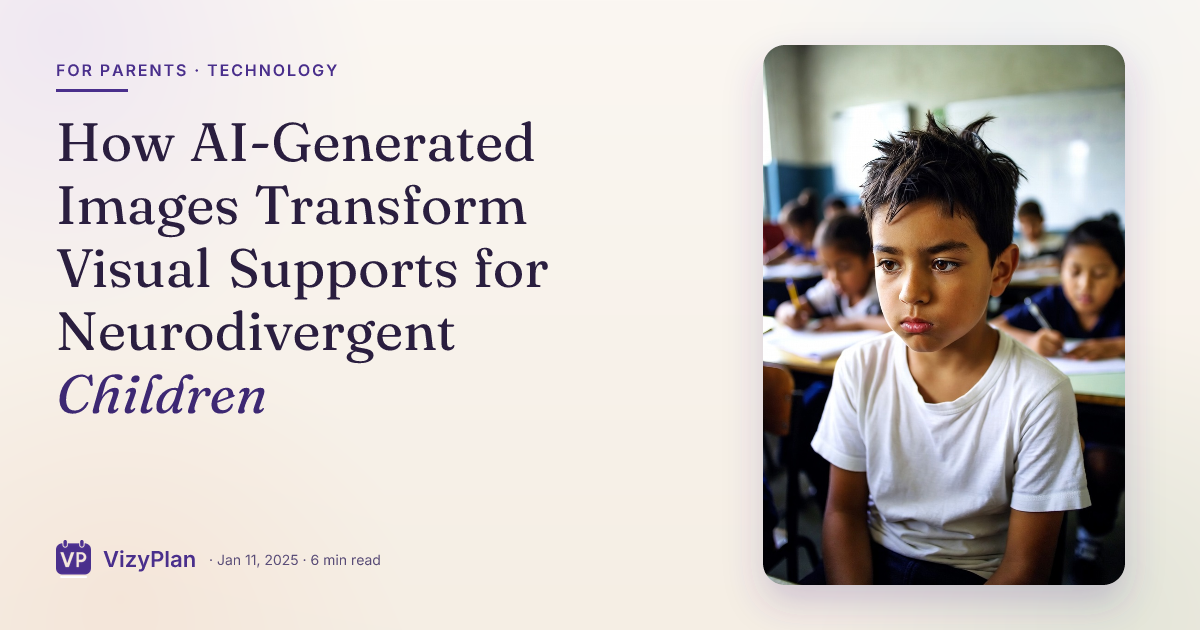
This is where AI changes the equation. Traditional visual supports rely on stock images, clip art, or photos you take and print yourself. AI-powered tools can now generate custom images that match your child's appearance, your home environment, and the specific steps in your family's actual routines. When a child sees themselves in the visual, not a generic cartoon, engagement increases because the connection between the image and real life is immediate.
We built VizyPlan around exactly this idea. Using AI-generated images, families can create visual routines that look like their child's real life, not someone else's. The result is visual supports that children actually look at, follow, and feel connected to.
This is not a niche idea. Alibaba launched an AI-powered tool in 2024 that has been used by over 50,000 people to create picture books for children with autism, generating audio-enhanced visual stories from simple prompts. The demand for personalized, AI-generated visual content for autism support is growing globally.

Communication Tools That Learn and Adapt
For many autistic children, communication is the central challenge of daily life. Whether your child uses spoken language, sign language, picture exchange, or a speech-generating device, the tools available have changed dramatically in the last few years.
AI-powered augmentative and alternative communication (AAC) apps now use predictive language modeling that learns from your child's communication patterns. Instead of scrolling through hundreds of symbols to find the right word, the system learns which words your child uses most in specific contexts and brings them forward. Research on one such system showed a roughly 30 percent reduction in message construction time, which can make the difference between a child communicating their needs and giving up in frustration.
These tools can now recognize not just words but gestures, breathing patterns, and eye movements to predict communicative intent. For children who communicate through non-traditional means, AI is opening doors that did not exist five years ago.
The American Speech-Language-Hearing Association (ASHA) confirms that AAC devices do not slow down speech development. They actually support the production of speech and are used alongside verbal communication, not instead of it. If you have been hesitant about AAC because someone told you it would prevent your child from talking, the research says otherwise.
A tablet-based program called EMooly, which integrates generative AI and augmented reality, was tested in a controlled study with 24 autistic children. The results showed significant improvements in emotion recognition skills, a critical building block for social communication. This matters because understanding emotions in others is one of the skills that families tell us they wish they could support more effectively at home.
Emotion Recognition and Behavior Tracking
One of the most exhausting parts of parenting an autistic child is trying to figure out what triggered a meltdown when your child cannot tell you. Was it the noise? The change in routine? Something that happened at school three hours ago? The detective work is relentless.
AI is starting to help with that detective work in meaningful ways.
Emotion recognition technology using camera-based facial expression analysis and audio pattern detection has reached 90 percent accuracy in research settings. One system achieved real-time detection of seven distinct emotions, and adults with autism were able to adapt to the system in approximately 19 minutes.
For families, this has practical implications. Tracking your child's emotions and behaviors over time can reveal patterns that are invisible in the moment. AI-powered tracking tools are starting to analyze these patterns automatically, identifying connections between environmental triggers and behavioral responses that would take a human observer weeks or months to notice.
In the therapy world, AI-driven analytics in ABA software can now flag when a child is at risk of plateauing or regressing, allowing therapists to adjust strategies before progress stalls. A 12-month observational study of 43 children published in JMIR Neurotechnology found that an AI-based therapy platform was an effective supplement for enhancing therapeutic outcomes across cognitive, social, and developmental domains.
This does not replace the therapist. It gives the therapist better data, faster.
Enjoying this article?
Get practical tips and insights delivered to your inbox — no spam, ever.
Smarter IEPs and Classroom Support
If you have ever sat through an IEP meeting feeling like the goals were too vague, too generic, or completely disconnected from what your child actually needs at home, you are not alone. IEP quality for students with autism varies significantly, and many plans do not adequately prepare students for real-world skills.
AI is changing how IEPs are developed and tracked. Platforms like Expert IEP and EZducate use machine learning to align activities with specific IEP goals, track behavioral patterns, and integrate therapy homework into the school day. Research has found that ChatGPT-assisted IEP goal setting produces goals that are higher quality, more personalized, and more comprehensive across developmental domains.
A 2025 systematic review confirmed that AI-powered adaptive learning systems significantly enhance accessibility and social-emotional development for students with autism, ADHD, and dyslexia. These platforms adjust content, pacing, and delivery in real time based on how a student interacts with the material. For a child who needs more repetition on one concept but can skip ahead on another, this kind of personalization was previously impossible without one-on-one instruction.
AI is also showing up in pre-employment transition services, helping autistic youth build career readiness skills before they face the services cliff after high school. This is especially important given that employment rates for autistic adults remain far below those of the general population.
Your Home Is Getting Smarter Too
Some of the most practical AI applications for autism families are the simplest ones.
Voice assistants can send reminders for daily tasks, prompt routine steps, and help children manage their own schedules with simple voice commands. For a child who struggles with the multi-step process of getting ready in the morning, a smart speaker that walks them through each step, brush teeth, get dressed, pack backpack, can build independence without requiring a parent to stand over them repeating instructions.
Smart lighting systems with customizable brightness and color temperature are becoming a key accommodation for families managing sensory sensitivities. Adjustable LED lights that minimize glare and flickering, which are particularly disruptive for individuals with sensory differences, can reduce the environmental triggers that contribute to meltdowns.
Smart thermostats, white noise machines, and programmable environments all serve the same purpose: creating predictable, controllable spaces that reduce anxiety. For families where a change in the room's lighting or temperature can cascade into a difficult afternoon, these tools offer meaningful relief.
AI in Diagnosis: Earlier Answers for Families
One of the most significant developments is happening before families even begin building daily routines.
Cognoa's Canvas Dx became the first FDA-authorized AI-based diagnostic aid for autism, designed to help diagnose or rule out autism in children ages 18 months to 6 years. Instead of waiting months or years for a specialist evaluation, the system analyzes caregiver questionnaires, physician observations, and video of the child to provide faster answers.
A separate tool from Duke University, SenseToKnow, correctly detects autism 88 percent of the time using a digital screening app. For families who are navigating the often agonizing wait for a formal diagnosis, AI-powered screening tools can provide earlier indicators that allow parents to begin support sooner rather than later.
Earlier identification means earlier intervention. And the research on early intervention is unambiguous: starting support before age three is associated with significantly better outcomes in communication, daily living skills, and social engagement.
What AI Cannot Do
Honesty matters here. AI is a tool, not a savior. And it comes with real limitations that every family should understand.
AI does not replace human connection. No app, algorithm, or smart device substitutes for the relationship between a child and their therapist, teacher, or parent. The most effective autism interventions are relational. AI can enhance those relationships by providing better tools, better data, and more personalized support, but it cannot replace the human being delivering the care.
Privacy deserves serious attention. Stanford's 2025 AI Index Report found that AI-related data privacy risks surged 56 percent. When AI tools collect data about your child's behavior, communication patterns, or daily routines, that data needs to be protected. Before adopting any AI-powered tool, understand how your child's data is stored, who has access to it, and whether it can be deleted.
Screen time still matters. The American Academy of Pediatrics now focuses more on content quality than strict time limits, but the principle holds: technology should supplement face-to-face interaction, not replace it. For families using AI-powered visual supports, first-then boards, or social stories, the goal is to use the tool to prepare for real-world situations, then put the device down and live them.
AI bias is a real concern. If an AI system was trained primarily on data from one demographic, it may not work equally well for all children. Families and providers should watch for tools that do not reflect their child's background, culture, or communication style.
The American Occupational Therapy Association has cautioned against technology designed to "normalize" autistic behaviors, noting that support should focus on autonomy and quality of life rather than enforcing neurotypical standards. This is an important distinction. The best AI tools meet your child where they are, rather than trying to make them someone they are not.
What This Means for Your Family
You do not need to adopt every new technology that appears. You do not need a smart home filled with sensors and cameras. You do not need to turn your parenting into a data science project.
What you can do is pay attention to the tools that solve the specific problems your family faces. If mornings are the hardest part of your day, an AI-powered visual schedule that shows your child their actual routine in images they connect with might make more difference than any other single change. If communication is the barrier, an AAC app with predictive capabilities might unlock conversations you did not think were possible yet. If you are drowning in IEP paperwork, an AI-assisted platform might help you advocate more effectively for your child.
The families who benefit most from AI are not the ones who use the most technology. They are the ones who choose the right tools for their specific challenges and use them consistently.
VizyPlan was built by a parent navigating this same journey. We use AI to create the personalized visual routines and social stories that research shows make a real difference, because every child deserves to see themselves succeeding in their own day. Not a stock photo child. Not a clip art version of someone else's life. Their life.
The technology is here. The evidence supports it. And your family deserves tools that actually work.
VizyPlan uses AI-generated images to create personalized visual routines for neurodivergent children. Start your free trial and see what happens when your child's schedule finally looks like their real life.