
Value-based care in autism therapy has moved from conference panels to contract language faster than most practice owners expected. The fee-for-service model that paid for hours of treatment is giving way to one that asks a harder question. What did the child actually gain? Payers and the investors behind large provider groups increasingly want proof of progress, not a log of hours billed. For clinicians who got into this work to change lives, the shift is uncomfortable and also an opening.
What value-based care in autism therapy actually measures
The outcome measures gaining traction are the ones you already track in some form. Skill mastery rates, goal attainment scaling, reductions in challenging behavior, functional and daily-living skill gains, and parent satisfaction are all on the table. As Jim Spink, CEO of Autism Care Partners, put it, standardized data sets are necessary to be a value-based provider. The warning underneath that statement matters. If providers do not define the outcomes that count, payers will define them instead.
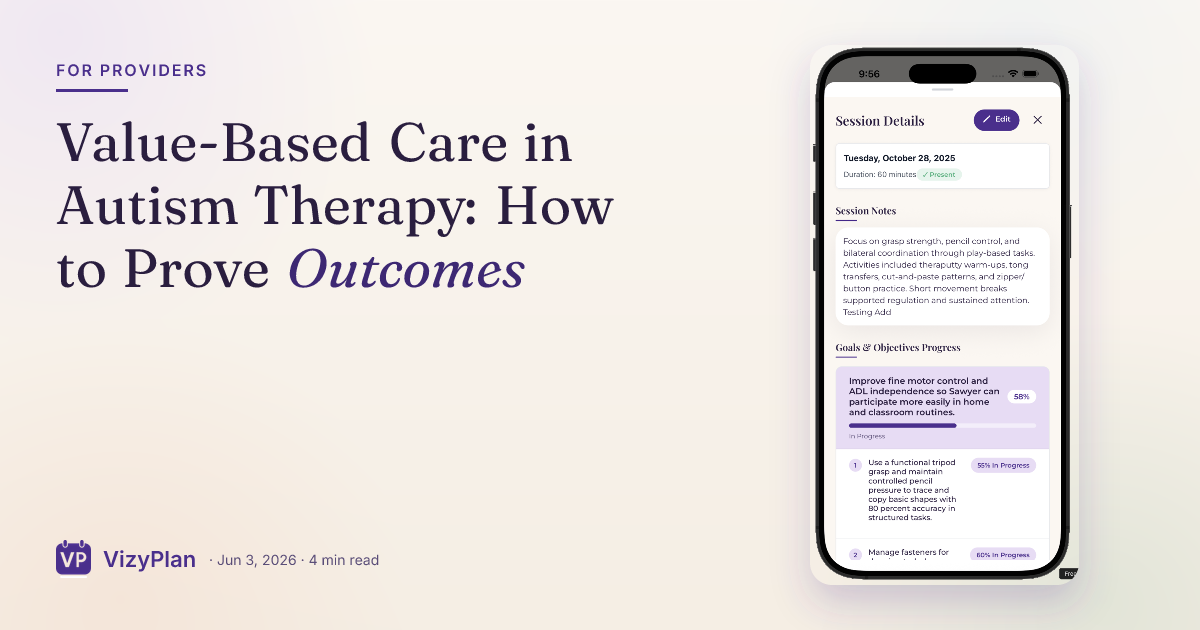
The field has an unusual advantage here. ABA already collects trial-by-trial data during sessions, which means autism therapy may hold one of the most robust outcome data infrastructures in all of behavioral health. The data exists. The question is whether it tells the story payers are asking about.
Why generalization is the outcome that is hardest to prove
The outcome that matters most to a family, and increasingly to a payer, is whether a skill shows up outside the therapy room. A child who masters a request at the table but cannot use it at home has not generalized the skill. Generalization is also the hardest thing to document, because most of it happens where the clinician is not. We have written before about why progress stalls at the front door and why social stories fall apart between sessions. The same gap that frustrates families is the gap a value-based contract will measure.
The practical move is to build generalization evidence into the plan instead of hoping it appears. A parent-run home routine, pulled directly from the active goal and practiced in a few minutes a day, produces exactly the cross-setting data a value-based model rewards.
VizyPlan turns a clinical goal into a visual routine the family runs at home. The child sees themselves doing the step, the family runs the rhythm, and the carryover becomes visible. The clinical work stays yours. The generalization story finally has data behind it.
Enjoying this article?
Get practical tips and insights delivered to your inbox — no spam, ever.
Download VizyPlan and start your 7-day free trial today. See what your families would run between sessions. Just $6.99/month after your trial, no credit card required upfront.
VizyPlan was built by an autism dad and an autism mom who is a licensed speech-language pathologist who needed something that did not exist. Start your free trial.