
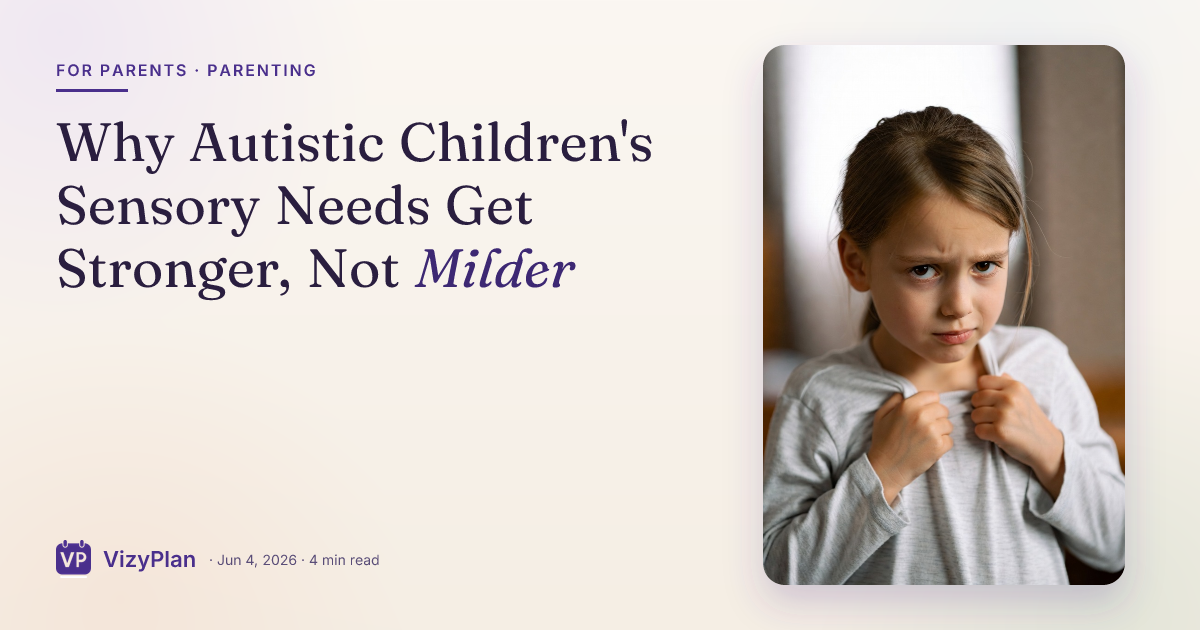
Somewhere in the first year after a diagnosis, many parents are quietly reassured that their child will grow out of it. The covering of the ears at the hand dryer, the refusal of the tag-in seams, the meltdown in the bright grocery aisle. Give it time, the thinking goes, and the world will feel less loud. A large study following more than 1,500 children suggests the opposite is closer to the truth. Autistic children's sensory needs tend to get stronger over time, not milder, and understanding why changes how you build the day around them.
What the research found about autistic children's sensory needs
Researchers at the USC Chan Division and the University of North Carolina at Chapel Hill followed more than 1,500 children born in North Carolina for six years, publishing their findings in the journal Child Development. Children who were autistic, or who showed autistic traits, had sensory patterns that intensified as they grew. Non-autistic children, by contrast, stayed relatively steady. The differences were not a phase fading on a timeline. They were a feature deepening on one.
The team also found that sensory differences may appear before the social and communication differences more commonly associated with autism. As lead author Yun-Ju Chen described it, early sensory differences may cascade into the more definitive features of autism over time. Sensory processing is not a side issue. For many children it is the ground floor.
What this changes about how you build the day
If sensory needs strengthen rather than fade, the goal is not to wait them out. The goal is to build durable accommodations into the ordinary day so your child spends less energy bracing against the environment and more on everything else.
- Treat sensory supports as permanent infrastructure, not training wheels. Noise-reducing headphones, seamless clothing, and a low-stimulation corner are not crutches to remove later.
- Make the day predictable. A child who knows what is coming spends less of their sensory budget on uncertainty. Our guide to building sensory processing into daily routines breaks this down.
- Watch for the quiet signals. Interoception and sensory load overlap. Our post on interoception and body awareness covers the cues that come before the meltdown.
VizyPlan lets you build a predictable, low-surprise day your child can see in advance, with their own photos in their own spaces. When the day is visible, the sensory system has one less unknown to brace against.
Enjoying this article?
Get practical tips and insights delivered to your inbox — no spam, ever.
Download VizyPlan and start your 7-day free trial today. Build a calmer, more predictable day for your child. Just $6.99/month after your trial, no credit card required upfront.
VizyPlan was built by an autism dad who needed something that did not exist. Start your free trial.