You have seen the headlines. Autism is at the center of a national conversation unlike anything in recent memory. Promises of new research. Debates about causes. Funding changes that could reshape the services your family relies on. It is a lot to take in, especially when you are already navigating the daily realities of raising a neurodivergent child.
No matter where you fall on the political spectrum, one thing is true: your child still needs support today. And the noise coming from Washington can make it hard to figure out what actually matters for your family right now.
Let us cut through it.
What Is Happening Right Now
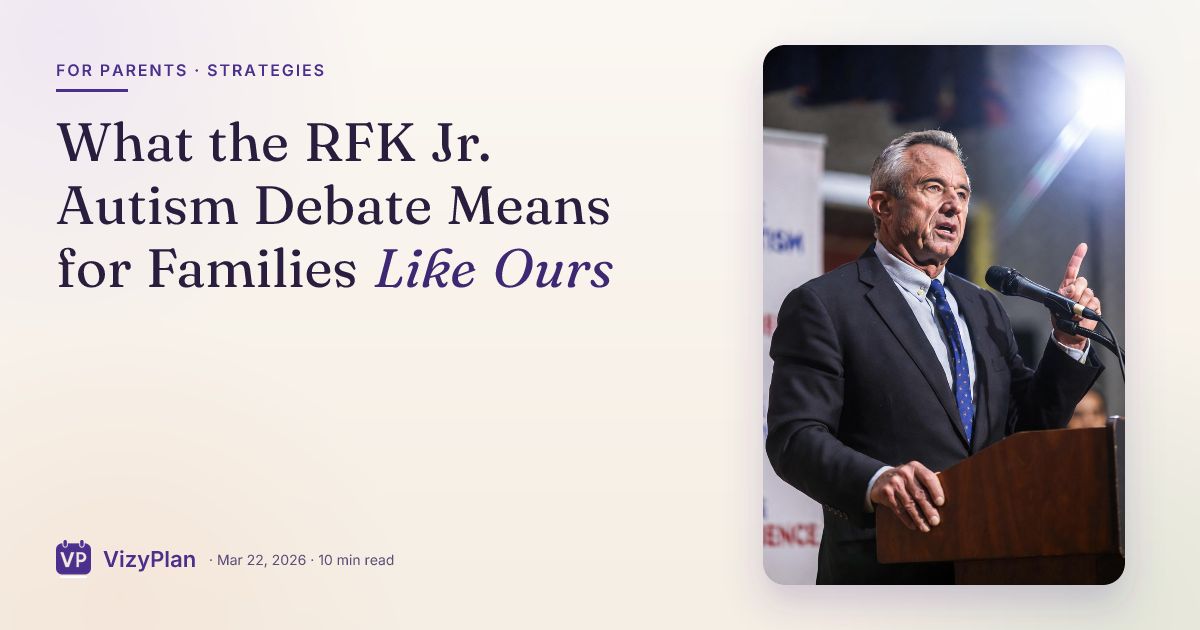
Since taking the role of HHS Secretary, Robert F. Kennedy Jr. has placed autism at the center of federal health policy in ways that have drawn both praise and criticism.
In April 2025, the administration announced a large-scale research initiative to explore environmental causes of autism, including food additives, pesticides, medications, and prenatal factors. Kennedy pledged to have preliminary answers by September 2025, a timeline later pushed to March 2026.
The initiative drew national attention. It also drew controversy. A proposed national autism registry was introduced and then withdrawn after more than 80 organizations raised privacy concerns. NIH spending on autism-related research fell 26 percent in the first four months of 2025, dropping from $147 million to $116 million. The Interagency Autism Coordinating Committee was overhauled with entirely new members, some of whom hold views that diverge from established scientific consensus.
In response, leading autism researchers formed an independent panel called the Independent Autism Coordinating Committee, which held its first meeting on March 19, 2026.
Meanwhile, Congress approved nearly $1 trillion in Medicaid cuts over the next decade. For many families raising autistic children, Medicaid is the primary payer for therapy services.

Where Parents Stand
This is where it gets personal. And this is where honesty matters most: parents are not a monolith. Families in the autism community hold a wide range of views, and all of them come from a place of love for their children.
Some parents welcome the attention. A KFF/Washington Post survey from October 2025 found that roughly 4 in 10 American parents identify with the "Make America Healthy Again" movement. Many of these parents feel that rising autism rates have not been taken seriously enough and that environmental factors deserve more investigation. They appreciate that someone in a position of power is treating autism as a national priority, and they want research into questions they feel have been dismissed.
Other parents are deeply concerned. Advocacy organizations including the Autism Society of America, the Autistic Self Advocacy Network, and the Autism Science Foundation have raised alarms about research funding cuts, the framing of autism as something to be "prevented," and the appointment of advisory panel members whose views conflict with the existing body of research. Many autistic adults and their families worry that the current direction could set back decades of progress on acceptance and inclusion.
And many parents are simply exhausted. They are not tracking the politics. They are tracking therapy waitlists, IEP meetings, and how many meltdowns happened before 9 AM. For these families, the debate in Washington feels disconnected from what they actually need: shorter waitlists, affordable services, and tools that help their child get through the day.
All three of these perspectives are valid. All three exist in the same community. And the truth is, you do not have to pick a side to take care of your child.
What Science Tells Us About Autism's Causes
The scientific picture is complex, and being honest about that complexity is important.
Research consistently shows that autism is 60 to 90 percent heritable. Genetics are the primary contributing factor, with hundreds of genes implicated across large-scale studies. A major 2025 study from Princeton identified biologically distinct subtypes of autism with different genetic backgrounds, suggesting that autism may not be a single condition but several related ones with different underlying biology.
At the same time, researchers acknowledge that some portion of the increase in prevalence may reflect genuine growth, and environmental factors during pregnancy and early development continue to be studied. A Danish study found that 60 percent of the rise in autism diagnoses among children born between 1980 and 1991 was explained by changes in diagnostic criteria and reporting practices. The remaining portion is still being investigated.
The CDC now identifies 1 in 31 children as having autism spectrum disorder. Most experts attribute the rising numbers primarily to broadened diagnostic criteria, improved screening, greater awareness, and better access for underserved communities. But the scientific community supports continued research into all contributing factors, including genetic, environmental, and prenatal influences.
What researchers broadly agree on is that the debate about causes should not delay the support that children and families need right now.
What Actually Matters for Your Family
Regardless of where you stand on the political debate, here is what directly affects your daily life.
Medicaid Funding Is the Biggest Immediate Concern
Nearly $1 trillion in Medicaid cuts were approved by Congress, set to take effect at the end of 2026. Medicaid is the primary payer for autism services for many families, covering therapies that private insurance often limits or excludes entirely.
Several states are already pulling back. North Carolina attempted a 10 percent rate cut for ABA providers. Nebraska cut provider payments by nearly 50 percent. Additional cuts are being considered in Colorado and Indiana. ABA therapy without insurance runs $120 to $150 per hour, and the estimated lifetime cost of raising a child with autism ranges from $1.4 to $2.4 million.
If your child receives therapy through Medicaid, now is the time to understand your state's specific plans. Contact your state representative. Reach out to organizations like Autism Speaks or your state's Autism Society chapter for advocacy toolkits. This is not a partisan issue. Families across the political spectrum rely on these services. We covered financial resources in detail in our guide to autism funding and programs.
Enjoying this article?
Get practical tips and insights delivered to your inbox — no spam, ever.
Research Funding Has Been Reduced
NIH autism research funding dropped 26 percent in early 2025. The Department of Defense, which previously directed $15 million annually toward autism research, did not include autism among its funded programs. More than 50 autism-related studies lost funding, and over half of surveyed researchers reported that they or colleagues in their lab could lose their jobs.
Whether you believe the administration's research priorities are moving in the right direction or the wrong one, the reduction in overall funding is a measurable reality. Less research means slower progress on the questions all families share: What supports work best? How do we identify autism earlier? What interventions lead to the strongest outcomes?
Special Education Services Face Uncertainty
IDEA funding, which supports special education services in public schools, faces potential restructuring. Medicaid reimbursements that schools depend on for speech therapy, counseling, and occupational therapy are also at risk. If your child has an IEP or 504 plan, staying connected with your school district about how federal changes might affect local services is important.
Early Intervention Remains the Strongest Evidence We Have
Here is the one thing every researcher, every advocacy organization, and every clinician agrees on, regardless of their position in the broader debate: early intervention works.
A systematic review of multiple studies found that early intensive behavioral interventions before age three are associated with IQ improvements of 9 to 15 points and significant gains in communication and daily living skills. The National Clearinghouse on Autism Evidence and Practice recognizes 28 evidence-based practices for autism, including visual schedules, structured routines, social stories, and reinforcement systems.
The political debate about what causes autism may take years to resolve. The evidence about what helps autistic children thrive is already here.
What You Can Do Right Now
You do not have to wait for Washington to act. Here is what is within your control today.
Build structure at home. Visual schedules reduce anxiety and increase independence for neurodivergent children. First-then boards help with transitions. Social stories prepare your child for new or challenging situations. These are not just nice-to-have tools. They are evidence-based practices supported by decades of research.
Track patterns. Monitoring your child's emotions and behaviors gives you data to bring to therapy sessions, school meetings, and medical appointments. Pattern tracking turns "I feel like things are getting harder" into "Here is exactly what is happening and when."
Advocate locally. Your child's school, your state legislature, and your insurance company are the decision-makers who most directly affect your family. Know your rights under IDEA. Attend school board meetings. Call your state representative about Medicaid funding. The most effective advocacy happens close to home.
Protect your own wellbeing. Research shows that 45 percent of autism caregivers experience depressive symptoms. One in five is at risk for burnout. Caregiver burnout is not a sign of weakness. It is a predictable consequence of sustained stress without adequate support. Getting help for yourself is getting help for your child.
Stay informed, but set boundaries. The news cycle around autism is intense right now. It is okay to limit your media consumption. It is okay to step away from social media threads that leave you feeling worse instead of better. Stay informed about the policy changes that directly affect your family, but do not let the broader debate consume the energy you need for your child.
Connect with other families. Whether through local support groups, online communities, or the parent sitting next to you in the therapy waiting room, connection matters. Isolation is one of the most common experiences parents report after an autism diagnosis, and it does not have to stay that way.
The Debate Does Not Define Your Family
Autism is in the headlines for many reasons right now. Some of those reasons could lead to positive change. Some could make things harder. Most families will not know the full impact for years.
But here is what we do know. Your child is the same child they were before the debate started. They still light up at the things that bring them joy. They still need the same patience, structure, and love they needed yesterday. And the tools that help them, the visual supports, the predictable routines, the patient repetition of skills, those do not change with election cycles or policy shifts.
One in 31 children is now identified with autism. That number represents millions of families who are showing up every single day. You are part of that community. And you and the parent who disagrees with you politically have far more in common than you might think. You both stayed up too late last night. You both worry about the future. And you both want the absolute best for your child.
Start there.
VizyPlan helps you build the daily structure and visual supports that research shows make a real difference for neurodivergent children. Start your free trial and give your child evidence-based tools today, because your family does not have to wait for Washington to act.