

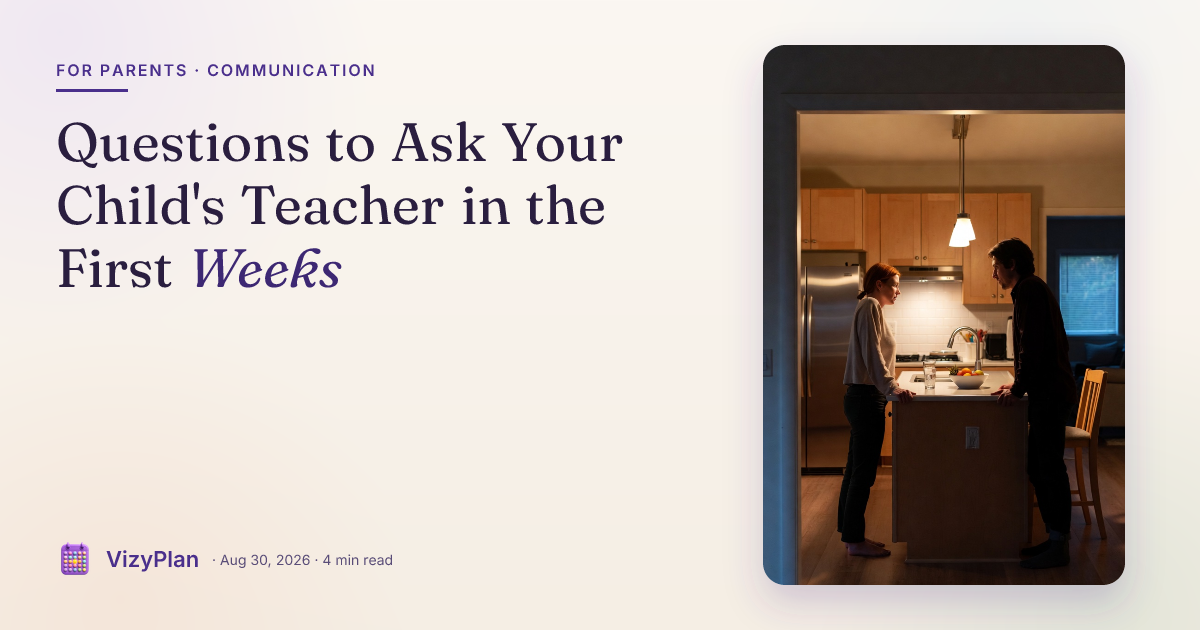
How are they doing? Great, thanks! And the conversation is over, both of you smiling, neither of you informed. There are better questions to ask your child's teacher, and the first weeks of school are exactly the time to use them.
The problem is not the teacher and it is not you. Vague questions produce vague answers, especially in September, when the teacher is still learning thirty names. The right questions are specific enough to answer, short enough to respect a teacher's time, and designed to open a channel instead of closing one. That channel is worth building deliberately: a meta-analysis of family school engagement interventions found that structured efforts to build two-way communication measurably improve the parent teacher relationship itself, and decades of research tie family engagement to better achievement, behavior, and attitudes toward school.
Eight questions to ask your child's teacher
- What time of day seems hardest for him? Difficulty at school is rarely uniform. This answer often points straight at a hunger, transition, or sensory pattern you can actually address.
- What does she do when she is stuck? Ask for help, freeze, wander, melt down? The stuck behavior is the skill gap worth working on at home.
- Who does he gravitate toward? Friendship seeds are visible to teachers weeks before kids can name them. You want to know the moment one sprouts.
- What do you see right before things go wrong? Every child broadcasts a warning signal. A teacher who is asked this question starts watching for it, which is half the intervention.
- What is one thing she does well that surprised you? Strengths get invisible in files full of deficits. Make the teacher say one out loud early; it changes how they see your child all year.
- How do you prefer to hear from me, and how often? Email, app, a Friday note? Matching the teacher's channel doubles the odds the channel gets used.
- What is one thing about him the file does not say? Then tell them: the interest that unlocks him, the phrase that calms him, the thing that looks like defiance but is panic. Teachers act on this for years.
- What does a good day look like in your room? Now you know the target the teacher is steering toward, and you can name good days at home when they happen.
Make it a channel, not an interview
Pick three questions, not all eight, and offer something back: a photo of the home routine, a one paragraph user manual for your child, an honest we are working on mornings, tell me what you see. The research is clear that partnership, two adults trading information, beats one-way updates. If the daily report you get from your child is a single word, our post on when fine is the only answer pairs well with this one, and home school communication that works covers the system side. When the answers you get back raise bigger questions, it may be time to request an IEP meeting.
VizyPlan was built by an autism dad and an autism mom who is a licensed speech-language pathologist so the home picture is something you can show a teacher, not just describe from memory.
Enjoying this article?
Get practical tips and insights delivered to your inbox — no spam, ever.
Download VizyPlan and start your 7-day free trial today. Bring the teacher a picture of home that is worth a thousand updates. If it helps, keep going for $6.99/month or $59.99/year.
VizyPlan was built by an autism dad and an autism mom who is a licensed speech-language pathologist who needed something that did not exist. Start your free trial.