
Your three-year-old walks up to you in the kitchen and says, in the exact voice of a Bluey character, "Want to play, Dad?" An hour later, when the iPad runs out of battery, they melt down and yell, "It is broken, it is broken, it is broken," in the cadence of a YouTube clip you have heard a hundred times.
If you have been told this is "non-functional language" or that your child has a "language delay" because they cannot reliably name a single object, this post is for you.
What you are seeing has a name. It is called gestalt language processing. And once you understand it, almost everything your child says starts to make sense.
What Gestalt Language Processing Actually Means
Most kids learn language one piece at a time. They start with single words like "ball" or "milk," then string two words together, then three, and slowly build sentences. This is called analytic language development, and it is the model nearly every parenting book, pediatrician chart, and speech goal is built around.
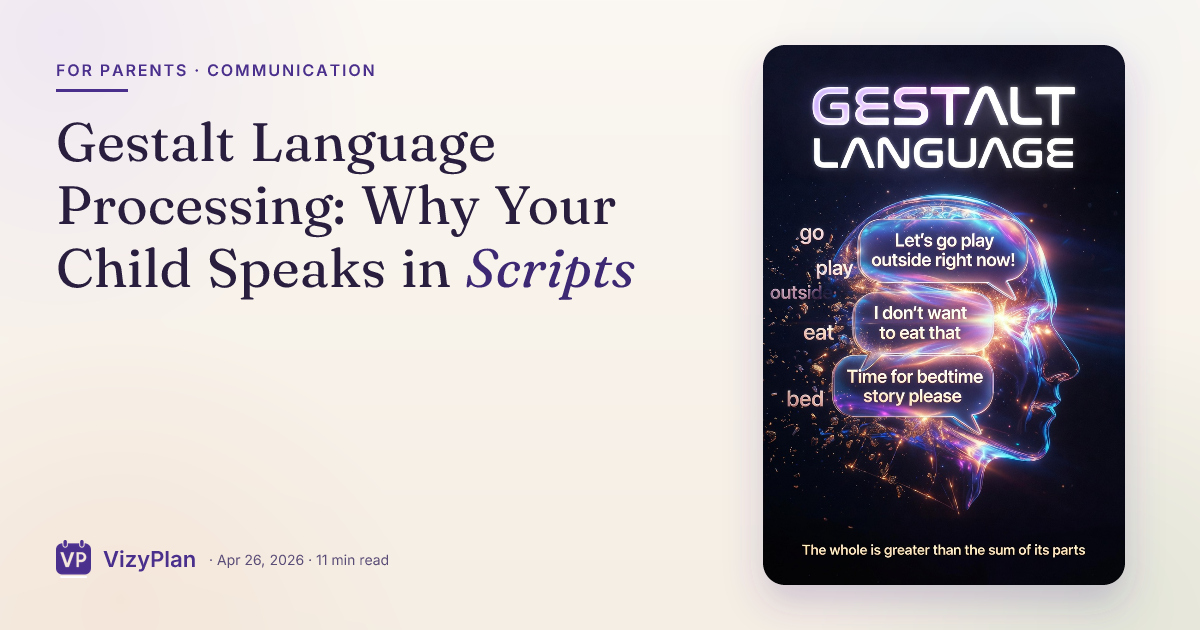
But many children, especially autistic children, do not learn this way. They acquire language in chunks. Whole phrases, full sentences, entire songs, memorized as single units. Then, slowly, they break those chunks down into smaller pieces and start to recombine them.
That is gestalt language processing. The word gestalt comes from a German word meaning "whole" or "form." The child is processing language as a whole shape rather than as a series of individual parts.
This idea is not new. Researcher Ann Peters described two language acquisition styles in the 1980s. Speech-language pathologist Barry Prizant studied echolalia in autistic children and showed that what looked like meaningless repetition actually served at least 14 different communicative purposes. More recently, SLP Marge Blanc built on this work in her 2012 book Natural Language Acquisition on the Autism Spectrum, where she described six developmental stages that gestalt processors move through on the way to flexible, original speech.
The framework went mainstream in parent communities and on SLP social media over the past few years. It is now one of the most-discussed topics in autism speech-language work, and it has changed how a lot of families understand what their kids are doing.
The Six Stages, in Plain Language
Marge Blanc's protocol describes six stages of gestalt language development. You do not need to memorize them, but understanding the arc helps you see where your child is and what comes next.
Stage 1: Whole Gestalts. Your child speaks in long memorized chunks. A line from Frozen. A phrase from Mom. The opening of a song. They might not have many useful single words yet, but they are saying entire sentences with strong rhythm and intonation. It can sound like fluent speech, which makes it confusing when the same child cannot reliably ask for water.
Stage 2: Mitigated Gestalts. Your child starts mixing and trimming the chunks. Two scripts get smashed together. A phrase loses its tail. You hear "Let it go" combined with "Time to brush teeth" and you realize they are starting to manipulate the pieces.
Stage 3: Single Words and Two-Word Combinations. The chunks have been broken down enough that single words start coming out as standalone units. Your child uses "open" or "more" or "go" the way another child might have at age one. Then two-word combinations show up, often surprising and original. This is a huge breakthrough, even though it can look like a child who "should be talking more by now" finally catching up.
Stage 4: Beginning Original Sentences. Your child puts together their own short sentences. Grammar is loose. Verb tenses get mixed. But the words are theirs, generated for the moment, not pulled off a memorized track. "I want juice" becomes possible.
Stage 5: Complex Sentences with Developing Grammar. Sentences get longer. Plurals appear. Past tense shows up. Your child can talk about what happened yesterday, what might happen tomorrow, what someone else did across the room.
Stage 6: Original Speech with Complete Grammar. Self-generated, grammatically complete language. The path from echolalia to here is long, and not every child reaches stage six in the same timeline. But many do, and many of them end up sounding nothing like the early days of memorized scripts.
The key insight: progress in this model does not look like single words building into sentences. It looks like big chunks getting smaller, then more flexible, then original. The order is reversed from what most milestone charts assume.
How to Recognize a Gestalt Language Processor at Home
Some kids fit this profile clearly. Others are subtle. Here is what parents and SLPs commonly notice.
They speak in long phrases before they have many single words. A two-year-old who can say "To infinity and beyond" but cannot reliably say "milk" is not failing at language. They are processing it differently.
The intonation is unmistakable. Gestalt processors are sometimes called "intonation babies" because they pick up the music of language before the lexicon. Your child sounds exactly like the character or person they learned the phrase from. The melody is the giveaway.
Songs come before speech. Many gestalt processors sing before they reliably talk. Theme songs. Lullabies. Commercial jingles. The whole song comes out fluently, then breaks down into pieces over time.
Scripts seem random until they are not. Your child quotes a movie line that has nothing to do with what is happening. But if you start watching, you might notice they only quote that line when they feel a specific way. The script is doing emotional work. It is communication, just not the kind we expect.
They use media to communicate. Your child opens YouTube to a specific video clip when they feel a certain way. They navigate to a particular scene to show you what they need. The media is the language.
Single words feel "stuck." Some children pick up single words but cannot combine them. The word sits there, used to label things, but not used in sentences. This is a clue that the child may be a gestalt processor whose system is wired for chunks, not single-word building blocks.
What to Do Right Now
You do not need a clinical credential to start supporting a gestalt processor. The basic moves are simple, and most of them are about what you stop doing as much as what you start.
Listen for the function, not the words. When your child says a script, ask yourself what they might be communicating. Are they tired? Hungry? Excited? Overwhelmed? Anxious? The same script can carry different meanings in different moments. Track which scripts come up where, and patterns emerge.
Respond to intent. If your child says "Time to go home" while they are playing happily at the playground, they may not be saying they want to leave. They might be saying they feel anxious about what comes next. Reply to what you think they mean. "You sound a little worried. We have ten more minutes here, then we will go home."
Reduce questions, increase comments. Questions feel like a quiz to a child who is processing language as whole chunks. They have to find the right verbal token to send back, which is a huge ask if the tokens are still locked inside larger gestalts. Narration is easier. Instead of "What do you want to do?" try "I see you got the blocks out. The red one is on top." Comments give your child language to absorb without demanding a verbal response.
Use "we" instead of "you" or "I." Pronouns are notoriously tricky for gestalt processors. If you model with "you" pronouns, your child will repeat the script back exactly, and end up saying "you want a snack" when they mean "I want a snack." Modeling with "we" keeps the language usable in either direction. "We can have a snack" works for both of you.
Model short, useful gestalts. Your child is going to acquire language in chunks anyway. Give them chunks that are short, functional, and easy to flex. "Let us go." "All done." "I need help." "More, please." These are gestalts your child can reuse across many situations.
Do not try to eliminate scripting. This is the biggest mindset shift for many parents. The scripts are not noise to filter out. They are your child's vocabulary at this stage, and they will eventually break down into more flexible pieces if your child has the time and space to do that work. Interrupting or redirecting echolalia teaches your child that their communication is not welcome, which makes the whole process harder.
Track which scripts show up when. A simple note in your phone or an emotion log can reveal a lot. The line your child quotes when they need a hug. The phrase that comes out when the lights are too bright. The song they sing when transitions are coming. Once you see the patterns, you can respond to the underlying need before the script has to do all the work.
Enjoying this article?
Get practical tips and insights delivered to your inbox — no spam, ever.
How Visual Supports Help Gestalt Processors
This is where the day-to-day mechanics of family life come in. Gestalt processors often have less spare bandwidth for figuring out what is happening next, which means visuals do extra heavy lifting.
A clear visual schedule reduces the cognitive load of guessing what comes next. When your child can see the day laid out, they need fewer scripts to manage uncertainty. The schedule itself becomes a shared reference, and you can say things like "First snack, then park" and point, instead of relying on long verbal explanations.
Social stories give your child new useful gestalts in a low-pressure way. A short story about going to the dentist, written in the voice and rhythm your child already responds to, hands them ready-made scripts they can pull out when the moment comes. You are not eliminating their scripting. You are expanding the script library with phrases that fit the situations they actually face.
First-then boards and choice boards break communication into small visual pieces, which works beautifully for kids whose verbal output is still mostly scripts. They give your child a way to make a request or a decision without having to find the right gestalt under pressure.
The Honest Part About Evidence
I am going to be straight with you, because you have probably seen this framework presented as either the answer to everything or as pseudoscience, and the truth lives somewhere in the middle.
The original idea that echolalia is communicative is well-supported. Prizant's work on this has been cited and replicated for decades, and you would be hard-pressed to find a current SLP who would tell you to ignore your child's scripts.
The specific six-stage protocol from Marge Blanc, the Natural Language Acquisition framework, has not yet been studied in controlled, peer-reviewed intervention trials. A 2024 systematic review presented at the American Speech-Language-Hearing Association found no full-text intervention studies on the protocol itself. Some clinicians have raised real concerns about specific recommendations and goal-writing within the framework. Other clinicians who use it report meaningful progress with their clients.
What this means for you, as a parent: the broad ideas, that echolalia has meaning, that scripts are communication, that your child is doing real language work in their own way, are well-grounded. The very specific stage-by-stage protocol is newer and less validated. Many SLPs use a flexible blend of GLP-informed strategies and other evidence-based approaches.
If you are looking for an SLP, ask whether they understand gestalt language processing and how they incorporate it. If you are evaluating advice you see online, look for the warm, child-led, function-focused suggestions and be cautious of anything that promises a fixed timeline or dismisses individual variation.
You do not need to commit to a clinical position. You just need to see your child more clearly, and respond to the language they actually have.
What My Son Taught Me About Scripts
My son was nonverbal until age two. When language started coming, it came in chunks. Lines from his favorite shows. The exact phrasing his early intervention therapist used. Songs. For a long time, well-meaning people would tell me he was "just repeating" and that we needed to redirect to "real" language.
He was speaking real language. We were the ones not listening.
The day I realized this, he was lining up cars on the floor and saying "Five, six, seven, eight" in the rhythm of a counting song. I almost ignored it. Then I noticed he was actually counting his cars. The script was carrying real meaning. It was just borrowed packaging.
That moment changed how I parented. I stopped trying to translate his scripts into "proper" speech and started listening for what they were doing for him. The redirecting stopped. The narrating started. We added visual schedules, emotion tracking, and short modeled phrases he could borrow. Within months, the scripts started bending. Pieces broke off. New combinations showed up. He was doing the work all along. He just needed us to stop interrupting it.
Where to Go From Here
If you suspect your child is a gestalt language processor, here is what I would do, in order.
Read the echolalia companion post. It pairs with this one and goes deeper into the communicative functions of scripting.
Watch your child for a week. Note the scripts. Note the contexts. Note the intonation. You will start to see the system.
Stop redirecting. Replace it with comments, narration, and "we" language.
Build out your visual supports. A predictable day with calmer transitions gives your child more bandwidth for language work.
Talk to your SLP. If you are on a therapy waitlist, use the time to learn what stage your child is in and try the at-home strategies above. If you have an SLP, ask how they support gestalt language processors and how they think about your child specifically.
Be patient. Gestalt language development can move slowly, then suddenly. Children sit at one stage for months, sometimes longer. Then a piece breaks off, a chunk recombines, and progress shows up in a rush. Your job is not to push the timeline. It is to keep the conditions right.
Your Child Is Already Talking
The hardest thing about being the parent of a gestalt processor is that the world will keep telling you your child has a language delay. The world is using the wrong yardstick. Your child has been talking the whole time. They have been telling you what they need, what they feel, what they are afraid of, in the language they have. Movie lines and song lyrics and YouTube scripts and that one thing Grandma said three months ago.
Once you start listening differently, you will hear them.
That is the shift. That is what gestalt language processing offers, more than any specific stage chart or protocol. The permission to listen to your child the way they are actually speaking, instead of the way you were taught to expect.
Your child is communicating. You just learned a new language.
Download VizyPlan and start your 7-day free trial today. Build visual routines that give your child predictable scripts for their day, track emotional patterns and the contexts where scripts show up, and create social stories that expand your child's library of useful gestalts. Just $6.99/month after your trial, no credit card required upfront.
VizyPlan was built by an autism dad who sat on his living room floor and needed something that did not exist. Now it does. Start your free trial and give your child the tools to see their day and navigate it with confidence.