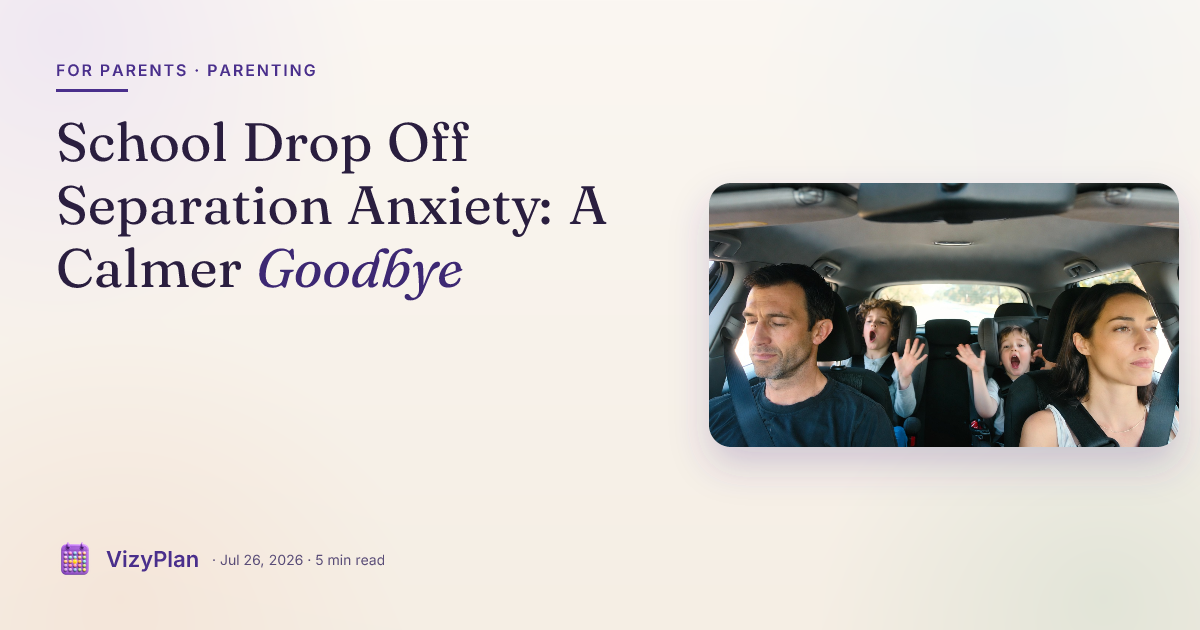
You are eleven feet from the classroom door and your child's hand has become a clamp. The teacher is doing the bright voice. Two other parents are watching. School drop off separation anxiety puts you in the worst kind of bind, because the two things you want, your child feeling safe and your child getting through the door, seem to point in opposite directions in that exact moment.
They do not, actually. But the way out is counterintuitive.
What the research says about school drop off separation anxiety
The clinical literature on anxiety-driven school difficulty converges on one approach: graded return, meaning gradual exposure to the feared situation with support, rather than waiting for the fear to pass on its own. The StatPearls clinical review on separation anxiety disorder describes cognitive behavioral therapy as first-line, with the best outcomes and the shortest treatment duration, and notes that a wait-and-see approach has not proven effective.
The second finding is the one that changes what parents actually do. Parent-based treatment works about as well as child-focused therapy. A scoping review in the Journal of Paediatrics and Child Health covering therapeutic and educational interventions for childhood separation anxiety describes parent-based programs, including SPACE, which stands for Supportive Parenting for Anxious Childhood Emotions, as reducing family accommodation of childhood anxiety with results comparable to treating the child directly.
Family accommodation is the technical name for the thing every loving parent does. Staying five more minutes. Answering the same reassurance question for the ninth time. Coming back in when they cry. Each of those makes the next morning slightly harder, because it teaches a very reasonable lesson: the fear was correct, and leaving is negotiable.
That is not a criticism of any parent. It is the most natural response in the world. It is also the lever.
Why an autistic child's version looks different
Not all school door distress is separation anxiety in the classic sense. Sometimes the child is not afraid of losing you. They are afraid of what happens after you leave, which is a different problem with a different fix.
A 2023 study of 1,121 families in Frontiers in Psychiatry found that among children experiencing serious school distress, 92.5 percent scored above the clinically significant anxiety threshold, 56.9 percent had sensory processing differences, and children were affected across an average of 4.8 sensory systems. For those children, the doorway is not the problem. The cafeteria is the problem, or the noise, or the unpredictable part of the day two hours from now.
The way to tell the difference is to ask about the middle of the day, not the morning. If your child can name what they are dreading, it is usually not about you leaving. Our post on school refusal covers what to do when the reason is real and specific.
Enjoying this article?
Get practical tips and insights delivered to your inbox — no spam, ever.
A drop off plan that gets shorter every week
- Make the goodbye a fixed script, not a feeling. Same words, same length, same order, every day. Predictability at the door does more than warmth at the door, because warmth that varies in length becomes a variable your child has to solve.
- Cap it at thirty seconds and hold the cap. Long goodbyes are not kinder. They extend the hardest moment and teach that the length is negotiable.
- Hand off to a named person, not to a room. One adult, by name, who your child expects to meet. A known face converts an unknown into a routine.
- Give your child something to do in the first two minutes. A job, a task, a specific place to put the backpack. Anxiety struggles to hold on to a body that is already busy.
- Move the emotional work earlier. Talk about the day at breakfast when the nervous system is calm, not at the door when it is not. Reassurance lands at 7am. It bounces at 8:05.
- Shorten it deliberately, week by week. Walk to the classroom this week, the hallway next week, the door after that. A graded return only works if it actually grades.
Give the day a shape before you get there
Most of the fight at the door is about uncertainty, and uncertainty is the one variable you can genuinely reduce from home. A child who has seen the whole day laid out, arrival, morning work, specials, lunch, pickup, walks in solving a smaller problem than a child who is walking into a blank.
VizyPlan was built by an autism dad and an autism mom who is a licensed speech-language pathologist so a child can look at the day, in photos of their own school, before they have to live it. Our posts on first day of school anxiety and the meet-the-teacher visit cover the two weeks before this becomes a daily question.
One last thing. If drop off has been hard for six weeks and is not moving, that is not a discipline gap, and pushing harder is not the next step. Loop in the school counselor and your child's clinician. Persistent school distress responds to a plan, and it rarely responds to willpower.
Download VizyPlan and start your 7-day free trial today. Let your child see the whole day before they walk into it. Just $6.99/month after your trial, no credit card required upfront.
VizyPlan was built by an autism dad and an autism mom who is a licensed speech-language pathologist who needed something that did not exist. Start your free trial.