

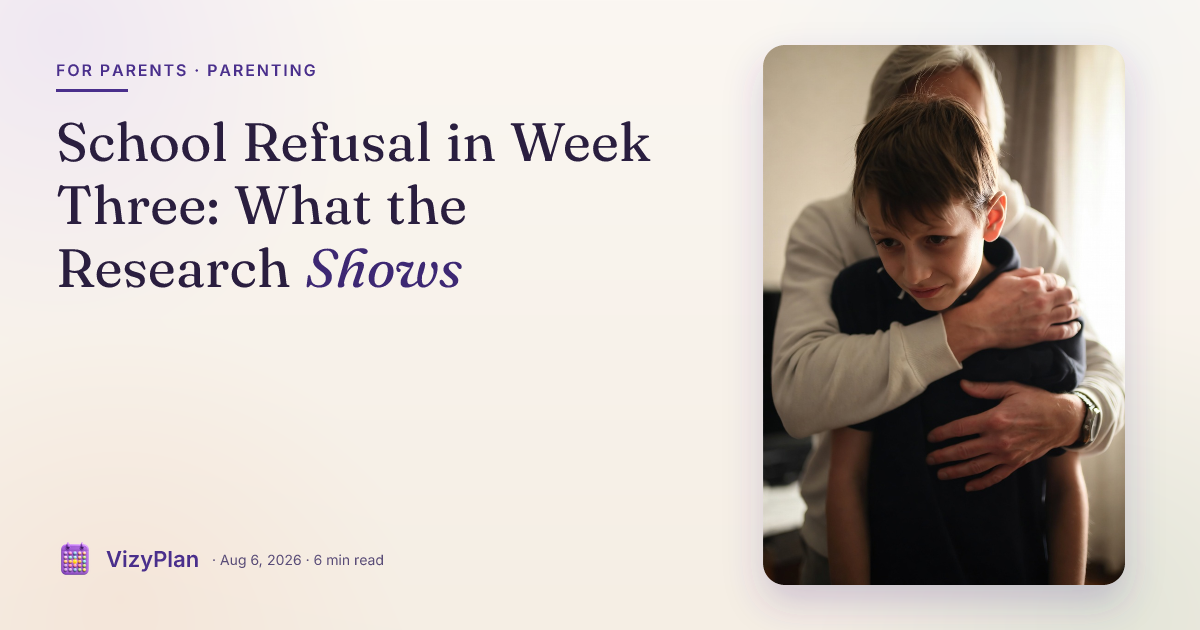
The first two weeks went better than you dared hope. New teacher, new backpack, a bit of novelty carrying everything along. Then Monday of week three arrives and your child is on the floor by the door, or in bed with a stomach ache that is real, or simply saying no in a voice you have not heard before. School refusal in week three is one of the most common patterns families describe, and almost nobody warns them it is coming.
School refusal is much more common in autistic students than families are told
The most-cited figure comes from a Norwegian study. Munkhaugen and colleagues observed 216 students aged 9 to 16 across 20 school days, 78 of whom were autistic, and reported school refusal behaviour in 42.6 percent of the autistic students compared with 7.1 percent of their non-autistic peers, published in Research in Autism Spectrum Disorders. The autistic students also refused for longer stretches.
A larger and more recent picture comes from a 2023 study of 1,121 families published in Frontiers in Psychiatry. Among children currently experiencing school distress, 92.1 percent were neurodivergent and 83.4 percent were autistic, diagnosed or suspected, with an odds ratio of 46.61 for autistic children experiencing school distress. 92.5 percent scored above the clinically significant anxiety threshold. And 56.9 percent had sensory processing differences, affected across an average of 4.8 sensory systems, with tactile and auditory systems affected in more than 80 percent.
Read that list as a description rather than a diagnosis. School refusal in autistic children usually is not a fear of school as an idea. It is an accumulation of specific, findable things.
Why week three specifically
Three things run out at roughly the same time.
Novelty runs out. The new backpack and the new room carried real motivational weight for about ten days. When that fades, what remains is the actual daily cost.
The mask runs out. A child holding themselves together across six and a half hours is spending a finite budget. Two weeks in, the reserve is gone, and the collapse usually shows up at home first, which our post on after-school restraint collapse describes in detail.
The unpredictable events start. Weeks one and two are heavy on routine-setting. By week three come the first fire drill, the first substitute, the first assembly, the first group project. Each one is a small proof that the day cannot be predicted.
What actually helps
- Look for the specific thing, not the general feeling. Walk the day period by period and watch for where your child stops answering. Refusal is usually anchored to one or two moments: the cafeteria, the hallway, a specific class, the bathroom, the bus. Fixing one real thing beats reassuring about everything.
- Believe the physical symptoms. Stomach aches and headaches in anxious children are genuinely felt, not performed. Treating them as fake teaches a child that you are not a reliable source of help.
- Reduce the ask before you reduce the day. A shorter demand often works better than a shorter schedule. A late start, a modified first period, or a check-in with a known adult on arrival can restore attendance without a partial-day plan that is hard to unwind.
- Name one safe adult and one safe place. A child who knows exactly where to go and who to find is solving a smaller problem than a child who only knows they feel awful.
- Get the school in the room early. Attendance letters escalate fast and they escalate on a timeline that has nothing to do with your child's nervous system. A meeting in week three is a very different conversation than a meeting in week nine.
- Ask for a functional assessment, not a consequence plan. The useful question is what the school day is asking of your child that they cannot currently do. Punishment-based responses to anxiety-driven refusal reliably make it worse.
Enjoying this article?
Get practical tips and insights delivered to your inbox — no spam, ever.
What not to do, even though it is tempting
Do not go silent with the school in the hope that it resolves. The clinical literature on anxiety-driven school difficulty is consistent that a wait-and-see approach does not work and that a graded return with support does. Graded means planned, incremental, and agreed in advance, not a slow drift.
And do not read refusal as manipulation. A child who could go and simply would rather not is a different situation from a child whose body will not let them, and the second one is far more common than the first in this population. Our post on shutdown versus meltdown covers how to tell what you are actually looking at.
Make the day predictable enough to be survivable
Almost everything on the list above reduces to one idea: give your child more of the day in advance. What happens, in what order, with which adult, and when it ends. A day that can be previewed is a day that costs less to enter.
VizyPlan was built by an autism dad and an autism mom who is a licensed speech-language pathologist so a child can see the whole day in photos of their own school before they walk into it, and see the after-school part too, which is often what they are actually holding out for.
If week three is hard, you are not behind and your child is not broken. You have hit the most predictable point in the school year, and it responds to a plan.
Download VizyPlan and start your 7-day free trial today. Give your child a day they can preview instead of a day they have to brace for. Just $6.99/month after your trial, no credit card required upfront.
VizyPlan was built by an autism dad and an autism mom who is a licensed speech-language pathologist who needed something that did not exist. Start your free trial.