
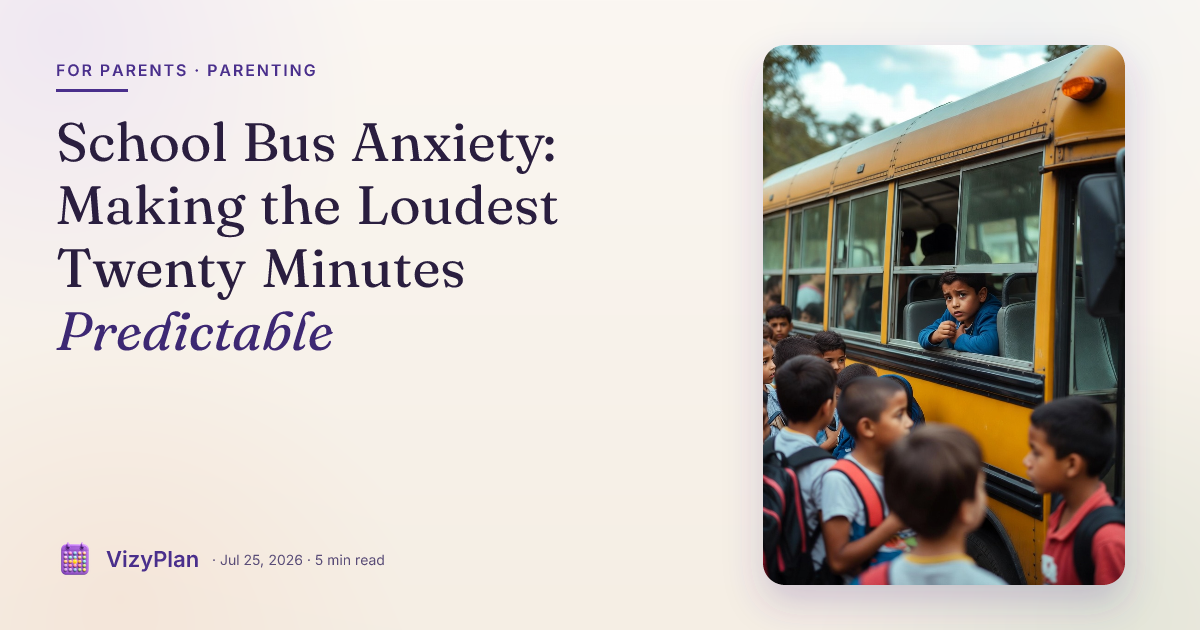
Everything about the school day gets planned except the twenty minutes that start it. School bus anxiety is one of the most common back to school worries families raise and one of the least supported, because the bus sits in a gap: it belongs to the school, but it has no teacher, no visual schedule, no seating chart, and often no adult who has ever read your child's plan.
School bus anxiety is a staffing and information problem, not just a nerves problem
A 2025 study published in Child: Care, Health and Development built and tested a training program for school transportation staff, and the caregiver focus groups that shaped it named the issue plainly: transportation staff often lacked understanding of intellectual and developmental disabilities, student-to-staff ratios were high, and communication between parents and transportation personnel was inconsistent. The program reached 886 transportation staff members, and more than 90 percent said they were satisfied with it, with over 80 percent reporting increased knowledge and confidence.
That is good news and a diagnosis at the same time. Drivers are not unwilling. In most districts they have simply never been given the information.
Research on urban students found the downstream effect. Transportation problems getting to and from school predicted fewer school resources, less sense of school belonging, and more school stressors, anxiety, and depression. A bad ride is not a small thing that resolves at the classroom door. It sets the floor for the day.
What actually makes the ride hard
Ask a child and you rarely get a clean answer, so it helps to know the usual suspects.
Noise. A full bus is loud, echoey, and unpredictable, which is the worst combination for a nervous system that is already over-responsive to sound. In a sample of 4,104 autistic people, 60.1 percent currently experienced auditory over-responsivity.
No visible schedule. The child cannot see how many stops are left, cannot tell how long the ride will take, and has no way to know when it ends. Our post on time blindness explains why "we are almost there" is not reassurance to a child who cannot feel the passage of twenty minutes.
Social unpredictability. Unassigned seats, mixed ages, no adult mediating. The bus is unstructured time on wheels, and unstructured time is consistently the hardest part of the school day, which our post on recess and lunch covers from the school side.
Motion and vestibular input. Some children find the movement regulating. Some find it nauseating. Both are worth knowing about.
Enjoying this article?
Get practical tips and insights delivered to your inbox — no spam, ever.
Six things to do before the first ride
- Ask for the driver's name and the route number in August. Then ask the school to pass a one-page profile to transportation. Most districts will do it if asked; almost none do it automatically. Our one-page profile guide works for a driver as well as a teacher.
- Request an assigned seat, preferably front-right. Front seats are quieter, closer to the adult, and easier to exit. Ask for it in writing so it survives a driver change.
- Do a practice ride or a bus visit. Many districts run a bus petting zoo or an orientation ride in August. If yours does not, ask if your child can sit on a parked bus for five minutes. Familiarity does most of the work.
- Send noise protection and a known item. Headphones or loops, plus one predictable object. A ride with a fixed sensory plan is easier than a ride your child has to survive on improvisation.
- Make the ride countable. Number of stops, a song that lasts the trip, a card with the route on it. Anything that turns an unknown duration into a finite one.
- Agree on a single exit script with the driver. What your child does if they cannot get off, or cannot get on. One sentence, known by everyone, prevents most of the worst mornings.
Build the ride into the routine instead of leaving it outside it
The bus tends to sit outside the visual schedule, which is exactly backward. It is the first transition of the day and the one with the least support. Putting it in the sequence, with a real photo of your bus stop and your bus, turns it from an ambush into a step.
VizyPlan was built by an autism dad and an autism mom who is a licensed speech-language pathologist so the whole morning, including the part that happens on a corner at 7:15, can live in one place your child can see. Our guide to resetting the back to school routine shows how to sequence the days leading up to it.
If the bus stays impossible after a real attempt, that is information, not failure. Transportation is a related service, and a documented need can be written into the plan.
Download VizyPlan and start your 7-day free trial today. Put the bus stop, the ride, and the classroom into one sequence your child can see coming. Just $6.99/month after your trial, no credit card required upfront.
VizyPlan was built by an autism dad and an autism mom who is a licensed speech-language pathologist who needed something that did not exist. Start your free trial.