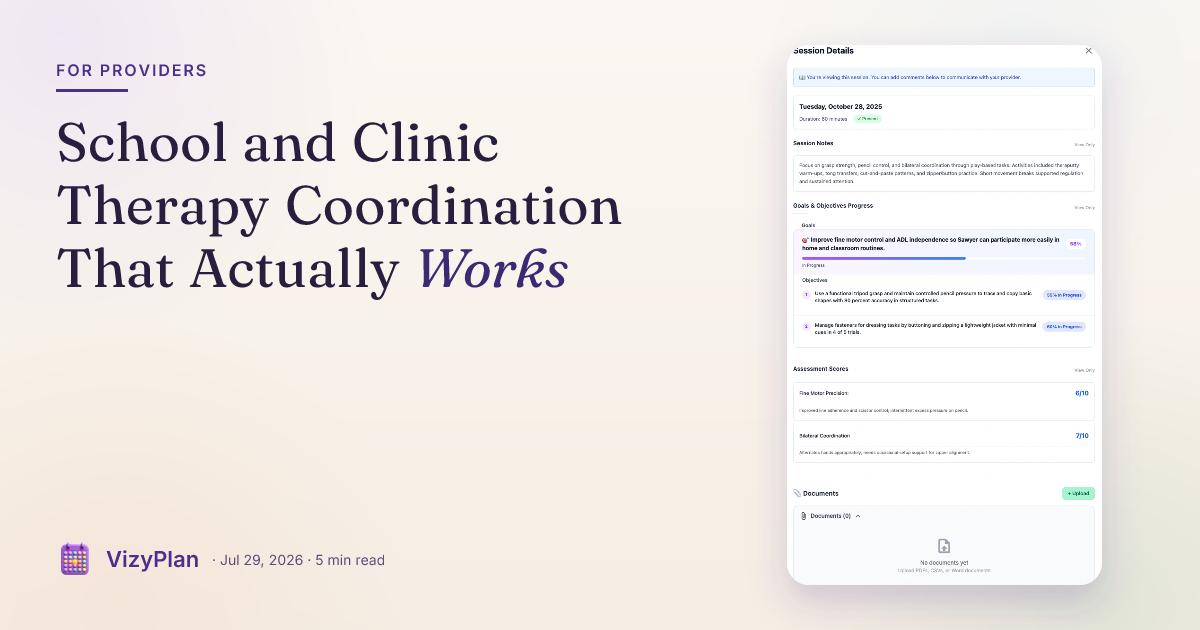
A child on your caseload also gets forty-five minutes a week from a school-based clinician who has never spoken to you, is working from a different assessment, is using a different prompt hierarchy, and is targeting a goal that sounds like yours but is not. School and clinic therapy coordination is the difference between two teams multiplying each other and two teams quietly canceling each other out, and August is the only month of the year when everyone has time to fix it.
School and clinic therapy coordination is what families are already asking for
Families are not confused about this. They are asking. A 2024 study in Frontiers in Rehabilitation Sciences exploring valued outcomes of school-based speech-language therapy found that family members emphasized coordinated care that was responsive to all of a child's needs, and specifically wanted greater communication and care coordination between health professionals and their children's educators.
The two settings genuinely have different mandates, and that part is fine. School services exist to give a student access to their education, which is why school goals lean toward classroom participation, curriculum access, and functional communication in a group. Clinic services are usually broader and more individualized. The problem is not the difference in scope. The problem is when the difference is never named out loud, and the child has to reconcile two systems by themselves.
The three failure modes to look for
Same skill, different topography. The school team teaches a break request with a card. You teach it with a spoken phrase. Both are defensible. Together they teach a child that the correct response depends on the room, which is the opposite of generalization.
Different criteria, invisible disagreement. Your goal says 80 percent across three sessions. Theirs says four out of five opportunities. Nobody is wrong and nobody can compare notes, so the child's progress looks great in one file and stalled in the other.
Duplicate effort on the easy target, no coverage on the hard one. Two teams independently pick the most measurable goal. The genuinely difficult skill, the one that would change the child's day, gets worked by neither, because it is hard to write and hard to score.
Five moves that take under an hour
- Get a release signed in August, not in November. Everything else on this list depends on it, and it is the step most often delayed until a crisis makes it urgent.
- Send one email with three questions. What are you targeting this quarter, what prompt or cue are you using, and what does the child do when it works. Three questions get answered. A meeting request often does not.
- Agree on the shared topography for one target, not all of them. Pick the highest-value skill, usually a break request or a help request, and make the response look identical in both settings. One aligned target beats six theoretically aligned ones.
- Write down who owns what. Access and participation goals live with the school. Skill acquisition beyond the classroom lives with you. Naming the split prevents the polite duplication that eats both caseloads.
- Share one artifact instead of one report. A photo of the visual support, a two-line description of the cue, a video of the child doing it correctly. Artifacts transfer. Narrative reports usually do not get read by the other side.
Enjoying this article?
Get practical tips and insights delivered to your inbox — no spam, ever.
Include the family as the third setting, not the audience
Home is where generalization either happens or does not, and it is the setting neither of you controls. That is precisely why it should be the one you align on first. Our post on the shared visual system across home, clinic, and school covers how to build one artifact all three settings use, and our post on the in-clinic to home generalization gap covers why skills stall at the clinic door.
The evidence supports leaning on the family here. A meta-analysis of 51 effect sizes found parent-implemented intervention produced moderate overall benefits across child outcomes. Parents are not a delivery channel of last resort. They are the setting with the most hours.
Write goals the other team can actually use
The fastest coordination win is a goal a school clinician can read in ten seconds and reproduce on Monday. Concrete response, concrete cue, concrete criterion, no acronyms that live only in your discipline. Our post on writing parent-friendly therapy goals applies almost word for word to the school team, because the constraint is the same: the reader has ninety seconds and a full caseload.
VizyPlan was built by an autism dad and an autism mom who is a licensed speech-language pathologist so the same sequence, in the same photos, can run in the classroom, in your session, and at the kitchen table without three teams rebuilding it three times.
Share VizyPlan with your families so the school team and your team are pointing at the same picture. The 7-day free trial lets a family try it first. Just $6.99/month after, no credit card required upfront.
VizyPlan was built by an autism dad and an autism mom who is a licensed speech-language pathologist who needed something that did not exist. Explore VizyPlan.