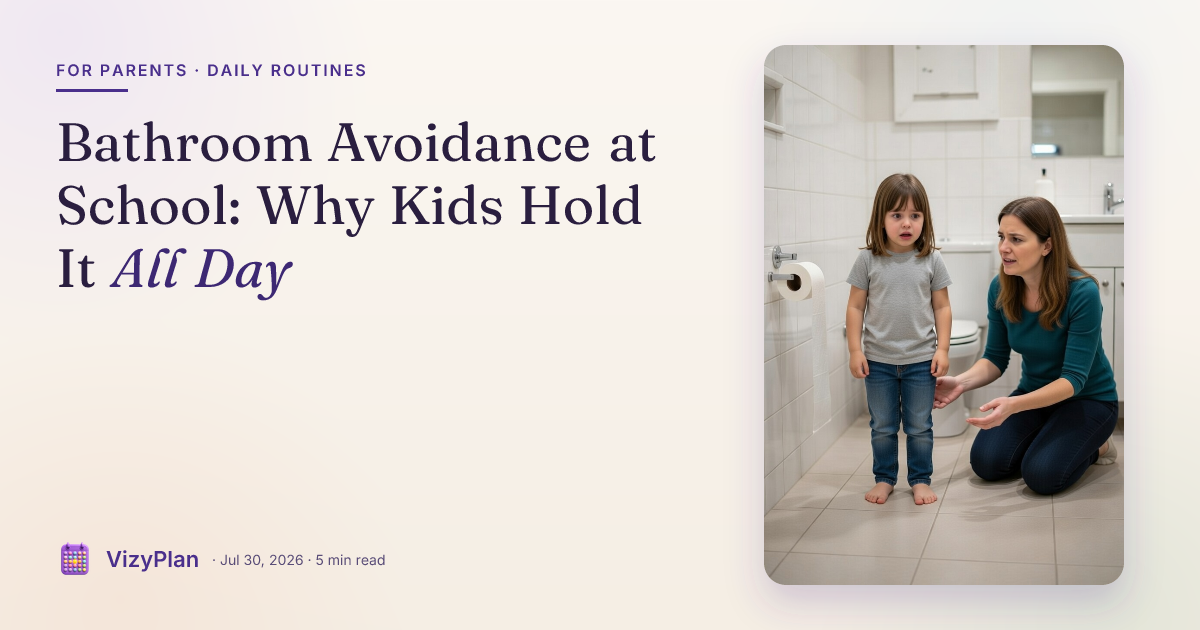
Your child has been independently using the bathroom at home for two years. Three weeks into the school year they come off the bus in a different pair of pants, or with a stomach ache, or having had nothing to drink since breakfast because that is the only strategy they could think of. Bathroom avoidance at school is one of the most common and least discussed back to school problems, and treating it as a compliance issue makes it worse every single time.
Bathroom avoidance at school has a documented physical layer
Start with the part that gets missed. Continence problems are substantially more common in autistic children than the general population. A study published in the Journal of Pediatric Urology00158-8/abstract) comparing 40 autistic children with a mean age of 11.3 years to 43 age-matched controls found daytime wetting in 45 percent of the autistic group versus 4.7 percent of controls, and nighttime wetting in 30 percent versus zero. A later systematic review in European Child and Adolescent Psychiatry confirmed that incontinence of several types co-occurs with autism at elevated rates.
So before anything else: if a previously reliable child starts having accidents, constipation and urinary tract issues belong on the list, and a pediatrician visit is a reasonable early step rather than a last resort. Constipation in particular is common, easy to miss, and produces exactly this pattern.
Then there is the interoception layer
Interoception is the sense that tells you what is happening inside your body: hunger, thirst, temperature, and the signal that you need a bathroom. Many autistic children register that signal late, faintly, or only when it becomes urgent. "Watch for the signs they need to go" is advice that assumes the signal arrives on time.
At home, the bathroom is nine feet away and the child can respond to a late signal. At school, the bathroom is down a hall, requires permission, takes four minutes, and the signal arrives with two minutes of margin. Our post on interoception and visual body cues covers how occupational therapists build that awareness deliberately.
And a sensory layer on top of both
School bathrooms are genuinely difficult sensory environments. Automatic flushes that fire without warning. Hand dryers that are painfully loud. Echo. Fluorescent light. Smell. Doors that do not close all the way. Between 56 and 70 percent of autistic youth meet criteria for sensory over-responsivity, and in a sample of 4,104 autistic people, 60.1 percent currently experienced auditory over-responsivity. A hand dryer at close range is not a minor annoyance for a child in that group.
Add the social layer, which is that using the bathroom at school requires asking, in front of everyone, and sometimes being told to wait, and you have four separate reasons stacked on top of each other. Holding it for seven hours starts to look like the rational choice it is.
Enjoying this article?
Get practical tips and insights delivered to your inbox — no spam, ever.
What to put in place before September
- Rule out the physical first. Constipation, urinary tract infection, and medication effects all produce this pattern. Ask the pediatrician before you build a behavior plan.
- Ask to see the actual bathroom your child will use. Not the building. The specific room. Then you know whether you are dealing with a hand dryer, an auto-flush, or a door that does not latch.
- Get a no-ask bathroom pass written into the plan. A silent signal or a permanent pass removes the hardest step, which is asking in front of twenty-four peers. This is a standard accommodation and schools grant it routinely when asked.
- Schedule the trips instead of waiting for the signal. Two or three fixed bathroom times built into the day works far better than relying on interoception that arrives late. Attach them to existing anchors: after arrival, before lunch, after recess.
- Solve the specific sensory problem. A sticky note over an auto-flush sensor. Permission to use a single-stall or nurse's bathroom. Headphones for the hand dryer. Small fixes, large effect.
- Send a spare set of clothes and normalize it out loud. An accident that comes with shame produces more avoidance, which produces more accidents. Break that loop early and explicitly.
Make the sequence visible, not verbal
For a child who is stuck on the steps rather than the signal, the sequence itself can be the barrier: ask, walk, wait, close, wipe, flush, wash, dry, return. That is nine steps under time pressure in a loud room. Our visual support guide to potty training covers how to break it down.
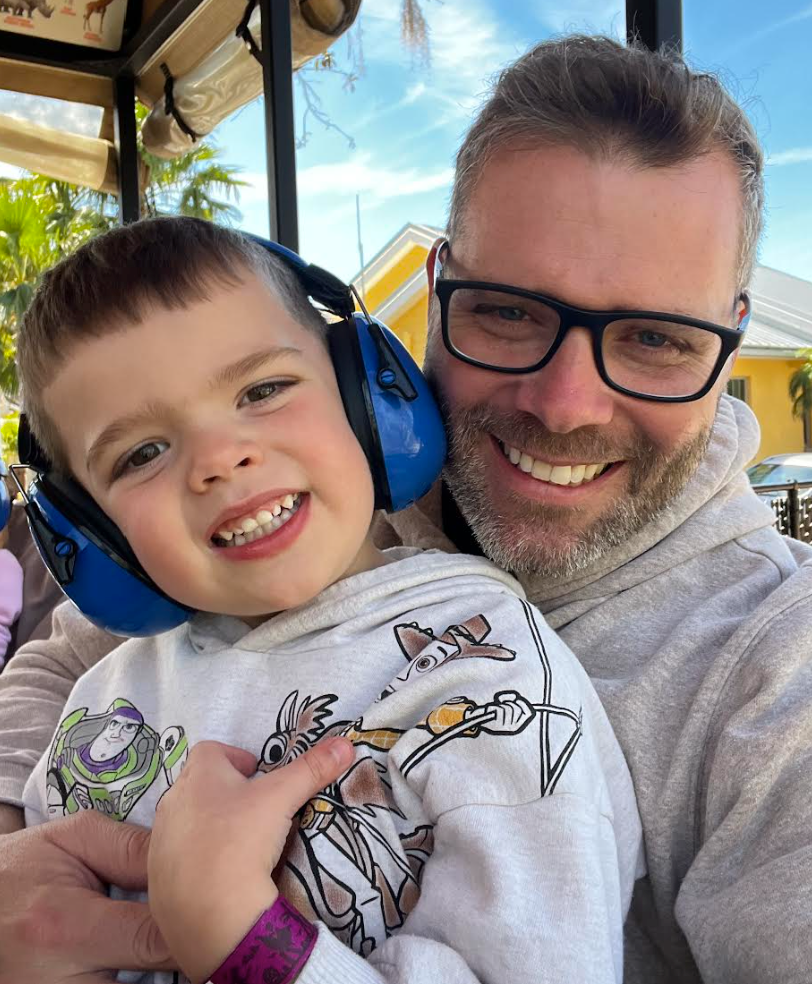
VizyPlan was built by an autism dad and an autism mom who is a licensed speech-language pathologist so a routine like this can live in photos of your child's real world and travel with them between home and school.
One last thing worth saying plainly to your child, and then to yourself: a body that needs a bathroom is not a behavior problem. Nobody is doing this on purpose.
Download VizyPlan and start your 7-day free trial today. Turn the hard sequences into something your child can follow without asking out loud. Just $6.99/month after your trial, no credit card required upfront.
VizyPlan was built by an autism dad and an autism mom who is a licensed speech-language pathologist who needed something that did not exist. Start your free trial.