
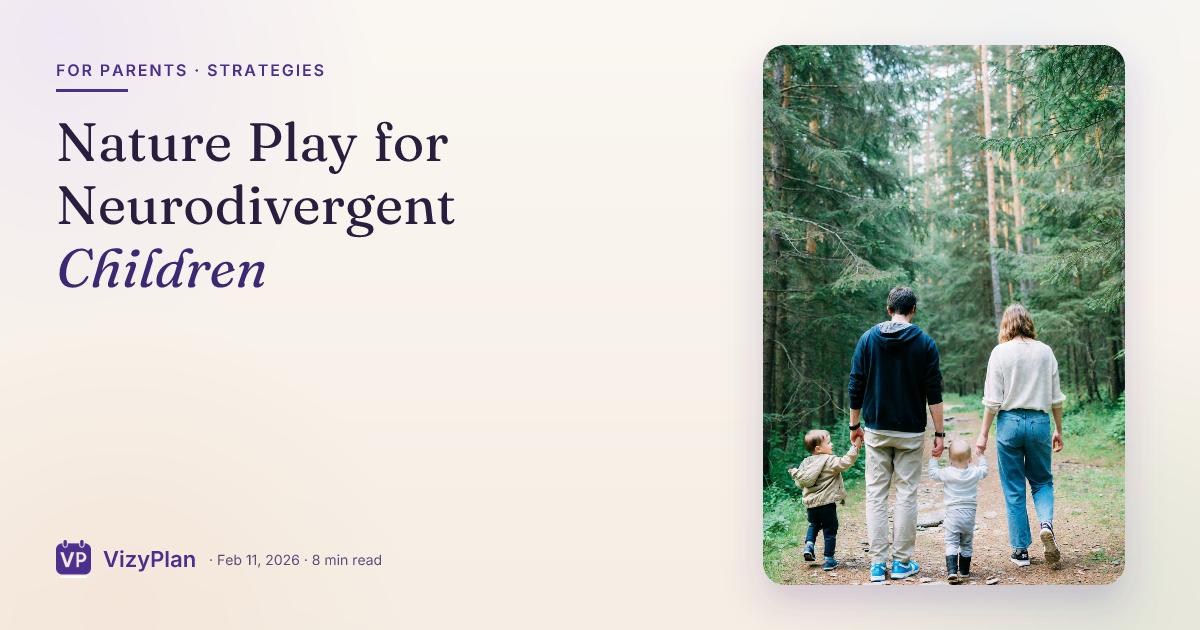
There is something about the outdoors that calms neurodivergent brains in ways that indoor environments simply cannot replicate. Maybe you have noticed it yourself: your child who is bouncing off the walls inside becomes focused and calm after thirty minutes at the park. The one who melts down in the grocery store can spend an hour exploring the backyard without a single struggle.
This is not a coincidence. A growing body of research demonstrates that nature exposure has measurable, significant benefits for children with ADHD, autism, and other forms of neurodivergence. The effects go beyond simply "burning off energy." Nature provides a unique sensory environment that actively supports regulation, attention, and emotional well-being.
The good news is that you do not need access to pristine wilderness to benefit. A backyard, a neighborhood park, a patch of grass, or even a window box with soil can provide the sensory input your child's brain is seeking.
What the Research Shows
The evidence for nature's benefits to neurodivergent children is substantial and growing.
Nature exposure reduces ADHD symptoms. Landmark research by Frances Kuo and Andrea Faber Taylor at the University of Illinois found that children with ADHD who played in green outdoor settings showed significantly reduced symptoms compared to those who played indoors or in built outdoor environments. Their studies demonstrated that even a twenty-minute walk in a park improved concentration in children with ADHD to a degree comparable to the effects of common ADHD medications. Follow-up research has consistently replicated these findings.
Green time outperforms screen time for regulation. Multiple studies have compared the regulatory effects of nature exposure versus screen time for children with attention difficulties. The results consistently favor nature: outdoor play in natural settings provides more sustained improvements in attention, mood, and self-regulation than equivalent time spent with screens. This does not mean screens are always harmful, but it does suggest that nature should be prioritized when regulation is the goal.
Sensory input in nature is uniquely regulating. Unlike the sensory environment of indoor spaces, which tends toward artificial lighting, static temperatures, and repetitive sounds, natural environments provide rich, varied, and gently stimulating sensory input. The feel of grass underfoot, the sound of wind in leaves, the warmth of sunlight on skin, the visual complexity of trees and clouds. This input is varied enough to engage the senses without the overwhelming intensity of urban or indoor environments.
Nature reduces cortisol levels. Research on stress hormones in children has found that time in natural settings reduces cortisol levels, the body's primary stress hormone. For neurodivergent children who often operate with elevated baseline stress due to the constant demands of navigating a world not designed for their neurology, this cortisol reduction supports overall regulation and resilience.
Sensory Benefits of Outdoor Play
Nature provides sensory input that many neurodivergent children actively need.
Proprioceptive input. Climbing trees, digging in dirt, pushing through tall grass, carrying sticks and rocks, and navigating uneven terrain all provide deep proprioceptive input that helps regulate the nervous system. Occupational therapists frequently recommend these types of "heavy work" activities for sensory regulation, and nature provides them naturally.
Vestibular stimulation. Swinging, spinning, rolling down hills, and balancing on logs all stimulate the vestibular system, which plays a critical role in body awareness and emotional regulation. Children who seek movement often find natural playground features more satisfying than manufactured equipment because the challenges are unpredictable and engaging.
Tactile exploration. Sand, water, mud, bark, leaves, grass, and stones offer an enormous range of textures. For children who are tactile seekers, this variety is deeply satisfying. For children who are tactile defensive, nature provides opportunities for gradual exposure in a low-pressure context, touching a leaf is less threatening than being asked to handle classroom art supplies.
Auditory regulation. Natural sounds, birdsong, running water, wind through branches, are processed differently by the brain than artificial sounds. Research on soundscapes has found that natural sounds activate the parasympathetic nervous system (the "rest and digest" response), while urban noise activates the sympathetic nervous system (the "fight or flight" response). For children with auditory sensitivities, natural environments often feel calmer and more tolerable.
Practical Nature Activities by Sensory Profile
Different children benefit from different outdoor activities based on their sensory needs.
For sensory seekers:
- Jumping in puddles or mud
- Digging and building with sand or dirt
- Climbing over rocks and fallen trees
- Rolling down grassy hills
- Splashing in streams or using water play equipment
- Throwing and kicking piles of leaves
For sensory avoiders:
- Quiet nature walks on smooth paths
- Sitting under a tree and watching clouds
- Gentle gardening with soft soil
- Bird watching from a comfortable spot
- Walking barefoot on grass (if tolerated) for gradual exposure
- Blowing dandelion seeds or bubbles
For children who need calming input:
- Slow walks in wooded areas
- Sitting by running water and listening
- Lying in a hammock outdoors
- Cloud watching
- Mindful breathing exercises outside where air feels different
For children who need alerting input:
- Running on uneven terrain
- Climbing playground structures
- Racing between trees
- Playing catch with natural objects (pinecones, soft leaves)
- Obstacle courses using natural features
Building Nature Into Your Routine
Consistency matters more than duration or location.
Add outdoor time to the daily visual schedule. When nature play appears on your child's visual routine, it becomes an expected part of the day rather than an optional addition. VizyPlan's visual schedule feature lets you include outdoor time as a regular step, with images that show your child in outdoor settings.
Start with what your child already enjoys. If your child loves water, start with puddle jumping or a nature walk near a stream. If they love dinosaurs, look for rocks and fossils. Interest-driven nature engagement is more sustainable than generic "go outside and play" directives.
Use nature play as a regulation tool. When you notice your child is becoming dysregulated, an outdoor break can serve as a reset. "Let us go check on the garden" or "Let us walk to the mailbox" provides a sensory shift that indoor strategies cannot match.
Prepare for sensory challenges outdoors. Nature is not without sensory challenges: bugs, unexpected textures, temperature changes, and bright sunlight can all be triggers. Bring sunglasses, bug spray (fragrance-free if scent is a trigger), and allow your child to wear preferred clothing that protects against textures they find aversive.
Track how nature affects your child's regulation. Use VizyPlan's emotion tracking to log your child's emotional state before and after outdoor time. Over weeks, you will likely see clear evidence that nature exposure correlates with better regulation, which reinforces the habit for your whole family.
Seasonal Nature Activities
Every season offers unique sensory opportunities.
Spring: Planting seeds, splashing in rain puddles, observing insects, feeling new grass grow Summer: Water play, sand exploration, longer outdoor time, nature scavenger hunts Fall: Collecting leaves, jumping in leaf piles, feeling cool breezes, observing seasonal changes Winter: Snow play (if climate allows), indoor seed starting, bird feeding, walking in quiet winter landscapes
Nature is not a cure for the challenges of neurodivergence. But it is a powerful, free, and consistently available tool that supports the regulation, attention, and emotional well-being your child needs to thrive. The outdoors was the original sensory gym, and it remains one of the most effective.

Download VizyPlan and start your 7-day free trial today. Build daily routines that include nature play, track how outdoor time affects your child's mood and regulation, and create visual schedules that make the outdoors a consistent part of your family's rhythm. If it helps, keep going for $6.99/month or $59.99/year.