
"It is my turn!" "I had it first!" "That is not fair!" If these phrases echo through your home on a daily basis, you are living the reality of teaching social sharing skills to a neurodivergent child. Turn-taking and sharing are among the earliest social expectations children encounter, and they are also among the most difficult for children whose brains process social situations differently.
The frustration is real for everyone involved. Your child struggles to wait, to relinquish a desired item, or to understand why another person's needs should temporarily take priority over their own. Siblings feel frustrated. Playdates become stressful. And you wonder whether your child will ever develop these fundamental social skills.
The good news is that turn-taking and sharing are teachable skills, not fixed personality traits. With visual supports, structured practice, and the right approach, neurodivergent children can absolutely learn to navigate these social expectations. The key is understanding why these skills are harder for their specific brain and building the instruction around that understanding.
Why Turn-Taking Is Uniquely Challenging
Several neurological factors converge to make turn-taking especially difficult for neurodivergent children.
Impulse control develops differently in ADHD. The ability to inhibit an impulse, to stop yourself from grabbing a toy you want right now, relies on prefrontal cortex functions that develop more slowly in children with ADHD. Research consistently shows that response inhibition is one of the core deficits in ADHD. Your child may genuinely understand the rule of taking turns but be unable to override the impulse to act immediately when they want something.
Perspective-taking requires abstract thinking. Understanding that another person also wants a turn with the toy requires theory of mind, the ability to understand that others have thoughts, feelings, and desires different from your own. Many autistic children develop theory of mind skills on a different timeline. Without this understanding, turn-taking rules feel arbitrary rather than logical.
Cognitive rigidity affects flexibility. Some autistic children develop strong associations between themselves and specific objects or activities. "That is MY puzzle" or "I always go first" reflects rigid thinking patterns that make sharing feel like a violation of the rules as they understand them. This is not selfishness. It is a brain that craves consistency and resists changes to established patterns.
Emotional regulation is tested. Waiting for a turn or giving up a preferred item triggers strong emotions: frustration, anxiety, disappointment. For children whose emotional regulation is already working harder than typical, these feelings can escalate quickly into meltdowns that make the social situation worse.
Visual Turn-Taking Cues
Making the abstract concept of "turns" concrete and visible dramatically improves comprehension and compliance.
Use a physical turn-taking object. A special "turn card," a designated hat, or a specific toy that indicates "it is your turn" gives the abstract concept a tangible form. Whoever holds the turn marker has the turn. When you pass it, the turn passes. This removes ambiguity about whose turn it is.
Create a visual turn order. A simple chart showing names or photos in order, with a movable marker indicating whose turn is current, lets everyone see the sequence. Your child can look at the chart and see that their turn is coming rather than relying on verbal promises that feel uncertain. VizyPlan lets you create personalized visual sequences that can include turn-taking steps within activities, making the structure clear and predictable.
Use visual timers for timed turns. When sharing a single toy or activity, set a visible timer for each person's turn. When the timer goes off, the turn changes. The timer is a neutral authority that removes the social negotiation that many neurodivergent children find overwhelming.
Post turn-taking rules visually. A simple poster with rules like "Look at the turn chart," "Wait for the timer," and "Say: Can I have a turn?" gives your child a reference they can check independently during play.
Social Stories for Sharing
Social stories prepare your child cognitively and emotionally for sharing situations before they happen.
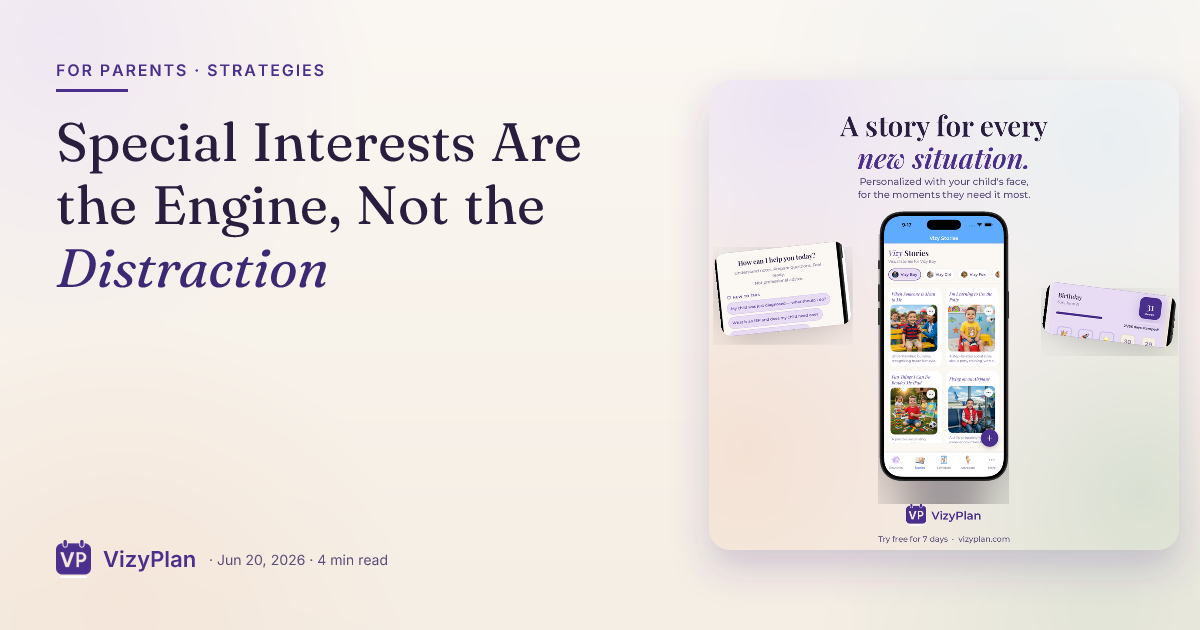
Create stories for specific scenarios. A story about sharing toys with a sibling during playtime, a story about taking turns on the playground swing, or a story about sharing materials in a classroom each addresses a different context your child encounters. VizyPlan's social story feature with AI-generated personalized images lets you build stories that look like your child in their actual environments, increasing engagement and relevance.
Include the feelings of all parties. A good sharing social story names how your child feels when they have to wait ("I might feel frustrated when it is not my turn. That is okay.") AND how the other person feels ("My friend feels happy when they get a turn too."). This dual perspective builds the empathy foundation that supports genuine sharing.
Practice the story before the situation. Read the social story about playground sharing before going to the park. Review the toy-sharing story before a playdate begins. This pre-teaching gives your child a script to follow when the real situation arises.
Structured Games for Practice
Games provide a natural, low-pressure context for practicing turn-taking.
Start with two-player games. The simplest turn-taking structure involves just two people. Board games, card games, or simple activities like rolling a ball back and forth create frequent turn-taking opportunities with minimal wait time between turns.
Choose games with short turns. Games where each turn takes only a few seconds (rolling dice, drawing a card, placing a piece) minimize the waiting time between turns. Long turns, like extended puzzle-building or complex strategy, increase the difficulty of waiting.
Use games your child is motivated by. A child who loves dinosaurs will tolerate the waiting inherent in a dinosaur-themed game far better than a generic card game. Interest-based motivation compensates for the executive function demands of turn-taking.
Gradually increase complexity. Move from two-player to three-player games, from short turns to longer turns, and from adult-supervised games to peer-supervised play. Each step builds on the last, expanding your child's capacity gradually.
Addressing Common Challenges
Even with preparation, specific challenges will arise.
When your child grabs. Respond calmly: "I see you want the truck. Right now it is Sam's turn. Your turn is next. Let us look at the timer." Redirect to the visual supports rather than lecturing about the rule. If grabbing persists, physically interrupt gently and help your child hand the item back, then immediately provide the visual timer showing when their turn begins.
When your child refuses to give up their turn. Offer a transition warning: "You have one more minute with the blocks, then it is your sister's turn." Use the visual timer. If the transition is still difficult, ensure the reward for taking turns is meaningful and immediate.
When sharing triggers a meltdown. Acknowledge the feeling first: "You are really upset because you wanted more time with that toy." Once your child is regulated, review the social story or visual rules. Do not try to teach during the meltdown. Regulation first, instruction second.
When your child "shares" by controlling. Some children learn to share technically but control the interaction entirely ("You can have it, but only if you use it this way"). This is a step in the right direction. Gently expand flexibility over time rather than correcting the control immediately.
Building Toward Natural Sharing
The goal is not robotic compliance with turn-taking rules but genuine social understanding.
Acknowledge when sharing happens naturally. When your child spontaneously offers a toy or waits patiently for their turn, name it specifically: "You noticed your brother wanted the blue crayon and you handed it to him. That was really kind." Specific praise reinforces the behavior more effectively than generic "Good job."
Use VizyPlan's reward system to track social wins. Set up sharing and turn-taking as trackable goals. When your child earns points for successful sharing, the visual progress provides sustained motivation beyond the individual moment.
Model sharing in your own interactions. "I am going to share some of my snack with you because sharing feels good." "It is Dad's turn to pick the movie tonight. Tomorrow is your turn." Children learn social skills by watching the adults around them practice those same skills consistently.
Turn-taking and sharing are not skills that develop overnight. They build slowly through repeated practice, consistent visual supports, and a patient approach that respects the genuine neurological challenges your child faces. Every successful turn, every moment of willing sharing, is a step toward social competence that will serve them throughout their life.
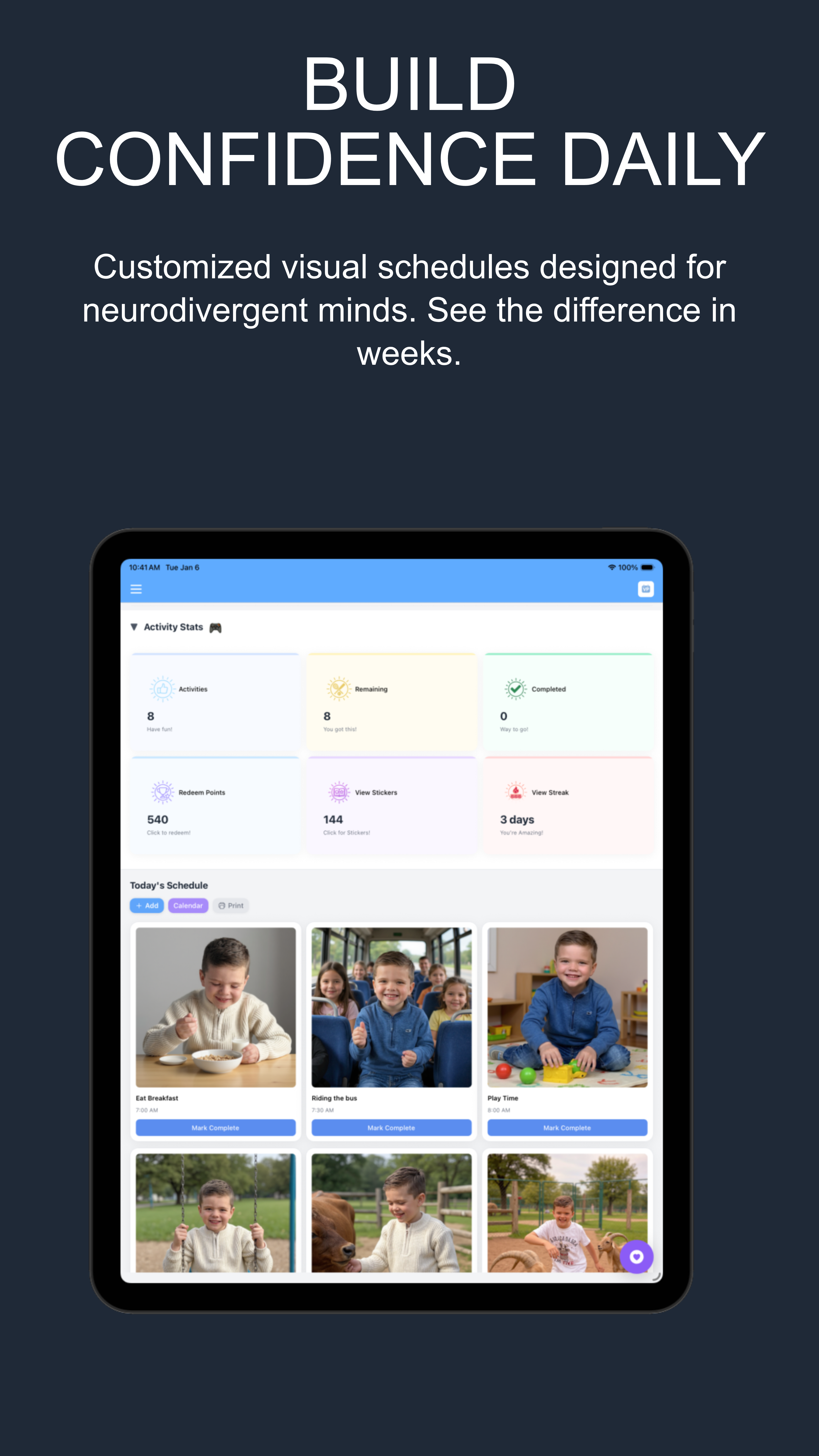
Download VizyPlan and start your 7-day free trial today. Create social stories, visual turn-taking sequences, and reward systems that make learning to share structured and motivating. If it helps, keep going for $6.99/month or $59.99/year.