
Your child holds it together all day at school. They follow directions, manage social interactions, cope with sensory input, and meet academic demands. Then they walk through the front door and everything falls apart. The tears, the screaming, the aggression, or the complete shutdown that happens within minutes of arriving home can be baffling and exhausting for parents who wonder what went wrong.
Nothing went wrong. What you are witnessing has a name: after-school restraint collapse. It is the result of your child spending their entire regulatory capacity at school, leaving nothing in reserve for the transition home. Therapists and educators increasingly recognize this pattern as one of the most common and least understood challenges facing neurodivergent families.
The good news is that a structured after-school routine, designed around your child's specific needs, can dramatically reduce the intensity and frequency of these meltdowns. The key is understanding that the after-school period is not the time to add more demands. It is the time to restore what school has depleted.
Understanding After-School Restraint Collapse
The science behind after-school meltdowns explains why your well-behaved school student transforms at home.
Masking depletes regulatory resources. Many neurodivergent children, especially autistic children, engage in "masking" at school. They suppress natural behaviors like stimming, monitor their social responses constantly, and work to appear neurotypical. This sustained effort is cognitively and emotionally exhausting. Research on autistic masking, sometimes called camouflaging, has linked it to increased anxiety, depression, and burnout. When the child reaches the safety of home, the mask drops and the accumulated stress releases.
Sensory overload accumulates throughout the day. A school day is a marathon of sensory input: fluorescent lights, echoing hallways, crowded cafeterias, unexpected fire drills, the smell of markers and cafeteria food. Sensory input that would be manageable in isolation becomes overwhelming when experienced continuously for six to eight hours. By dismissal, the sensory cup is overflowing.
Executive function fatigue is real. Following multi-step instructions, transitioning between classes, organizing materials, planning assignments, and managing time all draw from the same executive function resources. For children with ADHD, these resources are already limited. A full school day can exhaust them completely.
The transition itself is a trigger. Moving from the structured, predictable school environment to the comparatively unstructured home environment requires significant cognitive flexibility. The rules change, the expectations shift, and the child must reorganize their understanding of what is expected. For children who struggle with transitions, this shift alone can push them past their threshold.
Designing a Decompression Period
The first thirty to sixty minutes after school should focus entirely on regulation, not productivity.
Build in a sensory break immediately. Before homework, chores, questions about the school day, or any demands, give your child access to regulating activities. This might look like:
- Jumping on a trampoline or swinging for proprioceptive input
- Retreating to a quiet, dim room with a weighted blanket
- Watching a familiar, comforting show
- Eating a preferred snack in a calm environment
- Stimming freely without correction
- Listening to music with headphones
Do not require conversation right away. "How was school today?" is a well-meaning question that can feel like an interrogation to a depleted child. The demand to recall, organize, and verbalize information about the day requires executive function they may not have available. If you want to hear about their day, save it for later, after dinner or during a calm bedtime routine when some regulation has been restored.
Respect the crash. Some children need to lie on the floor, hide under blankets, or engage in behaviors that seem "unproductive." This is not laziness. It is a nervous system that needs time to decompress. Trying to redirect them immediately into the afternoon routine will likely backfire.
Match the decompression to your child's sensory profile. A child who is sensory-seeking may need intense physical activity. A child who is sensory-avoidant may need a dark, quiet space. A child who has been suppressing stimming all day may need permission to stim freely. There is no one-size-fits-all decompression strategy.
Creating a Visual After-School Schedule
Once the decompression period ends, a visual schedule provides the predictable structure your child needs.
Keep the afternoon schedule simple. An after-school routine does not need to include eight activities. Four to six clearly defined steps are usually sufficient:
- Decompression time
- Snack
- Homework or independent play
- Free time or preferred activity
- Dinner preparation or family activity
Post it where your child can see it. The after-school visual schedule should be visible as soon as your child walks in the door. Seeing what the afternoon holds immediately provides the predictability that reduces anxiety about the unstructured hours ahead.
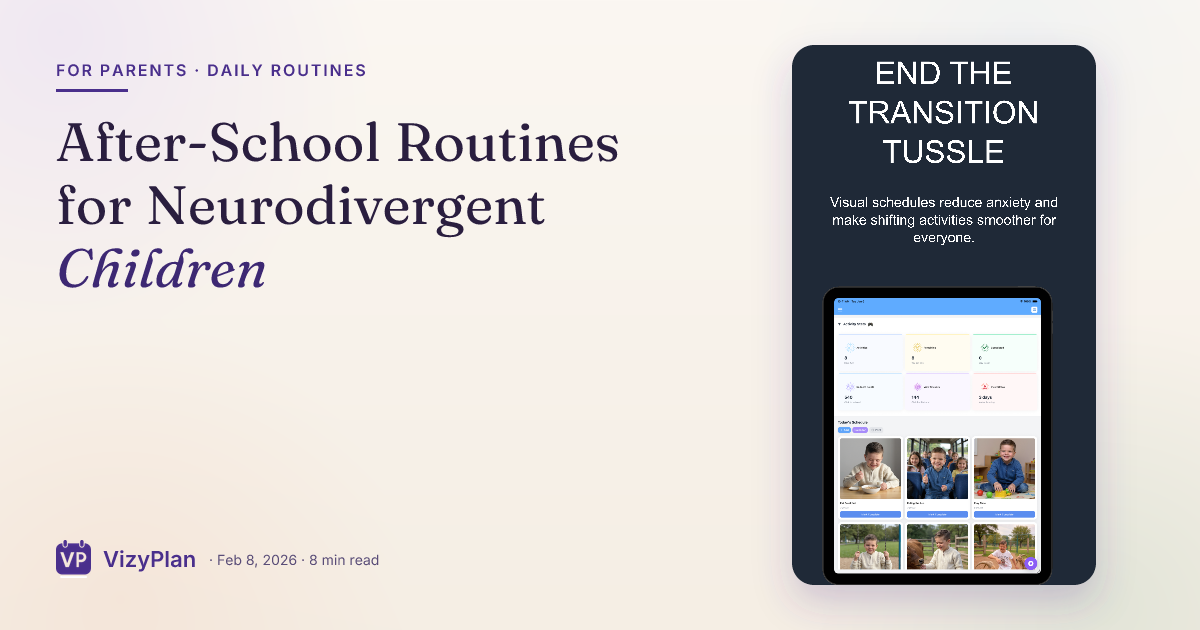
Include preferred activities. The schedule should not be all demands. When children can see that free time or a favorite activity is coming, they are more willing to tolerate the less preferred steps that come before it. VizyPlan's visual schedule feature lets you create a personalized afternoon routine that balances obligations with restorative activities, with images your child connects to.
Build in flexibility markers. Some afternoons your child will need a longer decompression period or a simpler homework session. Having a "flex" option in the visual schedule, perhaps a choice card where they can pick between two acceptable activities, gives them agency without abandoning the routine entirely.
Managing Homework After School
Homework is often the biggest flashpoint of the after-school period.
Timing matters enormously. Many neurodivergent children cannot do homework immediately after school. Their cognitive resources are depleted, and forcing academic work onto an exhausted brain leads to frustration, tears, and work that does not reflect their actual ability. Experiment with different timing: right after the decompression period, after dinner, or even in the morning before school.
Break homework into visual chunks. Rather than presenting the full homework assignment as one block, break it into small steps with a visual checklist. Each completed step gets checked off, providing visible progress and regular doses of accomplishment.
Use a first-then board. "First, complete five math problems. Then, ten minutes of tablet time." The visual structure makes the expectation and reward clear. VizyPlan's first-then functionality provides this structure in a format your child can reference independently.
Advocate for accommodations if needed. If homework consistently causes significant distress, talk to your child's teacher or IEP team. Reduced homework, modified assignments, or alternative formats may be appropriate. The after-school hours are too important for family connection and regulation to be consumed entirely by academic battles.
Tracking After-School Patterns
Understanding your child's after-school patterns helps you optimize the routine.
Log the intensity of after-school meltdowns. Using VizyPlan's emotion tracking, record how your child presents when they arrive home each day. Over time, patterns emerge. Maybe Mondays are hardest because the transition from weekend is still fresh. Maybe gym days are easier because physical activity at school provided some regulation.
Note what helps. Track which decompression activities actually reduce meltdown intensity and duration. You might discover that your child does best with twenty minutes of screen time followed by a physical activity, or that a specific snack consistently improves their afternoon mood.
Communicate patterns to the school. If tracking reveals that certain school activities consistently predict worse after-school collapse, sharing this data with teachers and therapists can lead to in-school accommodations that reduce the buildup.
Adjust the routine seasonally. After-school needs shift with the seasons. Longer daylight in summer may mean more outdoor decompression time. Winter darkness may require adjusting the schedule to accommodate your child's energy levels.
The after-school period is not a parenting failure. It is a natural consequence of the enormous effort your neurodivergent child puts in every day at school. By building a routine that prioritizes regulation before demands, you give your child the space to recover and the structure to navigate the afternoon successfully.
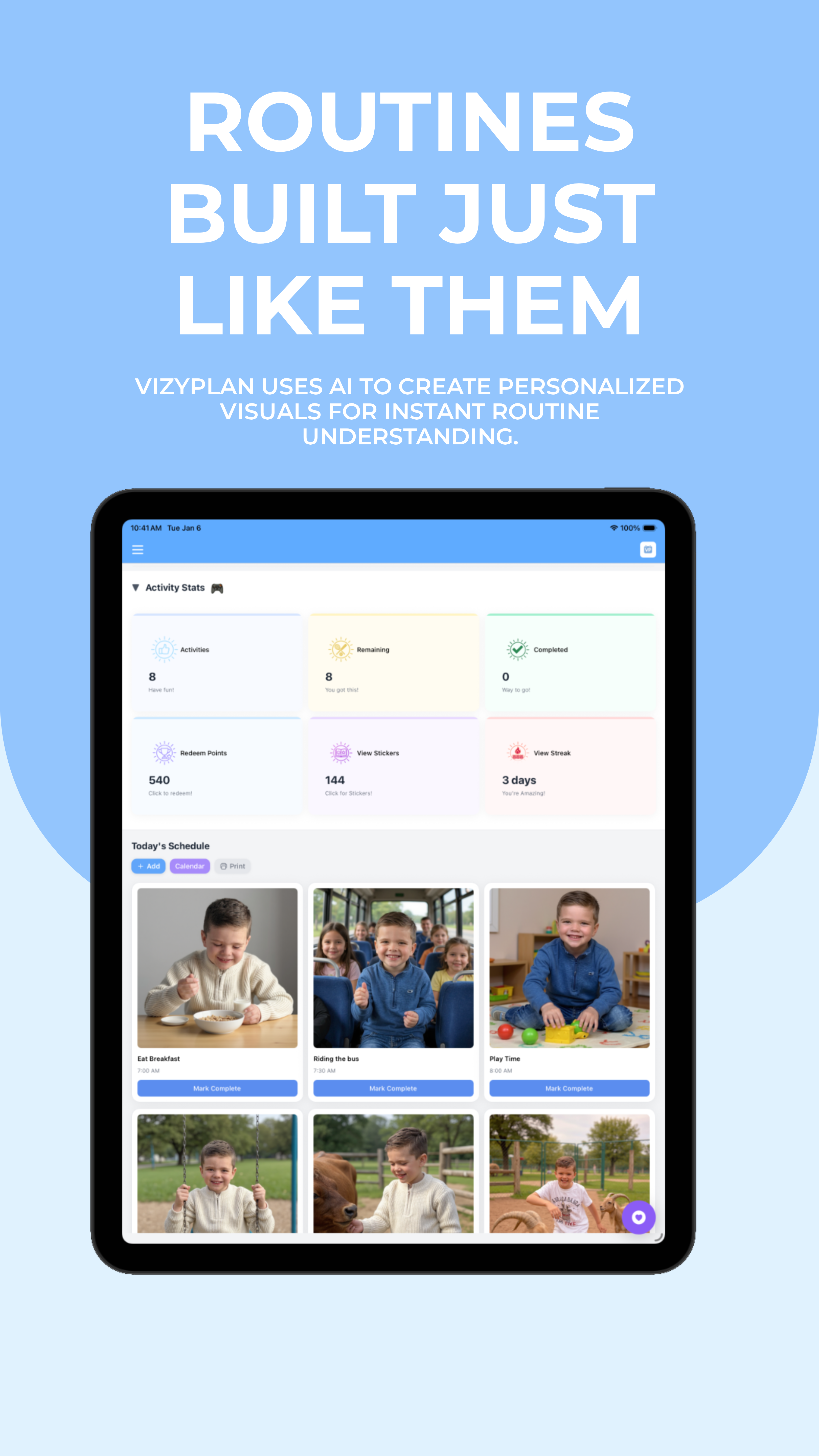
Download VizyPlan and start your 7-day free trial today. Create personalized after-school visual schedules, track emotional patterns, and build routines that turn chaotic afternoons into structured, manageable time. If it helps, keep going for $6.99/month or $59.99/year.