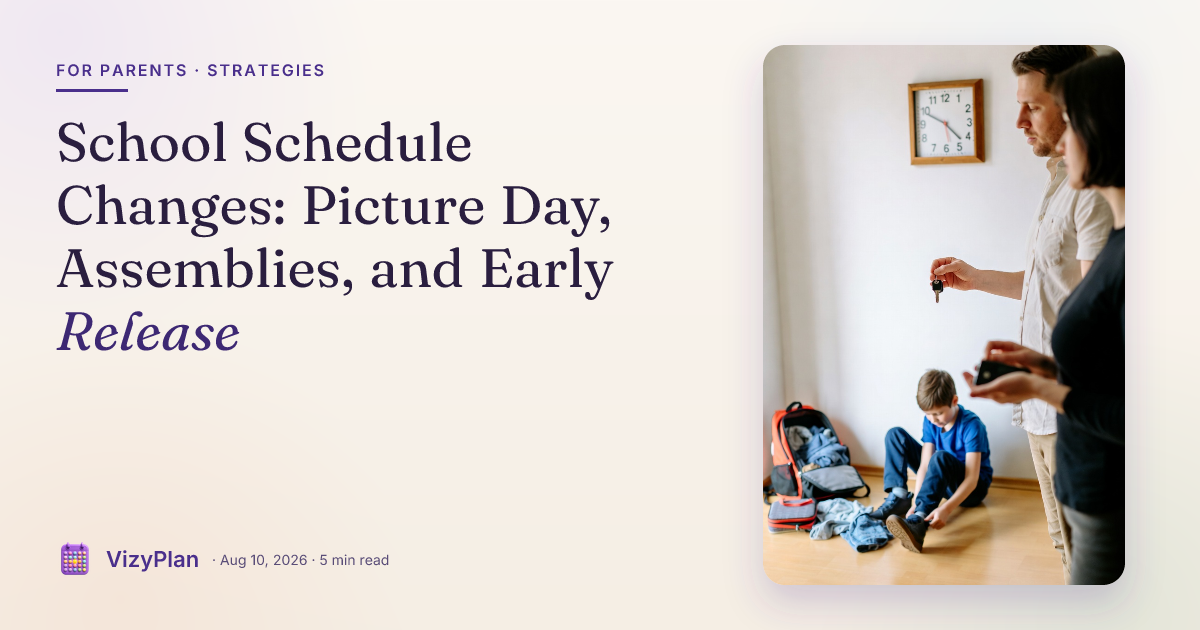

Your child is starting kindergarten in the fall. Or maybe you are moving to a new district mid-year. Or the school just told you your child is switching classrooms because of a staffing change. Whatever the reason, a new school or new classroom is coming, and the knot in your stomach is already tightening.
You know what a routine change does to your child. You have seen what happens when the predictable becomes unpredictable. And now everything, the building, the teacher, the classmates, the schedule, the sensory environment, is about to change at once.
You are right to take this seriously. A 2024 scoping review published in the International Journal of Developmental Disabilities found that the success of school transitions for children with developmental disabilities is highly dependent on the support put in place by both families and the receiving school. Research published in Neuropsychiatric Disease and Treatment identified six essential elements for positive transitions, including school readiness and inclusiveness, collaboration between families and staff, and the child's own perspective being heard.
The good news is that preparation works. The research is clear on this. And the earlier you start, the smoother the transition will be.
Why School Transitions Hit Neurodivergent Children Harder
Before diving into strategies, it helps to understand why this particular transition is so challenging for neurodivergent kids. It is not about being "difficult." It is about how their brains process change.
Everything is new at once. For neurotypical children, a new school means some adjustment. For a child with autism or ADHD, it means every single predictive model their brain has built, where the bathroom is, what the teacher's voice sounds like, which hallway leads where, when lunch happens, is suddenly useless. Their brain has to rebuild from scratch, and that process is cognitively exhausting.
The sensory environment is completely unknown. Every school has its own sensory signature. The pitch of the school bell. The echo in the hallway. The smell of the cafeteria. The lighting in the classroom. Your child has spent months or years adapting to their current environment. A new one means their sensory processing system has to recalibrate to an entirely new set of inputs, and that recalibration takes energy that is no longer available for learning, socializing, or self-regulation.
Social connections must be rebuilt. If your child worked hard to build even one friendship, that bond may be disrupted by a school change. For children who find social connection challenging in the first place, the prospect of starting over can be deeply anxiety-producing. Research consistently shows that social difficulty and peer exclusion are among the biggest challenges neurodivergent children face during school transitions.
The adults are strangers. Your child's current teacher probably understands their cues, their triggers, and their strengths. A new teacher does not. Neither does the new aide, the new lunch monitor, or the new bus driver. Every trusted adult relationship has to be rebuilt, and trust does not happen on a schedule.
Kindergarten: The First Big Transition
If your child is heading to kindergarten, this is likely their first experience with formal schooling. The stakes feel enormous, and the preparation needs to be intentional.
Start Months Ahead, Not Weeks
The research on school readiness for neurodivergent children is clear: gradual preparation outperforms last-minute cramming every time.
Practice school-like routines at home. Two to three months before kindergarten starts, begin building a morning routine that mirrors what the school day will require. Wake up at the same time. Get dressed. Eat breakfast at the table. Put on shoes. Practice the backpack. Walk to the car or bus stop. The more these steps feel automatic before school starts, the less cognitive energy your child will need on the first day.
Build independence in key self-care skills. Kindergarten teachers consistently report that the most helpful school readiness skills are independence, problem-solving, and emotional regulation. Practice opening and closing lunchboxes, unwrapping snacks, managing jacket zippers, using the bathroom independently, and washing hands. These micro-skills reduce the number of moments your child has to ask for help from an unfamiliar adult, which reduces anxiety.
Work on sitting and attending in small doses. This is not about forcing your child to sit perfectly still. It is about gradually building their capacity for structured activity time. Start with five minutes of a structured table activity and build up over weeks. Use a visual timer so your child can see how long the activity will last. Celebrate what they accomplish, not how still they sat.
Practice separations. If your child has not spent time away from you in a structured setting, start now. Short, positive separations with a trusted caregiver build the emotional muscle needed for school drop-off. If your child already attends daycare or preschool, talk to those providers about gradually increasing the structure and expectations to better mirror a kindergarten classroom.
Visit the School Before Day One
This is one of the most impactful things you can do. Contact the school and ask for a private tour when the building is quiet, before the school year starts. Walk the hallways with your child. Find the bathroom. Sit in the classroom. Touch the desk. Look at the playground. Let your child build a mental map of the space without the added stress of hundreds of other children.
If the school allows it, visit more than once. Each visit makes the environment slightly more familiar, which reduces the novelty response that triggers anxiety. Take photos during the visit and use them to create a social story about what school will look like.
Meet the teacher in advance. Request a brief meeting with your child's teacher before the first day. Bring a one-page summary of your child: their strengths, their triggers, how they communicate best, what calms them, and what support they need. This is not about handing the teacher a manual. It is about starting the relationship with information rather than incidents.
Prepare a Sensory Toolkit
Work with your child to assemble a small kit they can keep in their backpack: noise-reducing earplugs or earbuds, a favorite fidget tool, a chewing tool if they use one, and a comfort item if the school allows it. Knowing they have their tools available reduces anxiety about the sensory environment. Communicate with the teacher in advance about what your child has and why they need it.
Moving to a New School Mid-Year
A mid-year school change comes with its own set of challenges. Your child does not have the natural on-ramp of a new school year where everyone is adjusting. They are walking into an established ecosystem where friendships are formed, routines are set, and they are the unknown variable.
Transfer Documentation Proactively
Do not assume the schools will handle this smoothly. Request your child's complete records from the current school before the transition, including the current IEP or 504 plan, most recent evaluations, progress reports, behavioral plans, and any informal notes about strategies that work. Hand-deliver copies to the new school rather than relying on the transfer process.
If your child has an IEP, the new school must implement it as written until they either adopt it or hold a meeting to develop a new one. Know this. Enforce it. Do not accept "We do things differently here" as a reason to abandon accommodations that are legally required.
Create a Transition Timeline
Give your child a visual countdown to the change. Use a calendar they can see and interact with. Mark the last day at the current school, the days off in between (if any), and the first day at the new school. Build in specific events they can look forward to, like a goodbye lunch with their current class or a visit to the new school.
VizyPlan makes this easy. You can create a visual schedule of the transition itself, showing your child each step of the process with personalized AI-generated images. When a child can see what is coming, the uncertainty that fuels anxiety decreases.
Enjoying this article?
Get practical tips and insights delivered to your inbox — no spam, ever.
Address the Grief
Leaving a school means leaving behind people, routines, and places your child has grown attached to. Even if the move is positive, your child may grieve what they are losing. Acknowledge it. Saying "You are going to love your new school!" dismisses their feelings. Saying "It makes sense that you feel sad about leaving. We can talk about what you will miss, and we can also talk about what might be good about the new school" validates their experience while keeping the door open for hope.
For children who struggle to articulate their feelings, emotion check-ins using visual tools can help them express what they are processing. A feelings chart, a simple thumbs up or down, or VizyPlan's emotion tracking feature gives them a way to communicate without needing to find the words.
Switching Classrooms Within the Same School
Sometimes the transition is not a new building but a new classroom, a new teacher, or a new set of classmates. Parents sometimes underestimate how disruptive this can be for a neurodivergent child. The school is familiar, but the micro-environment has shifted, and for a child who relies on predictability, that shift can feel enormous.
Acknowledge That This Is a Big Deal
Adults may say "It is just a new classroom" or "It is the same school." For your child, it is not "just" anything. Their safe person is gone. The desk arrangement is different. The rules might be slightly different. The tone of voice is different. The schedule is different. Every one of those changes requires adaptation, and adaptation costs energy.
Build a Bridge Between Old and New
Ask the school if your child can visit the new classroom before the switch. Can they meet the new teacher briefly? Can they see where their desk will be? Can they take a photo of the new classroom to look at before the transition day?
If your child had strategies that worked in the old classroom, communicate those to the new teacher. Write them down. Do not assume the information will be passed along verbally. Bring the same visual supports your child used before and ask the new teacher to incorporate them from day one so there is at least one thread of familiarity.
Create a New Visual Schedule Immediately
Do not wait to see what the new routine looks like. Get the schedule from the new teacher as soon as possible and build a visual version your child can study and reference. When the daily flow is visible and predictable, the number of surprises drops, and with it, the anxiety.
What to Do in the First Two Weeks
No matter what type of school transition your child is making, the first two weeks set the tone for everything that follows.
Lower expectations at home. Your child is spending massive amounts of energy adapting to the new environment. They may come home exhausted, dysregulated, or operating on empty. This is not the time to add new demands. Protect their after-school decompression time. Let them stim, rest, and recharge.
Expect regression. Skills your child had mastered, bedtime routines, morning routines, emotional regulation, may temporarily slip. This is normal and expected. The brain is allocating resources to processing the new environment, and other systems temporarily lose bandwidth. Do not panic. Gently support the routines without pressure, and they will come back. For a deeper look at this pattern, see our guide on regression after routine disruption.
Check in daily, but do not interrogate. Instead of "How was school?" (which is too vague for many neurodivergent children), try specific questions: "Did you eat your snack today?" "Did you go to the playground?" "What was the hardest part?" Or use a visual check-in tool where your child can point to how they felt rather than explaining it in words.
Communicate with the school proactively. Send the teacher a brief email after the first week. Ask how your child is adjusting. Share anything you are seeing at home that the school should know about. Establish yourself as a partner early so small issues get addressed before they become big ones.
Celebrate small wins loudly. Your child walked into the building without crying? That is a win. They ate lunch in the cafeteria? Win. They told you one thing about their new classroom? Win. The first two weeks are about survival and adaptation, not perfection. Reward systems that recognize effort and bravery, not just achievement, build the resilience your child needs to keep going.
When to Worry vs. When to Wait
Every child's adjustment timeline is different. Some neurodivergent children adapt within a few weeks. Others need a full semester. Research suggests that children with developmental disabilities may need eight to twelve weeks to fully adjust to a significant routine change.
Wait if: Your child is gradually improving week over week, even slowly. They are eating, sleeping, and engaging in some positive way. They have hard moments but also have moments of connection or enjoyment.
Worry if: Your child is regressing significantly after the first month with no improvement. They are refusing to eat at school, having daily meltdowns that are escalating in intensity, showing signs of school refusal, or expressing things like "I hate myself" or "Nobody likes me." These are signals that the current level of support is not sufficient and the school team needs to be involved immediately.
If your child has an IEP, request a meeting to discuss whether the transition plan is adequate and whether additional supports are needed. If they do not have an IEP and are struggling significantly, this may be the time to request an evaluation.
You Know Your Child Best
School transitions are hard. They are hard for your child, and they are hard for you. Watching your child walk into a building full of strangers, knowing how much energy it will cost them, knowing they do not yet have a safe person or a familiar routine, is one of the harder parts of this parenting journey.
But preparation matters. The research proves it, and your experience probably confirms it. A child who has practiced the routine, visited the building, met the teacher, studied the visual schedule, and packed their sensory toolkit is a child who walks through that door with more resources than a child who was dropped into the unknown.
You cannot eliminate the challenge. But you can reduce the number of unknowns. And for a brain that thrives on predictability, every unknown you remove is a gift.
Download VizyPlan and start your 7-day free trial today. Build visual schedules for the new school routine, create social stories that prepare your child for what is coming, and track their emotional adjustment through the transition. If it helps, keep going for $6.99/month or $59.99/year.
VizyPlan helps families of neurodivergent children prepare for every transition with visual routines, social stories, and emotion tracking that turns the unknown into the familiar. Start your free trial and give your child the preparation they deserve.