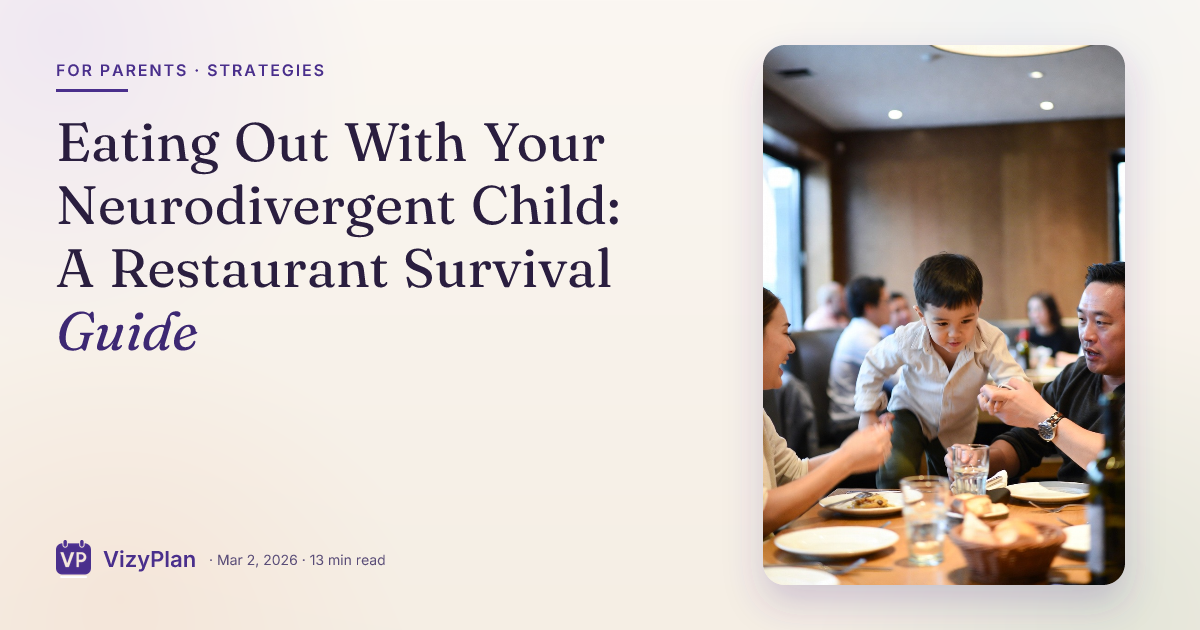
The last time you tried to eat at a restaurant with your child, you lasted eleven minutes. You know because you watched the clock the entire time. The music was too loud. The menu had nothing they would eat. The wait for food felt infinite, and your child was under the table before the appetizers arrived. You paid for food no one touched, carried a screaming child to the car, and sat in the parking lot wondering why you even tried.
You have probably stopped trying. Most families in your situation have. When every restaurant visit ends in a meltdown, a judgment-filled stare from a stranger, or food that goes completely untouched, the logical response is to stop going. And for a while, that works. But it also means your family misses birthday dinners, celebrations with friends, vacations where eating out is unavoidable, and the simple experience of sharing a meal together somewhere that is not your kitchen.
Here is the truth the research supports: dining out with a neurodivergent child is genuinely harder than dining out with a neurotypical child. But it is not impossible. It takes preparation, the right tools, and a willingness to redefine what "success" looks like at a restaurant.
Why Restaurants Are the Perfect Storm
A restaurant combines nearly every challenge a neurodivergent child faces into a single environment. Understanding why it is so hard is the first step to making it manageable.
The Sensory Assault
A 2021 scientific review found that 50 to 70 percent of autistic people are hypersensitive to everyday sounds. A typical busy restaurant operates at 70 to 80 decibels, with clattering dishes, background music, conversations from surrounding tables, and kitchen noise layering on top of each other. For a child whose nervous system is already working overtime to filter sensory input, a restaurant can feel like being trapped inside a noise machine with no off switch.
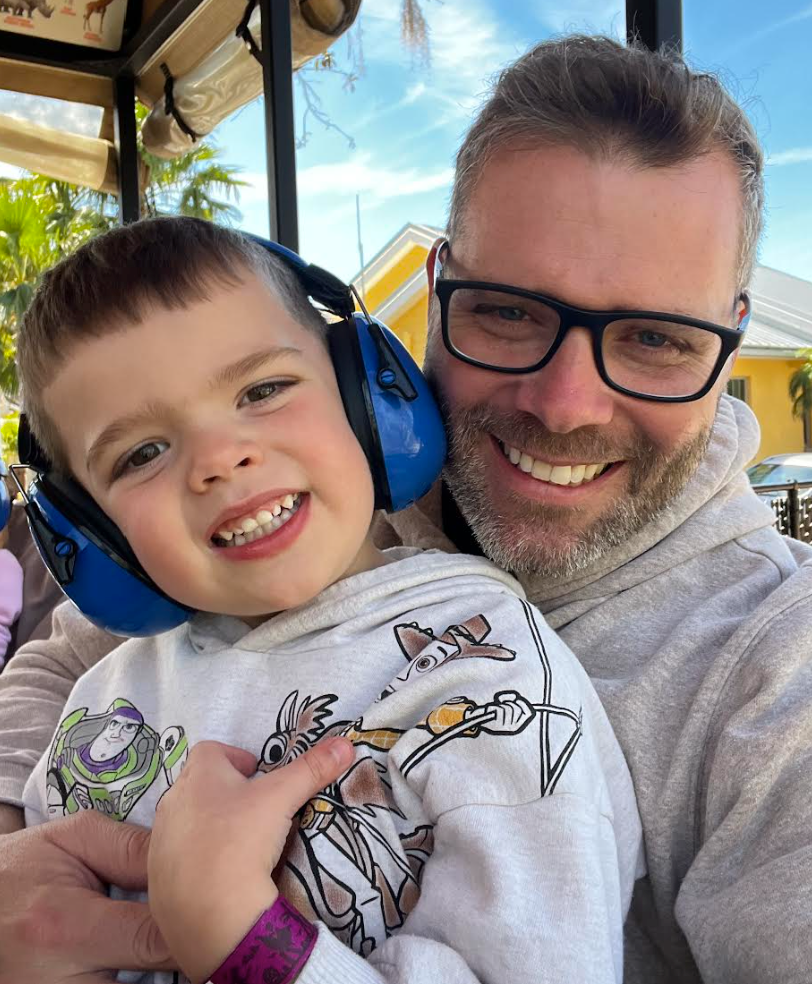
Research from Frontiers in Psychiatry confirms that autistic children show increased neural resource recruitment in noisy environments, meaning their brains are working significantly harder to process sound than neurotypical peers. Noise-cancelling headphones can reduce surrounding noise by up to 20 decibels, which is often the difference between "I can handle this" and a full meltdown.
But sound is only part of it. Bright overhead lighting, unfamiliar smells from other people's food, the visual chaos of a busy dining room, the texture of an unfamiliar booth seat, the temperature of the air conditioning blowing directly onto their skin. Every sense is being activated simultaneously in an environment your child did not choose and cannot control.
The Food Problem
Research shows that eating problems affect 51 to 69 percent of autistic children, which is five times higher than in neurotypical peers. A study published in the Journal of the American Dietetic Association found that food textures are the primary reason for food refusal in autistic children. Some children have food repertoires limited to as few as five foods.
This is not picky eating. For many neurodivergent children, this is a genuine sensory and sometimes medical condition. ARFID (Avoidant Restrictive Food Intake Disorder) co-occurs with autism in an estimated 12.5 to 33.3 percent of cases, according to research reviewed by the Priory Group. Children with ARFID are not being difficult. Their nervous system is rejecting foods that feel unsafe based on texture, smell, temperature, appearance, or even brand.
Now put that child in a restaurant where the menu is unfamiliar, the preparation method is unknown, and the food looks and tastes different from what they eat at home. Even if the restaurant serves chicken nuggets, they are not the same chicken nuggets. The breading is different. The shape is different. The sauce on the side is the wrong color. For a child who depends on food sameness for safety, an unfamiliar restaurant plate can trigger the same fight-or-flight response as any other perceived threat.
The Waiting Problem
Children with ADHD find waiting excruciating. Research confirms that impulsivity, difficulty staying seated, and restlessness are core features that become especially visible in public settings. The NIMH describes hyperactive-impulsive symptoms as including being unable to stay seated, running or climbing at inappropriate times, and difficulty waiting for their turn.
A restaurant requires waiting at nearly every stage: waiting to be seated, waiting to order, waiting for food, waiting for the check. For a neurotypical child, this is boring. For a child with ADHD, each waiting period is a battle between their brain's need for stimulation and the social expectation to sit still and be quiet. That is a battle they will lose more often than not, and it is not because they are choosing to misbehave.
The Judgment Factor
Research consistently shows that families of autistic children experience enacted stigma in public settings. Parents worry that their child's behavior is "being attributed to bad parenting, laziness, or lack of motivation," because there is often no visible indicator explaining why the child is struggling. Studies confirm that autism-related stigma negatively impacts family wellbeing, including mental health and social connections.
Many families simply stop eating out to avoid the judgment. That avoidance protects your mental health in the short term, but it also shrinks your family's world over time.

Before You Go: The Preparation That Changes Everything
The difference between a restaurant meltdown and a manageable meal almost always comes down to what happens before you walk through the door.
Choose the Right Restaurant
Not all restaurants are created equal for neurodivergent families.
- Noise level matters most. Avoid restaurants with hard surfaces, open kitchens, and loud music. Look for places with carpet, booth seating, sound-absorbing materials, and separate dining areas. Some restaurants now offer designated "quiet hours" with reduced music and dimmer lighting.
- Menu familiarity is critical. Check the menu online before you go. If your child eats five foods, make sure at least one of them is on the menu, prepared in a way your child will accept. Call ahead and ask if the kitchen can accommodate modifications (plain pasta, unbreaded chicken, specific brands of condiments).
- Fast service reduces wait time. For early attempts, consider restaurants where food arrives quickly: fast-casual, counter-service, or family-friendly chains with predictable menus. The goal is not a Michelin-starred experience. The goal is a successful meal outside your home.
- Time it right. The Marcus Autism Center specifically recommends visiting during off-peak hours. A Tuesday at 4:30 PM is a fundamentally different sensory experience than a Saturday at 7:00 PM. Less noise, fewer people, faster service, more space.
Build a Restaurant Social Story
Social stories are one of the most evidence-based tools for preparing autistic children for new experiences. Research from the Pennsylvania Autism Self-Advocacy Coalition (PAAutism) and multiple occupational therapy organizations confirm that social stories help children understand restaurant procedures step by step.
Build a simple visual story that walks through the entire sequence:
- "We are going to a restaurant called [name]. Here is a picture of it."
- "We will walk in and wait to be seated. This might take a few minutes."
- "We will sit at a table and look at the menu. I already know what I want to order."
- "We will tell the server what we want. Mom or Dad can order for me if I want."
- "We will wait for our food. I can play with my activity bag while I wait."
- "When the food comes, I will eat. If I do not like it, I have my safe snack."
- "When we are done, we will pay and leave. I did it."
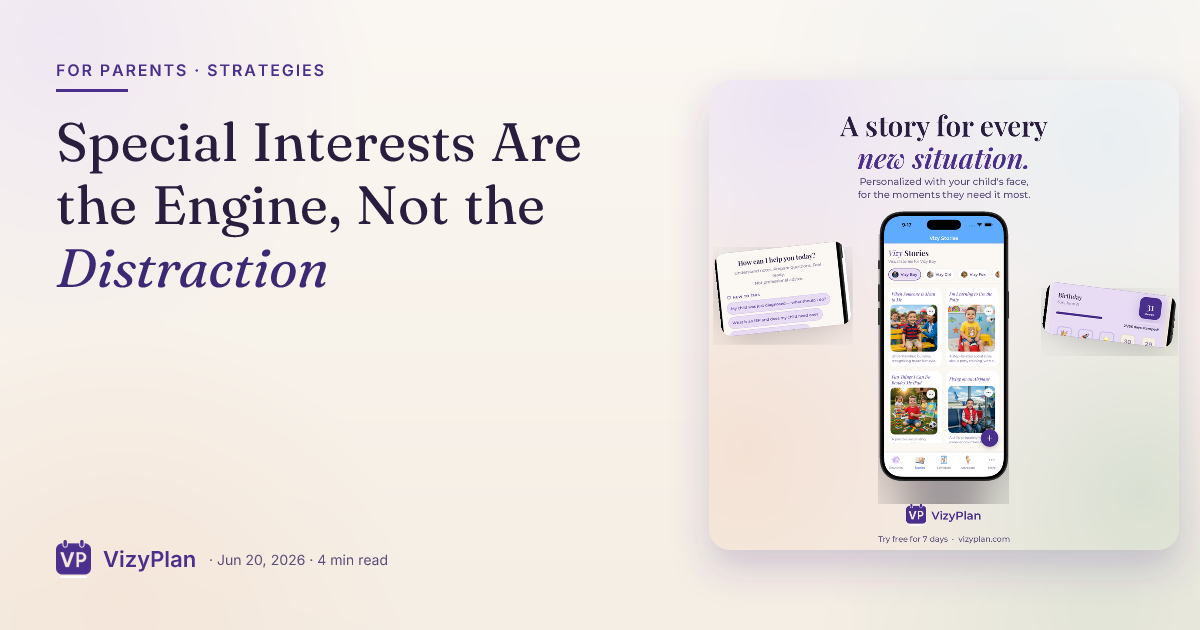
VizyPlan lets you create personalized restaurant social stories with AI-generated images that show your child in the actual setting, making the experience concrete and recognizable before you ever leave the house.
Preview the Menu Together
Do not wait until you are sitting at the table to figure out what your child will eat. That adds decision-making pressure to an already overwhelming environment.
Pull up the menu at home. Let your child look at pictures of the food (many restaurant websites have photos). Decide together what they will order. If nothing on the menu works, plan to bring a safe food from home. The Marcus Autism Center explicitly recommends bringing preferred foods to ensure your child will eat and to minimize disruptive behavior. This is not cheating. This is smart planning.
Practice at Home
Set up a practice restaurant experience at your kitchen table. Use a printed menu (or make one). Take turns being the server. Practice the sequence: sitting down, looking at the menu, ordering, waiting, eating, and saying thank you. The more familiar the sequence becomes in a safe environment, the less overwhelming it will be in a real one.
Research on graduated exposure for autistic children confirms that systematic desensitization, starting with familiar environments and gradually increasing challenge, is an evidence-based approach to reducing anxiety around new experiences.
What to Pack: Your Restaurant Survival Kit
Never go to a restaurant empty-handed. Your preparation bag is not optional. It is infrastructure.
Sensory Tools
- Noise-cancelling headphones. Research shows these reduce environmental noise by up to 20 decibels, which can make a busy restaurant tolerable for a sound-sensitive child.
- Fidget toys or sensory tools. Whatever helps your child stay regulated in other settings will help here too.
- Sunglasses or a hat with a brim if your child is sensitive to overhead lighting.
- A familiar comfort object that provides grounding.
Waiting Tools
- A visual timer. Research from the Texas SPED Support Autism Toolkit confirms that visual timers reduce anxiety and problem behaviors during waiting periods. Set it when food is ordered so your child can see the time passing rather than experiencing it as endless.
- A first-then board. "First we wait, then we eat." "First we eat, then we get dessert." Making the sequence visible gives your child something to hold onto.
- An activity bag. Coloring supplies, a small puzzle, a preferred book, or a tablet with headphones. This is not about screen time philosophy. This is about making it through the meal.
Food Backup
- Safe snacks from home. If the restaurant food does not work, your child still eats. Hunger plus sensory overload plus unfamiliar food is a guaranteed meltdown recipe.
- Familiar utensils or cups if your child is sensitive to how silverware feels or how a cup's rim touches their lips.
- Preferred condiments in small containers. If your child only eats ketchup from a specific brand, bring it.
During the Meal: Strategies That Actually Work
Manage the Environment
- Request a booth away from the kitchen, bathroom, and entrance. Booths provide physical boundaries that help a child feel contained rather than exposed. The Marcus Autism Center specifically recommends this.
- Sit near an exit so you can step outside quickly if your child needs a sensory break without making a scene.
- Ask for the check when your food arrives. This is a widely recommended strategy from multiple autism centers. It means the moment your child is done eating, you can leave immediately. No waiting for the server. No extra ten minutes of sitting still while your child is maxed out.
- Reduce visual clutter at the table. Move salt shakers, sugar caddies, and table advertisements out of reach if they are distracting or overwhelming.
Support Your Child Through the Wait
The wait for food is where most restaurant visits fall apart. Your child has been managing sensory input, sitting still, and coping with an unfamiliar environment, and now they have to do all of that while hungry.
- Set the visual timer as soon as you order. "Our food will come in about this much time. You can watch the timer."
- Engage them with the activity bag. Do not save it as a last resort. Hand it over proactively.
- Offer specific praise. "You are doing a great job sitting in your spot and waiting." Research on behavior management confirms that specific positive reinforcement during the desired behavior is more effective than correction after the undesired behavior.
- Take movement breaks. If your child needs to move, walk to the bathroom, step outside for thirty seconds, or walk the perimeter of the waiting area. Movement is regulation, not misbehavior.
- Use the waiting strategies you have practiced at home. If your child has a visual waiting routine, bring it.
Handle the Food
- Do not force new foods. A restaurant is the worst possible environment for food exposure therapy. The goal is for your child to eat something, feel comfortable, and have a positive experience. Expanding food repertoire happens at home in a controlled, low-pressure setting.
- Let them eat their safe food without commentary. If they brought crackers from home and that is what they eat while everyone else has pasta, that is a win. They are sitting at a restaurant eating a meal with their family.
- Modify without apology. Ask for sauce on the side, plain noodles, bread with nothing on it, a separate plate so foods do not touch. Good restaurants will accommodate. If a server seems annoyed, that is a server problem, not a you problem.
When It Goes Wrong (Because Sometimes It Will)
Even with perfect preparation, some restaurant visits will not work. That is not failure. That is reality.
Have an Exit Plan
Before you sit down, decide with your co-parent or partner what the exit signal looks like. Maybe it is a specific word. Maybe it is one parent taking the child outside while the other gets the food boxed up. Whatever it is, agree on it beforehand so you are not negotiating in the middle of a meltdown.
Do Not Punish the Meltdown
Your child is not melting down because they are being bad. They are melting down because their nervous system is overwhelmed. Punishing a meltdown teaches your child that restaurants are places where they get in trouble, which guarantees they will resist going next time. Instead, calmly leave, validate their experience ("That was really loud in there. I understand"), and try again another day.
Reframe Success
A successful restaurant visit does not have to mean sitting for a full meal, ordering from the menu, and eating politely for an hour. Success might look like:
- Walking into the restaurant and sitting for five minutes before leaving
- Ordering a drink and staying for ten minutes
- Eating a safe snack from home while the family eats restaurant food
- Making it through the main course before needing to leave
Every positive experience, no matter how short, builds your child's tolerance and confidence. This is graduated exposure in action. Research confirms that systematic, positive exposures over time reduce anxiety and increase comfort with new environments.
Building Toward Longer Meals
Think of restaurant visits as a skill you are building over months, not a test you pass or fail on any single outing.
The Graduated Exposure Approach
Research on systematic desensitization confirms this approach works for reducing anxiety around new environments:
1. Week 1-2: Drive past the restaurant. Talk about it. Look at pictures online. 2. Week 3-4: Walk inside the restaurant during off-hours. Look around. Leave. 3. Week 5-6: Sit at a table for 5 minutes. Have a drink. Leave. 4. Week 7-8: Order one item. Eat quickly. Leave. 5. Week 9+: Gradually extend the visit as your child's tolerance builds.
Each step should end positively. If your child gets overwhelmed at step 3, do not push to step 4. Stay at step 3 until it feels comfortable. Then move forward.
Track What Works
After each restaurant visit, note what went well and what did not. Which seat worked best? What time of day was easiest? Which foods did your child actually eat? What sensory tools helped? VizyPlan lets you track your child's emotions and behaviors across outings, helping you spot patterns that inform your next visit.
Celebrate Every Win
Your child sat at a restaurant table for twenty minutes and ate crackers from a bag you brought from home while wearing noise-cancelling headphones. That is worth celebrating. Genuinely. Because last month, they would not walk through the door. Progress in neurodivergent parenting does not always look the way the world expects it to look, but it is still progress.
The Sensory-Friendly Movement Is Growing
The good news is that the restaurant industry is starting to pay attention. Sensory-friendly dining initiatives are expanding across the country:
- Organizations like Autism Eats host sensory-friendly dining events where music is turned off, lights are dimmed, and families eat without judgment.
- Some restaurants now offer "Busy Buddy Sensory Boxes" with earphones and fidget toys for children who need support.
- Staff training programs are helping servers understand how to interact with neurodivergent customers, from speaking in clear and direct language to giving families extra time without hovering.
- The CDC reports that approximately 1 in 31 children are now diagnosed with ASD. The demand for inclusive dining is not niche. It is a growing need that smart restaurants are beginning to address.
You can help this movement by giving feedback. When a restaurant accommodates your family well, tell them. Leave a review mentioning their flexibility. When you find a server who gets it, ask for them by name next time. Building a roster of restaurants that work for your child means you always have a go-to option when your family wants to eat out.
Your Family Deserves a Seat at the Table
Eating out with a neurodivergent child takes more work than most people will ever understand. It takes planning that starts days before the meal. It takes a bag packed with tools that other families never think about. It takes a willingness to leave a restaurant eleven minutes in and call it a victory because last time it was seven.
But your family deserves to eat at restaurants. Your child deserves the experience of sitting in a booth, picking something from a menu, and watching a server bring food to the table. They deserve birthday dinners and vacation meals and the simple pleasure of not having to eat every single meal at the same kitchen table.
Start small. Pick one restaurant. Build the social story. Pack the bag. Go on a Tuesday at 4:30. Stay for fifteen minutes or stay for an hour. Whatever your child can handle today is enough.
Download VizyPlan and start your 7-day free trial today. Build restaurant social stories with AI-generated visuals your child recognizes, create visual waiting timers and first-then boards for dining out, track what works across restaurant visits to spot patterns, and give your child the preparation that turns stressful meals into family memories. If it helps, keep going for $6.99/month or $59.99/year.