
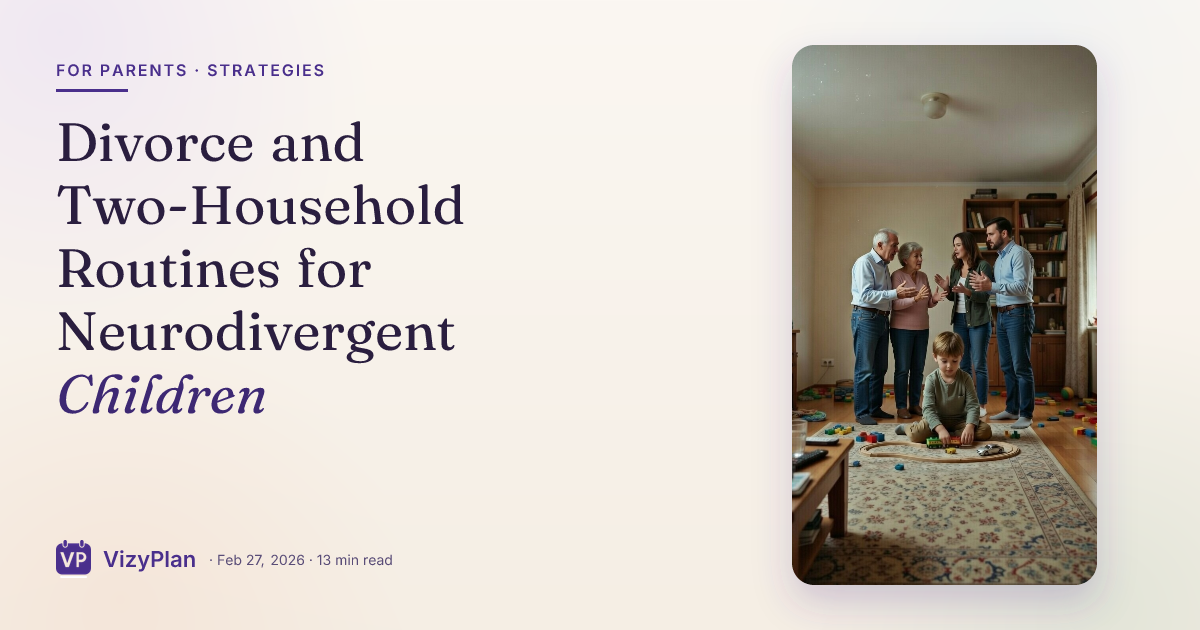
You are sitting in your car in the driveway, and your child is in the backseat refusing to unbuckle. It is Sunday evening. The handoff. Again. They were fine ten minutes ago, but the moment you pulled onto this street, the one that leads to their other parent's house, the meltdown started. The screaming. The kicking. The "I want to go home" that splits your heart in two because both houses are supposed to be home now.
This is not a tantrum. This is not defiance. This is a neurodivergent child whose entire nervous system is reacting to a transition that most adults struggle with, and your child is being asked to do it every single week.
If this is your life right now, you need to know something: the research says this is genuinely harder for your family. Not because you are doing it wrong. Because the way divorce typically works was not designed for a child who depends on predictability to feel safe.
The Numbers Behind the Stress
Divorce rates in families raising neurodivergent children tell a story that most parents already feel in their bones.
Hartley et al. (2010) conducted a landmark longitudinal study of 391 families and found that parents of children with autism have a divorce rate of 23.5% compared to 13.8% in comparison families. That alone is significant. But the more revealing finding was about timing: in families without autism, divorce risk drops substantially after the child turns eight. In autism families, the risk stays elevated through adolescence and into adulthood. The stress does not ease as children grow. It persists.
For ADHD families, the numbers are even more pronounced. A large-scale Danish study by Kvist et al. examined over 172,000 parent couples and found that parents of children diagnosed with ADHD were 75% more likely to divorce within ten years of the child's birth. Wymbs et al. (2008) at the University of Buffalo found that 22.7% of parents of children with ADHD had divorced by the time the child turned eight, compared to 12.6% in comparison families.
A 2023 literature review published in Children confirmed that ADHD families face a higher divorce risk than ASD families. The researchers believe this is partly because ADHD behavioral challenges tend to emerge later (school age), giving parents less time to adapt, while ASD is typically diagnosed earlier, allowing more time for developing coping strategies and accessing support services.
One thing the research is clear about: the commonly cited statistic that 80% of autism families end in divorce is a myth. Freedman et al. (2013) thoroughly debunked it. The real numbers are concerning enough without inflating them.
And here is what matters most for this conversation: the research consistently shows that "divorce does not appear to be specifically related to a diagnosed pathology of the child, but rather presents itself as a risk factor in certain situations." In other words, the divorce is not your child's fault. It never was.
Why Divorce Hits Neurodivergent Children Differently
Every child is affected by divorce. But neurodivergent children face a specific set of challenges that amplify the disruption in ways most divorce resources never address.
Routine Disruption Destabilizes Their Foundation
Insistence on sameness is a core feature of autism in the DSM-5. Research consistently shows that predictable routines serve as a self-regulation strategy for neurodivergent children, reducing anxiety and providing a sense of control in an otherwise overwhelming world. When divorce fractures the daily routine, it does not just inconvenience your child. It removes their primary coping mechanism.
We have data on what happens when routines collapse for autistic children. COVID-19 pandemic research showed that from routine disruption alone (without the added layer of family breakup), 51.9% of autistic children experienced behavioral changes, 57% showed skill regression, and 61.59% of parents reported increased meltdowns. Now add the emotional weight of divorce on top of that.
Transitions Between Homes Trigger the Nervous System
Research from Brown University Health confirms that children with ASD are "prone to anxiety, which can impact behavior during times of change or transition." The Indiana University Resource Center for Autism explains that this is driven by "a greater need for predictability, challenges in understanding what activity will be coming next, or difficulty when a pattern of behavior is disrupted."
Every custody handoff is a transition. A big one. Your child is shifting environments, adjusting to different sensory landscapes, recalibrating to potentially different rules and routines, and processing the emotional complexity of leaving one parent to be with the other. For a child who struggles with transitioning between activities at home, moving between two entirely different households is exponentially harder.
Emotional Processing Takes a Different Path
Children with ADHD "may struggle to manage their emotions, and their parents' divorce might cause them to go through a series of complex emotions causing outbursts or retreat," according to CHADD (Children and Adults with Attention-Deficit/Hyperactivity Disorder). Some children with ADHD fixate on ways they could have prevented the divorce, replaying scenarios endlessly.
Autistic children may react in ways that seem unexpected. Pathfinders for Autism notes that "children with Autism may react in a way that we would deem inappropriate," like laughing, which may reflect relief rather than humor. Some children show no visible reaction initially and then have a delayed response days or weeks later. Do not assume a calm reaction means they are fine. Give space for processing that may not look the way you expect.
How to Tell Your Neurodivergent Child About the Divorce
The conversation itself requires a different approach than what most divorce guides recommend.
Use Concrete, Direct Language
Skip the euphemisms. "Mommy and Daddy are going through some changes" is vague and confusing for a concrete thinker. Instead, say exactly what is happening: "Mommy and Daddy are not going to live in the same house anymore. You are going to have two houses. We both love you, and that will never change."
Pathfinders for Autism recommends that "young children may not need information beyond the fact that you and your spouse will be living in different houses." Do not over-explain the reasons for the divorce. That is adult information. Your child needs to know what is changing in their daily life, not why it is changing.
Focus on What They Care About
Children want to know what is going to happen to their world. Will they still go to the same school? Will they keep their toys? Will the dog come with them? Will they still see Grandma? Address these concrete details directly. For a neurodivergent child, these specific anchors matter more than abstract reassurances about everything being "okay."
Create a Social Story
Social stories are one of the most evidence-based tools for helping autistic children understand new situations. Build a simple story with real photos that walks through the new arrangement:
- "On Monday, Tuesday, and Wednesday, I live at Mommy's house. Mommy's house has my blue room."
- "On Thursday and Friday, I live at Daddy's house. Daddy's house has my toy shelf."
- "On weekends, I go back to Mommy's house. We always follow my schedule."
- "Both houses have my things. Both parents love me."
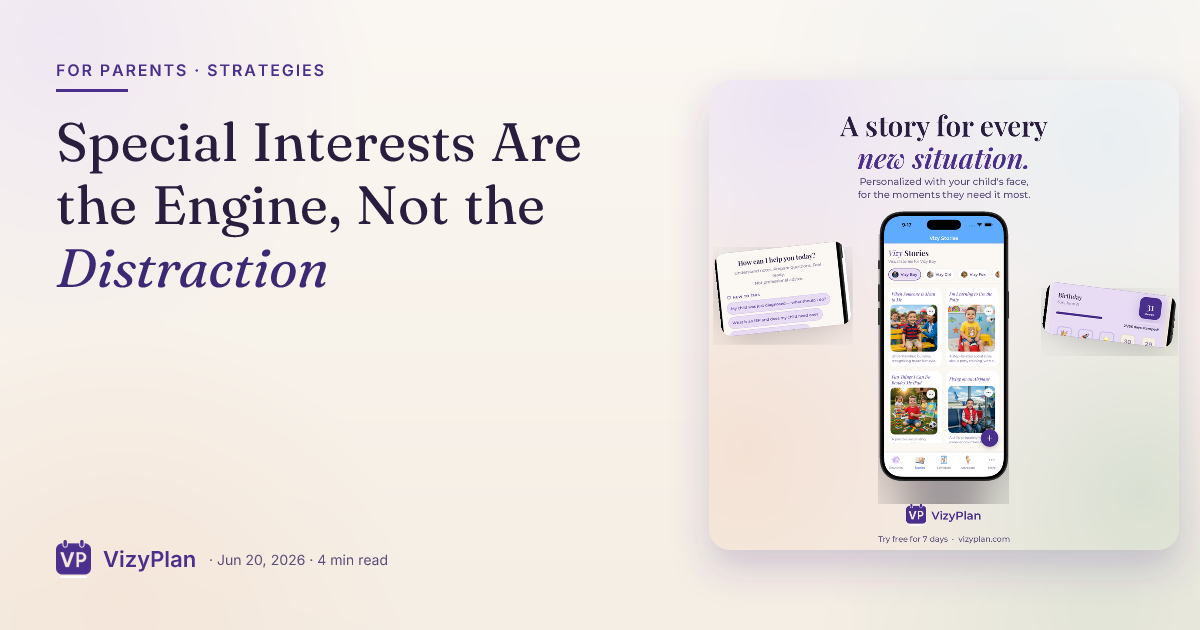
VizyPlan lets you create personalized social stories with AI-generated images that show your child's actual living situations, making the narrative concrete and recognizable rather than generic.
Prepare for the Unexpected
Your child might have questions you did not anticipate. They might ask the same question repeatedly for weeks. They might seem fine and then melt down at bedtime three days later. They might become more rigid about routines as a way to regain control. All of this is normal processing. Meet them where they are.
Inform your child's therapists, teachers, aides, and other support professionals about the divorce immediately. Behavioral changes at school or in therapy sessions need to be understood in context. Without that information, regression or acting out may be misinterpreted as a new behavioral concern rather than a response to a major life change.
Choosing a Custody Schedule That Works
Not all custody arrangements are equal when it comes to neurodivergent children. The Children's Hospital of Philadelphia (CHOP) Center for Autism Research provides specific guidance that every co-parenting family should consider.
Minimize Transitions
CHOP's CAR Autism Roadmap is direct: alternating nights is not ideal for a child on the autism spectrum because it involves too many transitions. Every transition is a potential meltdown, a sensory adjustment, and an emotional recalibration. More transitions means more daily stress for your child and for you.
If you share 50/50 custody, research supports longer blocks rather than frequent switches. Trading off every other week, or splitting the week into two blocks (Monday through Thursday with one parent, Friday through Sunday with the other), reduces the total number of transitions your child faces.
Consider Bird Nesting
Bird nesting is an arrangement where the child stays in one home and the parents rotate in and out. A 2024 study published in ScienceDirect found that "nesting eases the transition to separated family life by preserving the lifestyle to which children are accustomed."
For neurodivergent children, this can be transformative. Your child keeps the same bedroom, the same sensory environment, the same neighborhood sounds, the same route to school. The disruption falls on the adults, who are theoretically more equipped to handle it. If bird nesting is financially or logistically feasible for your family, it eliminates the single biggest source of transition stress.
Build Transition Rituals
Whatever schedule you choose, create predictable transition rituals that your child can rely on. Research confirms that when transition strategies are used, children with ASD require less time to transition and show more appropriate behavior.
- A visual countdown. Three days before a transition, start using a visual countdown. VizyPlan lets you build countdown routines that show your child exactly how many sleeps until the switch.
- A consistent handoff routine. Same time, same place, same sequence. Maybe it is always a hug, then loading the backpack, then waving goodbye from the door. The predictability of the ritual absorbs some of the anxiety of the change.
- A "landing" routine at each home. When your child arrives at each house, they follow the same first-fifteen-minutes sequence: put bag in the same spot, check the visual schedule for the evening, have a snack, and settle into a comfort activity. This anchors them in the new environment quickly.
Building Matching Routines Across Two Homes
This is where the real work happens, and where most families struggle the most. Two households means two sets of rules, two physical environments, two approaches to bedtime, mealtime, and everything in between. Your child needs bridges between these worlds.
Mirror the Core Routines
You do not need identical homes. You need identical structures. The morning routine should follow the same sequence at both houses even if the specific bathroom or kitchen is different. The bedtime routine should have the same steps in the same order. Homework time, screen time boundaries, and meal structures should be as consistent as possible.
This does not mean both parents must agree on every detail. Research from MindNLife UK (2024) suggests focusing on "shared values and limit setting rather than identical rules in each household." The structure matters more than the specifics. If bedtime is 8:00 at one house and 8:30 at the other, that is manageable. If bedtime has four visual steps at one house and no routine at the other, that is a problem.
Use the Same Visual Schedule System
When both homes use the same visual schedule format, your child carries internal continuity even as the physical environment changes. The schedule becomes the constant.
VizyPlan is particularly powerful here because both parents can build routines using the same app with the same AI-generated images your child already recognizes. When your child sees the familiar visual steps for their bedtime routine at Dad's house, it activates the same predictability they feel at Mom's house. The app becomes the bridge between two worlds.
Duplicate Sensory Essentials
Research on comfort objects and autism shows that object attachment serves as a critical self-regulation tool. Many autistic children have intense attachments to specific items that help them cope with transitions and unfamiliar situations. A child whose weighted blanket is at the other house cannot regulate at this house.
Invest in duplicates of the essentials:
- Weighted blanket at both homes
- Same type of noise-cancelling headphones
- Duplicate favorite sensory toys
- Same brand and type of bedding if texture matters
- Same nightlight, same white noise machine
- The same comfort and regulation tools available in both spaces
This is not spoiling your child. This is ensuring they have the regulation tools they need regardless of which home they are in.
Create a Transition Bag
Some items cannot be duplicated: a specific stuffed animal, a favorite shirt, a particular fidget. Designate a "transition bag" that travels with your child between homes. Let your child pack it themselves (with visual checklist support) so they feel ownership over the process. Include:
- Their irreplaceable comfort object
- A family photo from each household
- Their visual schedule (if physical rather than app-based)
- Any sensory tools they currently rely on
- A familiar scent item (same lotion or fabric softener on a small cloth)
Co-Parenting Communication That Protects Your Child
How you and your co-parent communicate directly impacts your child's adjustment. Research consistently shows that parental conflict is the single strongest predictor of poor child outcomes after divorce, more than the divorce itself.
Keep It Business-Like
Think of co-parenting communication as a professional collaboration focused on one client: your child. Use email, a shared calendar, or a co-parenting app like OurFamilyWizard or TalkingParents. Keep messages factual, concise, and focused on your child's needs rather than your frustrations with each other.
Share What Matters
Both parents need to know:
- What happened in therapy this week and any new strategies to practice
- Behavioral changes, meltdowns, or regressions and what triggered them
- What is working in the current routine and what needs adjusting
- Upcoming school events, IEP meetings, or medical appointments
- Changes in medication, sleep patterns, or eating habits
- Emotional state at drop-off and pickup
Never Put Your Child in the Middle
Neurodivergent children are not always able to filter or process the emotional weight of adult conflict. Do not ask your child to relay messages between households. Do not ask how things are "over there." Do not express frustration about the other parent in front of your child. Children with ADHD in particular may absorb and fixate on parental tension, blaming themselves for conflict they cannot control.
When Your Child Is Struggling
Even with the best planning, some periods will be hard. Watch for signs that your child needs additional support:
- Increased rigidity. If your child becomes significantly more inflexible about routines, food, or activities, they may be trying to regain control in a world that feels unpredictable. Rather than fighting the rigidity, add more visual predictability to their day.
- Regression. Losing skills they had previously mastered, whether toileting, verbal communication, or self-care abilities, is a common response to major stress. This is temporary with consistent support.
- Sleep disruption. Sleep challenges often intensify during periods of transition. Maintaining the exact same bedtime routine at both homes is your strongest tool here.
- Increased sensory sensitivity. Stress lowers the threshold for sensory overwhelm. Your child may suddenly struggle with sounds, textures, or environments they previously tolerated.
- Emotional outbursts at transition times. If meltdowns consistently happen around custody handoffs, the transition itself needs more support, not less. Add more visual preparation, lengthen the transition ritual, and consider whether the custody schedule needs adjustment.
If these signs persist beyond the initial adjustment period (typically 6 to 12 months), seek support from a therapist who specializes in neurodivergent children and family transitions. Your child may need professional help processing changes they cannot articulate on their own.
Taking Care of Yourself Through This
You cannot build two stable homes for your child if you are falling apart. Research on caregiver burnout shows that parents of neurodivergent children already carry stress at four times the rate of other parents. Divorce adds an entirely new layer.
Give yourself permission to grieve the family structure you planned. Give yourself permission to feel overwhelmed by the logistics of maintaining consistency across two homes while co-parenting with someone you are separating from. Give yourself permission to not have it all figured out yet.
And then do the next right thing. Build one visual routine. Set up one consistent bedtime. Duplicate one comfort item. Your child does not need perfection. They need predictability, and they need to see that both of their homes are safe places where their needs are understood.
Start Building the Bridge Today
Your child's world just split in two. Your job, the hardest and most important job, is to build a bridge between those two worlds that your child can cross without falling apart.
Start with one routine. Pick the transition that causes the most stress, whether that is the Sunday evening handoff, the Monday morning adjustment, or the bedtime at the new house, and build a visual sequence your child can follow. Make it concrete. Make it predictable. Make it the same in both homes.
Then build the next one. And the next. One visual step at a time, you are creating the consistency your child depends on, even when the rest of the world is shifting.
Download VizyPlan and start your 7-day free trial today. Build matching visual routines for both households, create social stories that help your child understand their new arrangement, track emotional patterns across transitions, and give your child the predictability they need no matter which home they are in. If it helps, keep going for $6.99/month or $59.99/year.