
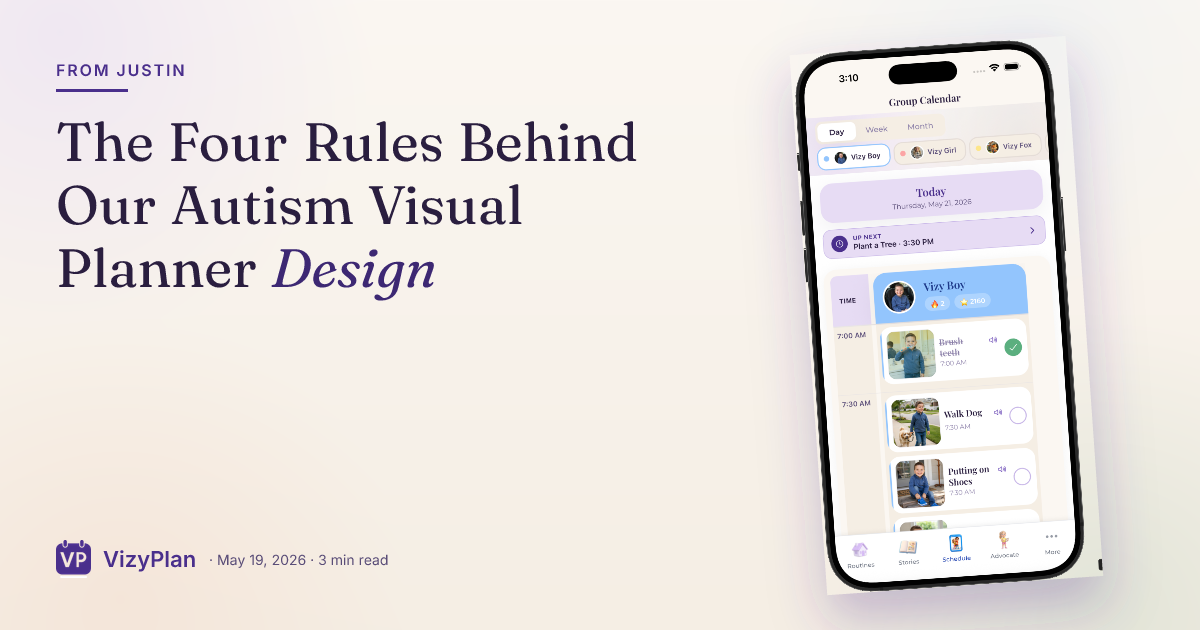
Before we wrote a line of code for our autism visual planner design, we wrote down four rules. They were the answer to a different question than most product teams ask. Not "what can we build?" but "what would we refuse to ship even if it would sell?" Every feature in VizyPlan today still has to pass all four.
Rule 1: The plan lives outside the child's head
The brain that struggles with executive function does not need more reminders shouted from across the room. The National Professional Development Center on ASD rates visual supports as an evidence-based practice across ages 3 to 22, spanning social, communication, behavior, and academic domains. The mechanism is simple: when the day is visible, working memory load drops, transitions soften, and the child gets to participate in their day instead of being narrated through it. Anything we ship has to make the day more visible, not more verbal.
Rule 2: The child must see themselves
Generic clip art fails the recognition test. UC San Diego mirror neuron research shows that autistic kids respond most strongly to images of themselves and their own world, with weaker activation for familiar people and weakest for strangers. A stock cartoon of a toothbrush is not your child's toothbrush. The whole personalized image generation system in VizyPlan exists to honor that finding.
Rule 3: Nothing can feel clinical
Therapy rooms are full of beige binders for a reason, and the reason is not that children like beige binders. If a feature looks like a clinician's clipboard, a tired parent will not use it at 6 a.m. and an exhausted child will not look at it twice. The autism visual planner design is intentionally warm, picture-first, and free of jargon. The Calm screen looks like a deep breath. The advocate tool looks like a parent's pocket, not a lawyer's file.
Enjoying this article?
Get practical tips and insights delivered to your inbox — no spam, ever.
Rule 4: A tired parent has to set it up in ten minutes
Most parent-facing tools assume a level of executive function their target audience does not have on a hard day. We test every flow against the "kitchen floor at 6 a.m." standard. If it cannot be set up in ten minutes by someone who slept four hours, it does not ship.
Every roadmap decision still gets graded against these four. The rules are the why.
Download VizyPlan and start your 7-day free trial today. If it helps, keep going for $6.99/month or $59.99/year.
VizyPlan was built by an autism dad who needed something that did not exist. Start your free trial.