This is the autism morning routine case study I wish someone had handed us the week after my son's diagnosis. One family. Six months of visual scheduling. Honest about what changed, honest about what did not. We are not running a clinical trial here. We are sharing what happened in our kitchen so other families have a reference point that is not a sales pitch.
Before: laminated cards and a lost binder
My son was nonverbal until almost three. Our first attempt at visual scheduling was the standard kit a lot of families end up with. Laminated picture cards from a binder, a velcro strip on the fridge, a printed routine taped above the toilet. It worked in theory and failed in practice. Cards went missing. The routine was generic clip art that he did not recognize as his routine. Mornings still ended with both of us crying. We were the audience the National Professional Development Center on ASD had in mind when it rated visual supports as an evidence-based practice, but the implementation was eating us alive.
Month one: the morning becomes visible
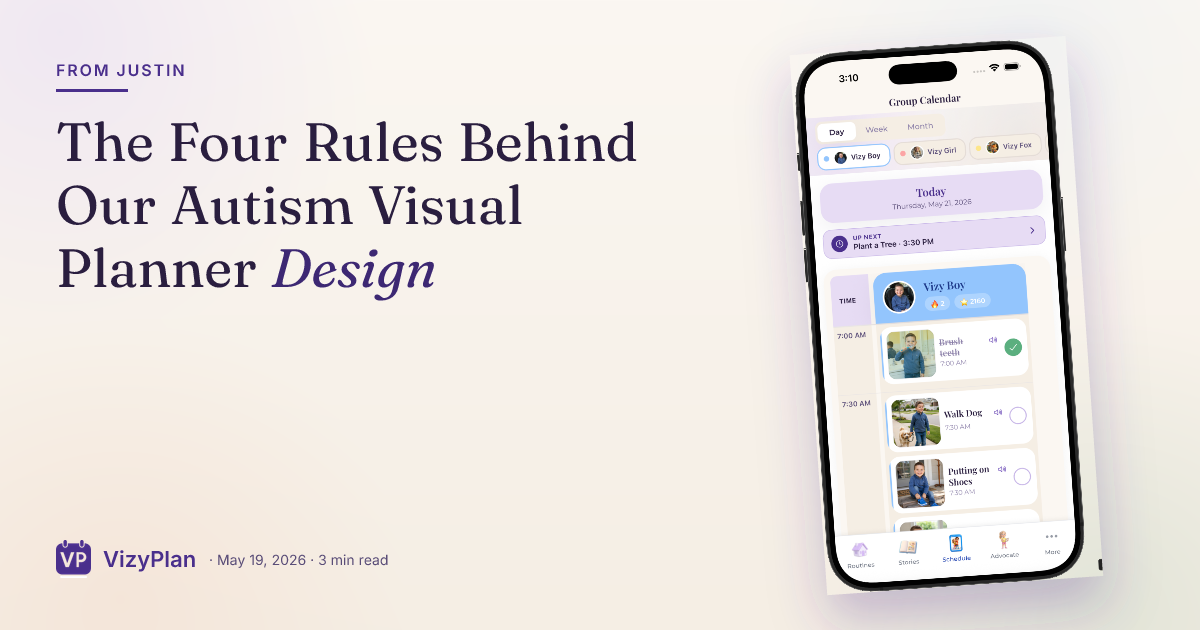
We built a six-step morning routine with photos of him doing each step. His own toothbrush. His own backpack. His own front door. The first week was just curiosity. By the end of month one he was tapping the next step on the iPad before I prompted him. The verbal narration count dropped sharply. We started keeping the schedule for the bedtime routine too.
Month three: transitions softened, not solved
By month three the transition meltdowns had not vanished. What had changed is that fewer transitions felt like surprises. He was checking the day view multiple times in the morning on his own. He started bringing the iPad to me to "show what is next." The data echoes the literature on visual schedules. Academic-related on-task behavior tends to rise once the schedule is reliable, though it is not a switch you flip.
Enjoying this article?
Get practical tips and insights delivered to your inbox — no spam, ever.
Month six: generalization to new places
The honest payoff at six months was not a specific behavior. It was that we could take the schedule on the road. A trip to grandma's house got a picture itinerary. The dentist visit got a social story the week before. He was using the visual format outside our house, which is where the generalization research on visual activity schedules said it eventually goes.
What did not change
Hard days are still hard. Sensory overload still happens. The schedule did not fix dysregulation. It is a planning tool, not a therapy. We say that loudly because too many parent-facing apps imply otherwise.
What changed is that the day became something he can see, which is the whole reason we built VizyPlan in the first place.
Download VizyPlan and start your 7-day free trial today. If it helps, keep going for $6.99/month or $59.99/year.
VizyPlan was built by an autism dad who needed something that did not exist. Start your free trial.