"How do you feel?" lands as a blank stare. Your child clearly feels something. They are flushed, withdrawn, or about to break, but they cannot tell you what they feel. The missing word for what is happening here is alexithymia, and alexithymia in autistic children is one of the most overlooked pieces of the emotion-regulation puzzle. About half of autistic individuals meet alexithymia threshold compared to roughly five percent of the general population, per the Kinnaird, Stewart and Tchanturia 2019 meta-analysis. That is not your child hiding their feelings. It is the translation step that did not happen.
What alexithymia actually is
Alexithymia, literally "no words for feelings," is a measurable difficulty identifying and describing one's own internal emotional state. It is not autism itself. Bird and Cook 2013 made the case that alexithymia, not autism per se, drives many of the emotion-recognition difficulties the field once attributed to autism directly. Cook and colleagues 2013 replicated the finding that alexithymia, not autism, predicts poor recognition of emotional facial expressions.
In practice this means a child can feel intensely without being able to label what they feel, and can struggle to read the emotions on faces in front of them. Both directions of the translation step are affected.
Why alexithymia in autistic children matters for everyday regulation
If your child cannot identify hunger as hunger, frustration as frustration, or overwhelm as overwhelm, every intervention that depends on naming the feeling first stalls. "Use your words" assumes the words exist. "Take a deep breath when you feel anxious" assumes anxiety has been recognized in time. The skills we ask of regulated kids depend on a translation step the alexithymic child has not finished building.
Three signals to watch for:
- Big body, no name. Visible distress, no language to describe it.
- Surprise meltdowns. The collapse arrives with no warning the child could articulate.
- Face confusion. Your child reads faces inconsistently or asks "are you mad?" when you are not.
Enjoying this article?
Get practical tips and insights delivered to your inbox — no spam, ever.
What helps build the translation step
The intervention literature points to externalizing the missing skill. You cannot will it into existence, but you can scaffold it with visible cues.
Visual emotion cards. A small set of faces and feeling words your child can point to instead of name.
Body-first labeling. "Your stomach feels tight. That is sometimes nervous." Anchor the word to the body sensation. The interoceptive bridge is what alexithymic kids are missing.
Pre-name the day's rough spots. Walking through the morning with a card for "frustrating" and a card for "tired" gives your child a vocabulary they can grab in the moment.
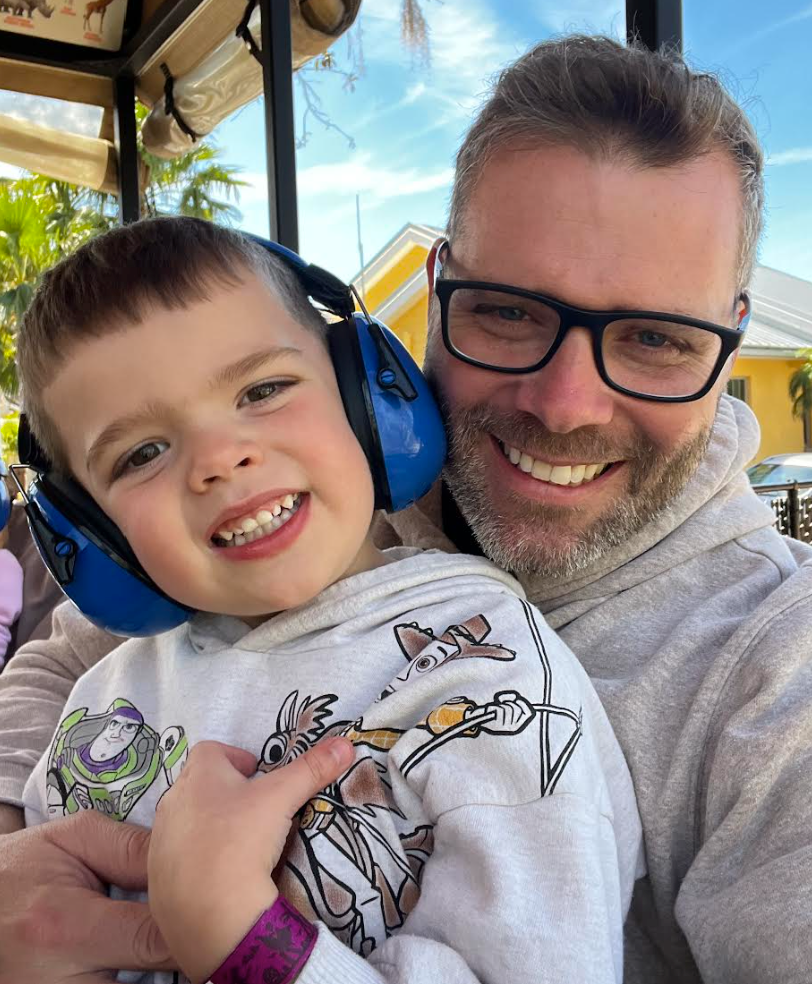
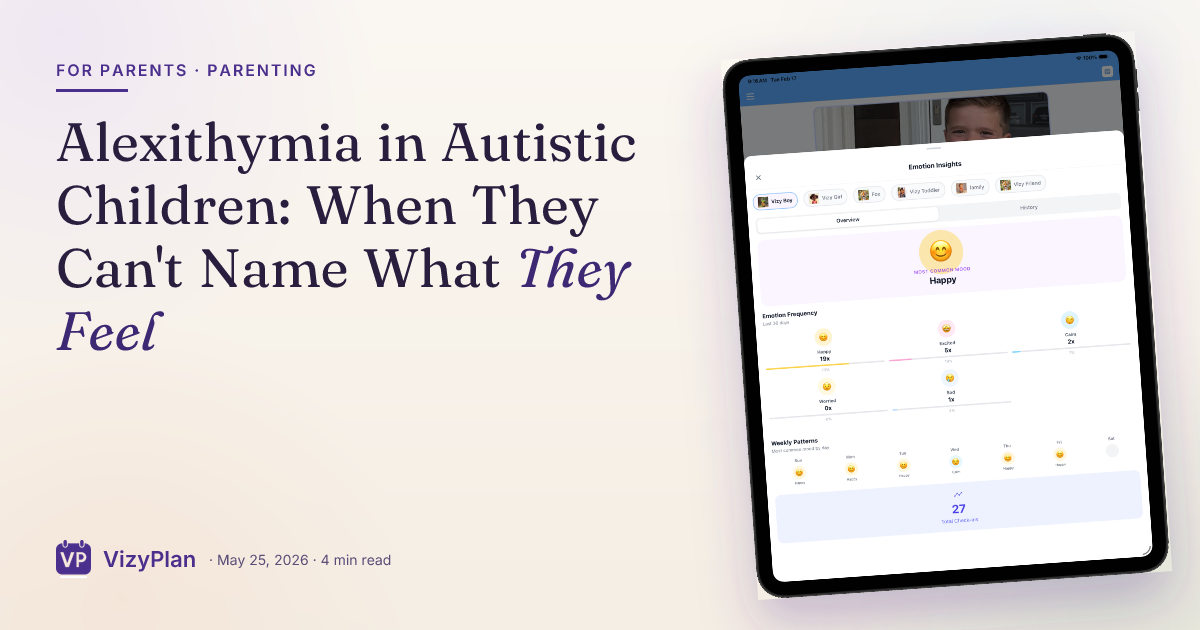
VizyPlan was built by an autism dad for moments like these. The visible day, the emotion-tracking cards, and one-tap social stories give your child the scaffolding the translation step needs while it develops.
Download VizyPlan and start your 7-day free trial today. Build the emotion translation scaffolding in 10 minutes. If it helps, keep going for $6.99/month or $59.99/year.
VizyPlan was built by an autism dad who needed something that did not exist. Start your free trial.