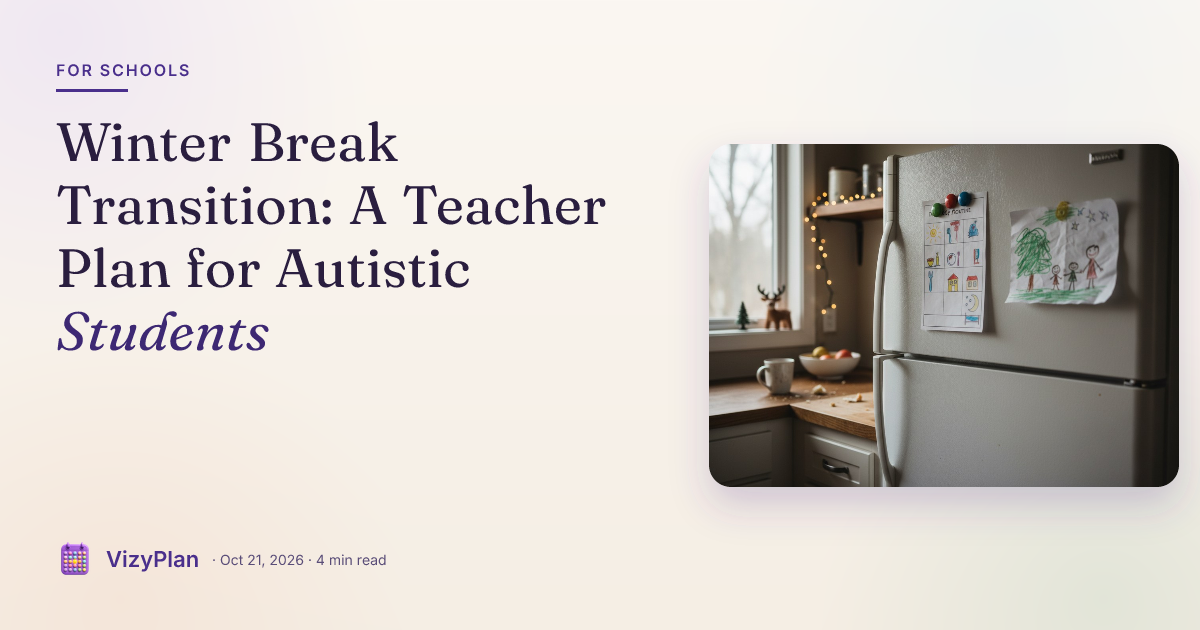
The last week before December break is the least predictable week of the school year. Parties, pajama days, a movie in place of math, a holiday concert, and then two weeks with no school at all. For many autistic students, the winter break transition starts days before the final bell and does not end until the second week of January.
None of that means the fun has to go. Students can enjoy a classroom party and still know exactly what happens next. The work is keeping enough of the usual day in place that the special parts feel like a change inside the routine, not the routine falling apart.
Why the winter break transition is so hard
The CDC lists getting upset by minor changes and needing to follow certain routines among the common signs of autism. December stacks dozens of those changes into a few days, then removes the school routine entirely for two weeks.
Families feel the disruption too. Attendance Works, a national nonprofit focused on school attendance, describes a spike in absences before and after winter vacation, so students come back to a room where peers are also missing and the rhythm is off.
Keep the classroom anchors in place
Anchors are the parts of the day that stay the same no matter what: morning arrival, the opening routine, lunch, recess, and dismissal. When a party or movie replaces an academic block, keep the blocks on either side exactly as they always are.
- Keep the same start and finish. A student who knows the day still opens and closes the usual way can tolerate a lot of change in the middle.
- Swap the activity, not the time slot. If the party happens during math, show it in the math slot on the schedule.
- Protect a quiet option. Pajama day and a loud party both work better with a calm corner and headphones available. Our guide to the classroom Halloween party covers the same setup.
- Preview the concert. Rehearsals and performances pull students out of the usual room. See a holiday concert autistic students can enjoy for a full plan.
How to plan the winter break transition in six steps
- Post a visual countdown to the last day. A paper chain, a calendar with days crossed off, or a strip of numbered pictures makes "two more school days" concrete. Autism New Jersey recommends a calendar or timetable to count down to changes like these.
- Put every special event on the daily schedule. Party, movie, concert, pajama day: each one gets a picture and a time on the schedule a day ahead. The 2020 National Clearinghouse on Autism Evidence and Practice report names visual supports, including schedules, among its 28 evidence-based practices for autistic children and youth.
- Warn before each switch. Short, consistent warnings before a movie ends or a party starts help students shift. Our post on classroom transition warnings summarizes what the research supports.
- Preview the break and the return date together. Show a simple calendar with the break days shaded and the first day back clearly marked. Students handle a gap better when the gap has a visible end.
- Send home a picture of the first day back. A photo of the classroom door, the student's cubby, and the January schedule gives families something to look at over break.
- Write the January re-entry plan before you leave. Decide what the first morning back looks like, then follow that plan, even if a holiday activity is tempting.
Enjoying this article?
Get practical tips and insights delivered to your inbox — no spam, ever.
Build a home-school bridge for the two-week gap
Families are the bridge across break, and they carry half of the winter break transition. A short, visual message works better than a long letter. Include the return date, a photo of the classroom, the first day schedule, and one or two familiar routines families can keep going at home, like the morning sequence or a picture of the lunch routine.
Keep the message brief and easy to scan. Our guide to home school communication that works covers formats that busy families actually read. Autism New Jersey also suggests giving students a break-related activity to look forward to on return, such as sharing one favorite moment from the holiday.
Plan the January re-entry like the first week
The first days back are the second half of the winter break transition, and for many students they feel like the start of the year. Treat them that way.
- Run the normal schedule from day one. A predictable return is calmer than a slow, unstructured one.
- Reteach the routines. Model arrival, transitions and dismissal again, as you did in September.
- Expect a dip and plan for it. Build in extra breaks and keep demands lighter for the first few days.
- Tell students who is back and who is not. If a para or classmate is out, show it on the schedule before the student arrives.
A steady winter break transition is less about cancelling celebrations and more about framing them. When students can see the countdown, the gap and the return date, December stops feeling like the floor dropping out.
VizyPlan was built by an autism dad and an autism mom who is a licensed speech-language pathologist so the same visual schedule can follow a student from the classroom to home and back again in January.
Share VizyPlan with your families so the countdown, the break and the first day back look the same at home as they do in class. Families can try it free for a week. If it helps, they can keep going for $6.99/month or $59.99/year.
VizyPlan was built by an autism dad and an autism mom who is a licensed speech-language pathologist who needed something that did not exist. Explore VizyPlan.