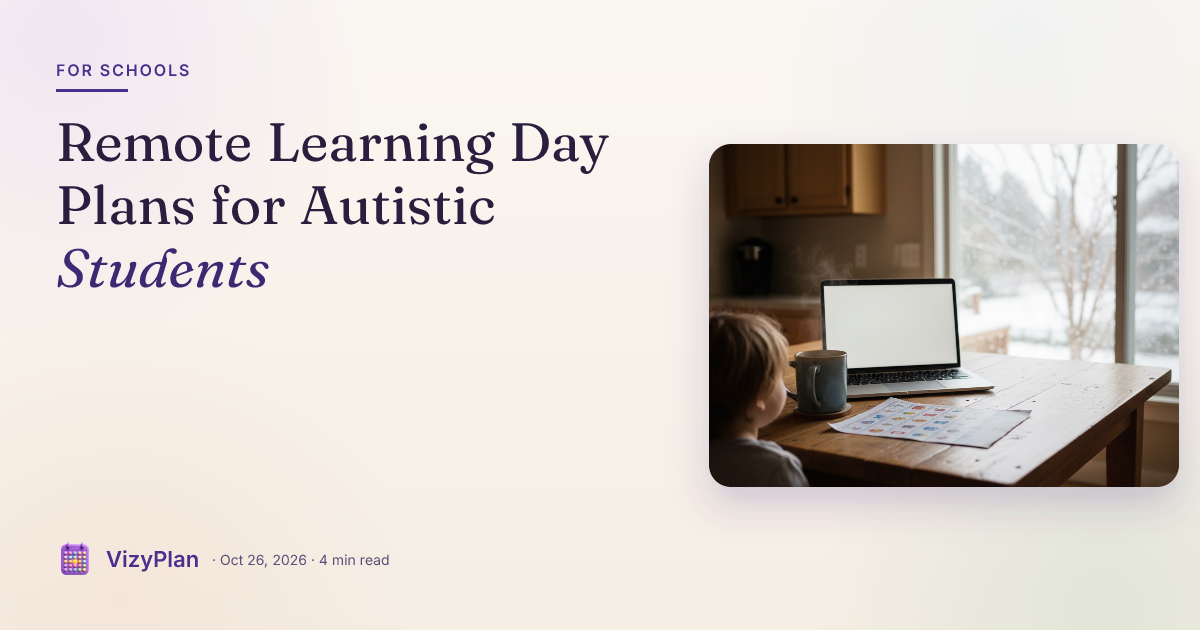
The first big storm used to mean a free day off. In a growing number of districts, the first big storm now means a remote learning day: school still happens, just at the kitchen table. For many autistic students, a surprise remote learning day is one of the hardest days of the year, because the place, the people and the schedule all change overnight.
The good news for teachers is that the hard part can be practiced in October, long before the first snowflake.
Why snow days are turning into remote days
Snow day rules now depend heavily on the state. A 2026 NWEA review of state policies found that 23 states cap how many remote days can count as instruction, usually 3 to 5 a year, while another 23 leave the decision to districts or have no specific limit. Only four states plus Washington, D.C. do not count remote instruction at all and require make-up days instead.
Pennsylvania is a good example of how the days work in practice. Districts there can use up to five Flexible Instructional Days a year that count toward the 180-day minimum, and district leaders have been reminded that state guidance expects IEP teams to plan ahead for how each student will participate.
Why a surprise remote learning day is hard for autistic students
Most autistic students rely on predictability. School has a known building, known adults, known bells and a known order of events. Home is a different setting with a different set of rules, and on a remote day the two collide: the student is asked to do school work in the place where school work usually does not happen.
Add an early morning phone alert, a parent who may be working from home, a new login screen and a video call full of faces, and a remote day can feel like a substitute teacher, a schedule change and a fire drill rolled into one.
How to prepare for a remote learning day before the first storm
The National Clearinghouse on Autism Evidence and Practice identifies visual supports and prompting among its evidence-based practices for autistic children and youth. Remote day planning puts both to work.
- Practice a remote learning day schedule in class. Pick a regular school day and run part of it as a rehearsal: log in on the device students will use at home, join a short call from across the room, open the assignment page, then log off. Students learn the steps while trusted adults are still in the room.
- Send one visual plan home. Families need one page, not a packet. Show the times, the login steps with screenshots, when live sessions start and end, and what counts as done for the day. Our guide to home school communication covers formats families actually read.
- Keep live sessions short and predictable. Start every call the same way, with the same greeting and the same agenda slide. Post the end time on screen and stick to it. Cameras can be optional, and the chat box gives students who find speaking on camera hard another way to answer.
- Mirror the classroom visual schedule. Use the same icons and order students already know from your classroom visual schedule, so the home version looks familiar.
- Plan the end of the day. A clear finish, such as a final check-in or a picture of the last task, helps students stop working and move on instead of wondering whether more is coming.
Enjoying this article?
Get practical tips and insights delivered to your inbox — no spam, ever.
Honor IEP services on remote days
Remote days are still school days. In its March 2020 supplemental fact sheet, the U.S. Department of Education said schools must still provide a free appropriate public education, which may include special education and related services delivered virtually, online or by phone. The same fact sheet noted that federal law requires remote instruction to be accessible but does not mandate one specific method.
In practice, that means planning now:
- Review each IEP for accommodations that need a home version, such as extended time, reduced work, or a visual timer.
- Coordinate with related service providers about whether sessions shift to video or get rescheduled. Our provider post on a therapy snow day plan covers that side.
- Check your state and district rules, since requirements differ, and loop in your special education team before the first storm.
The week-one work in making IEP accommodations happen applies here too: accommodations only help when someone has decided ahead of time who delivers them.
Keep expectations realistic
The NWEA review notes that short closures of one to three days are less likely to have lasting effects on learning than longer ones. A single remote learning day does not need to cover a full day of new content. Review work, a short reading, and one familiar task are often enough. Tell families clearly that a partial day is a successful day.
VizyPlan was built by an autism dad and an autism mom who is a licensed speech-language pathologist so a remote day can follow the same picture schedule a student already knows from school.
Share VizyPlan with your families so the first snow day at home still has a plan students can see. Families can try it free for a week. If it helps, they can keep going for $6.99/month or $59.99/year.
VizyPlan was built by an autism dad and an autism mom who is a licensed speech-language pathologist who needed something that did not exist. Explore VizyPlan.