December is one long line. Families will wait at the store checkout, wait for a turn at grandma's table, wait while a cousin opens a gift, and wait in a car that is not moving. For many kids on your caseload, waiting is where the hard moments live. Teaching waiting skills in sessions now, before the holidays arrive, gives families six weeks of practice instead of a crash course on December 24.
Why waiting is a skill, not a personality trait
Waiting looks simple, but it asks a child to accept that something good is coming without any sign that it is getting closer. For a child who communicates mostly through action, a delay can feel the same as a "no." Research on reinforcement schedule thinning after functional communication training describes exactly this practical problem: a child learns to ask, and the real world cannot always answer right away. Families feel that gap most during the holidays, when nobody controls the pace of the day.
Both functional communication training and visual supports appear on the 2020 National Clearinghouse on Autism Evidence and Practice list of 28 evidence-based practices, and teaching waiting skills draws on both.
What the research says about building delay tolerance
Three studies are worth knowing before you plan targets:
- Make waiting part of the request. In Ghaemmaghami, Hanley and Jessel (2016), four participants practiced longer and longer delays two ways. When the delay grew on a clock alone, problem behavior was higher. When reinforcement depended on calm, appropriate behavior during the wait, problem behavior and collateral responses stayed lower for every participant.
- Give the hands something to do. In Hagopian and colleagues (2005), three children with severe behavior had access to preferred items, like books, puzzles or a bubble machine, while they waited. Thinning went faster and problem behavior stayed lower with those items available. For one child, delays reached 4 minutes with the items present but never passed 20 seconds without them.
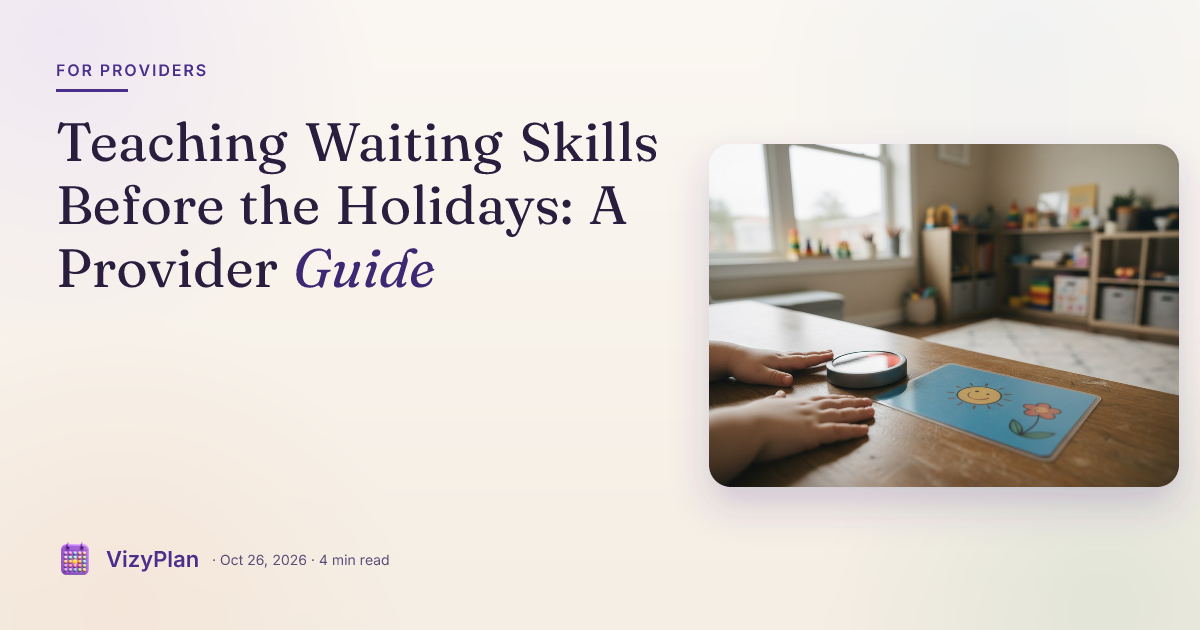
- Show the wait. In a single-case study by Grey, Healy, Leader and Hayes (2009), a red "wait" card and then a visual timer helped one child's waiting grow from 1 second to 10 minutes across school settings. A single participant is a starting point, not proof, but the approach is easy to try.
These are small studies, and many involved children with significant behavior support needs. Use them as a framework for teaching waiting skills, then adjust for each learner.
Enjoying this article?
Get practical tips and insights delivered to your inbox — no spam, ever.
Teaching waiting skills in session: a six-week plan
- Start with a wait the child will win. Find the current tolerance, even if it is 2 seconds, and begin just under it. Early success matters more than early length.
- Pick one wait signal and keep it. A printed "wait" card, a sign, or a "wait" symbol on the child's AAC system. SLPs can add the symbol to the core page so families and other providers use the same one.
- Add a visual timer. A timer with a shrinking colored section shows the wait getting shorter. Pair the timer with the wait signal every time.
- Hand over a waiting job. A fidget, a small book, a sticker sheet or a simple matching task. Following the Hagopian findings, the job should be something the child actually enjoys, not busywork.
- Reinforce the waiting itself. Deliver the item or activity at the end of a calm wait, and name what the child did: "You waited. Here is the iPad."
- Stretch slowly. Increase the delay in small steps across sessions. If problem behavior spikes, drop back to the last successful length rather than pushing through.
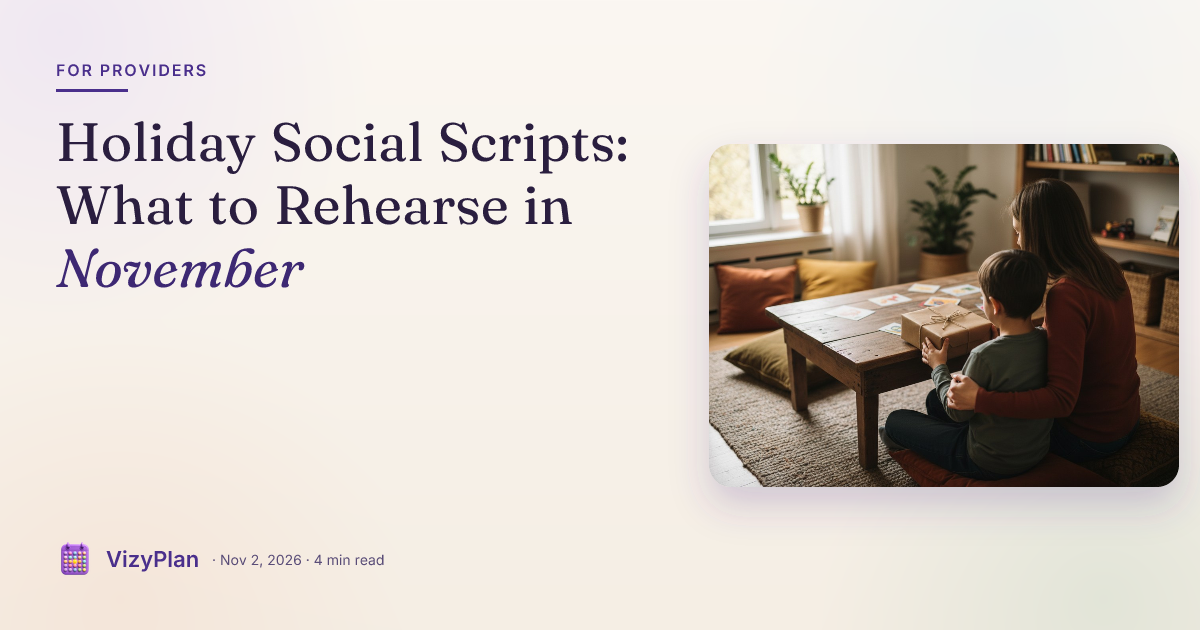
- Practice the holiday versions. Rehearse turn-taking while someone opens a wrapped box, waiting for a snack at a pretend checkout, or sitting at a table until a sibling finishes.
Generalize with families before December
Teaching waiting skills only pays off when the wait travels. A wait that only happens in the clinic room will not survive the mall. Send families home with the same card, symbol and timer, and coach one real place at a time: the kitchen before dinner, then the car, then a short store trip on a quiet weekday. Our guide to closing the in-clinic to home generalization gap covers how to stage that handoff, and parent coaching in the first six weeks explains teaching one strategy at a time.
For families who want a plain-language version, point them to our parent post on teaching waiting and patience. Fold waiting goals into your holiday break regression plan, and teaching waiting skills becomes the practice that carries a child through the break instead of a goal paused until January.
VizyPlan was built by an autism dad and an autism mom who is a licensed speech-language pathologist so a "wait" step, with its picture and timer, can live inside a family's daily routine.
Share VizyPlan with your families so the wait card from your session goes home for the holidays. Families can try it free for a week. If it helps, they can keep going for $6.99/month or $59.99/year.
VizyPlan was built by an autism dad and an autism mom who is a licensed speech-language pathologist who needed something that did not exist. Explore VizyPlan.