The email usually arrives with very little warning: a new autistic student mid-year will join your class after winter break. Your students already know where the pencils live, how lining up works and what happens after lunch. The new student knows none of it, and every unwritten rule is a fresh surprise. A little planning before day one can turn that surprise into something predictable.
A mid-year arrival is not a smaller version of the first day of school. The rest of the class has had months to settle, so the gap between what everyone else knows and what the new student knows is at its widest.
What IDEA requires for a new autistic student mid-year
When a student with an IEP transfers during the school year, federal special education rules do not let services pause while paperwork catches up. Under 34 CFR 300.323(e), a student who moves to a new district in the same state must receive a free appropriate public education, including services comparable to those in the previous IEP, until the new district either adopts that IEP or develops a new one.
Under 300.323(f), a student who arrives from another state in the same school year also receives comparable services while the new district conducts any evaluation it considers necessary and, if appropriate, writes a new IEP. State guidance, such as the District of Columbia transfer policy, reads "comparable" in its plain sense: similar or equivalent.
Records matter too. Section 300.323(g) says the new school must take reasonable steps to promptly obtain the student's records, including the IEP, and the old school must promptly respond. Your case manager or special education office handles the formal side, but a classroom teacher can help by asking early whether the IEP, the latest evaluation and any behavior plan have arrived.
What research says about school transitions and autism
A 2019 systematic review in the journal *Autism* by Nuske and colleagues pulled together 27 studies covering 443 autistic students, 453 parents and 546 teachers. Students struggled with anxiety and new social pressure, parents felt overwhelmed, and teachers often worked with limited resources. The strategies with the strongest support were a visit to the new school before starting, schedules or timetables, a peer buddy system, a safe person or space, and coping strategies.
A smaller 2017 study by Makin, Hill and Pellicano followed 15 autistic children across a move from primary to secondary school and found mostly negative experiences, which the authors linked largely to school and system factors rather than to the children. Their recommendation was to adjust the school environment before, during and after the move. Both studies looked at planned grade-level moves, not mid-year transfers, but the core lesson carries over to a new autistic student mid-year: the school has a lot of control over how hard the landing is.
A teacher plan for a new autistic student mid-year
- Ask for the records right away. Check with your case manager that the IEP, evaluation, behavior plan and any accommodation list are requested. If a sending teacher is reachable, a ten-minute call often tells you more than the file.
- Talk with the family before the first day. Ask what calms the student, what upsets them, how they communicate and what they love. Our guide to a one-page profile for a new teacher shows a simple format families can fill in.
- Offer a pre-visit to an empty room. Invite the family to come after dismissal or on a teacher workday. Walk the route from the entrance to the classroom, the bathroom, the cafeteria and the office.
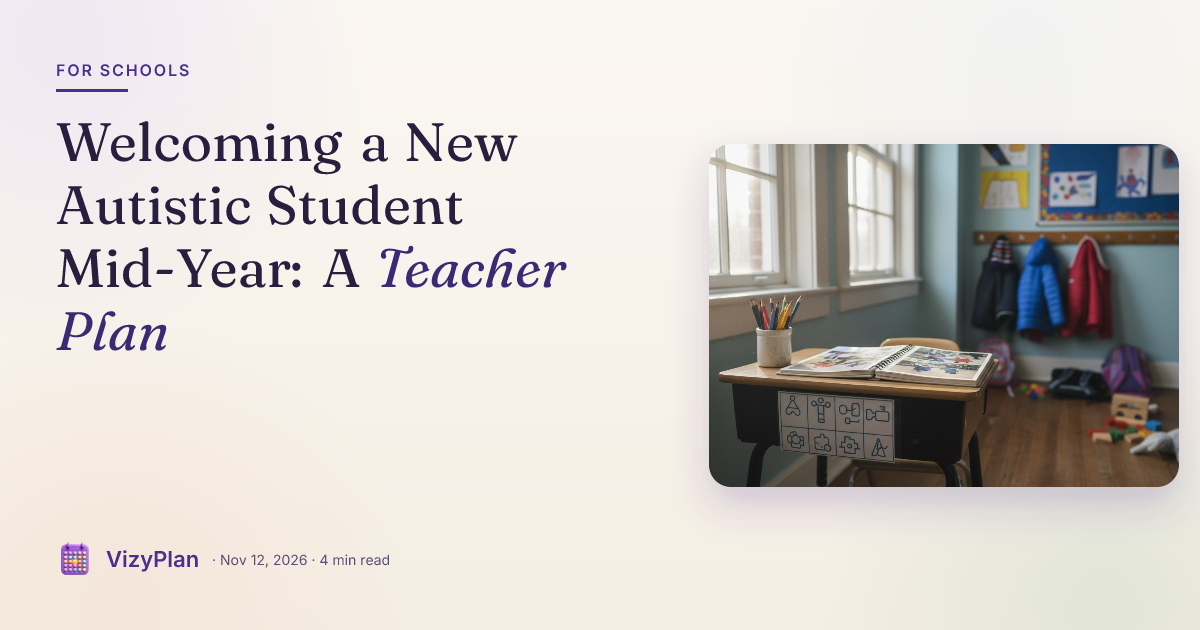
- Make a photo welcome book. Take real photos of the door, the cubby, the desk, the teacher, the bathroom, the playground and the pickup spot. Send the book home so the family can read it together several times before day one.
- Assign a peer guide. Choose a calm, kind classmate to show the way to lunch, specials and recess for the first week or two. Give the peer guide a clear job, and let the new student opt out if a buddy feels like too much.
- Name a safe person and a safe space. Tell the student exactly who to go to and where to sit when the room gets loud.
- Plan a lighter first week. Post a visual schedule on the desk, keep transitions predictable and hold off on new demands that can wait. Our teacher's starter guide to visual schedules covers how to build one quickly.
Enjoying this article?
Get practical tips and insights delivered to your inbox — no spam, ever.
The first week schedule
Think of the first week for a new autistic student mid-year as a slow build. Day one might be the morning routine, one subject, lunch with the peer guide and an early check-in with the family. By the end of the week the student is following most of the day, with breaks written into the schedule rather than earned. Keep the schedule the same each morning so the student can trust it.
Write down what you notice: the times of day that go well, the moments that are hard, and what helped. Those notes become useful when the team meets to adopt or revise the IEP.
Keep the family in the loop
A short note home on day one, day three and the end of week one goes a long way. Families of a new autistic student mid-year are often carrying the stress of a move, a new job or a new house on top of a new school. Share one specific good moment each time.
If the student is arriving right after the holidays, our guide to the winter break transition for autistic students covers why January restarts can feel bumpy for the whole class. The same notes you gather for a new autistic student mid-year also feed a smooth staff handoff when the next school year begins.
VizyPlan was built by an autism dad and an autism mom who is a licensed speech-language pathologist so a new student can see the same picture schedule at home the night before and at school the next morning.
Share VizyPlan with your families so a new student can preview the school day at home before walking in. The 7-day free trial lets a family try it first. If it helps, keep going for $6.99/month or $59.99/year.
VizyPlan was built by an autism dad and an autism mom who is a licensed speech-language pathologist who needed something that did not exist. Explore VizyPlan.