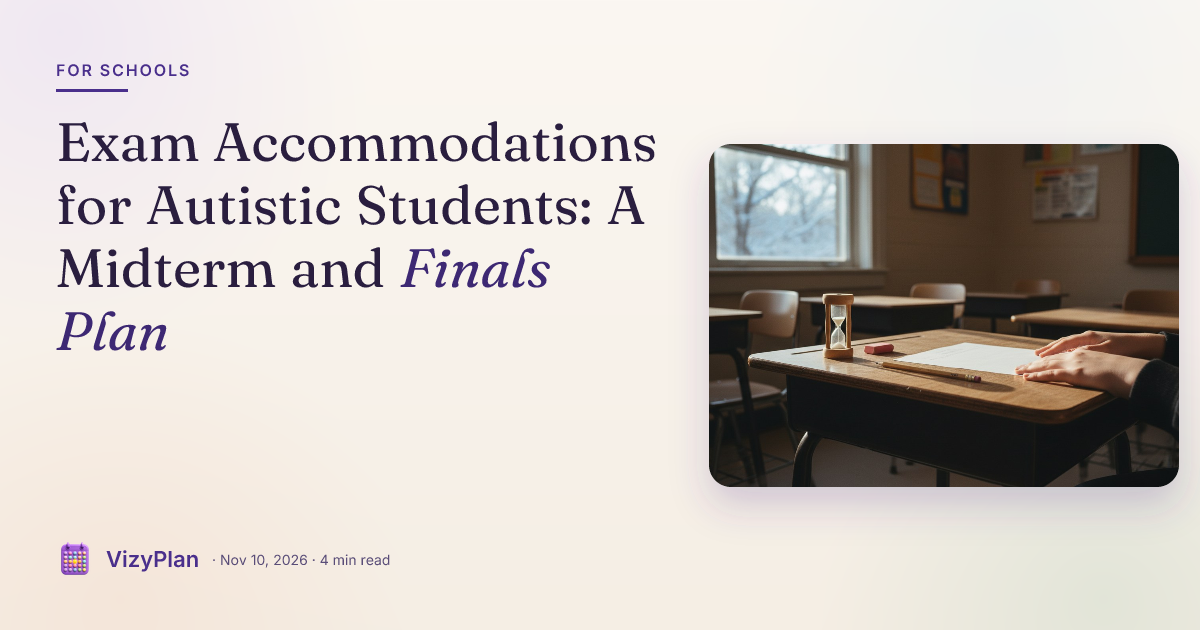
December and January bring midterms and finals, and for many high schoolers the exam schedule replaces the normal bell schedule for a week or more. Exam accommodations for autistic students are written into IEPs and 504 plans all year, but exam week is when they get tested too. Rooms change, proctors change, periods stretch to ninety minutes, and the person who knows the student best is often proctoring somewhere else.
Good exam accommodations for autistic students are not a favor or an advantage. Accommodations are how a test measures what a student knows instead of how well the student handles a crowded gym, a surprise format and a ticking clock.
Why exam week is hard for autistic students
Exam week removes the predictability many autistic students rely on. A 2020 meta-analysis in the journal *Autism* by Jenkinson, Milne and Thompson pooled 10 studies and found a large link between intolerance of uncertainty and anxiety in autistic people (a correlation of 0.62). The authors suggested uncertainty itself may be a useful target for support. A new room, an unfamiliar proctor and a test format nobody previewed are all uncertainty.
Research on test anxiety specifically is still thin. A small 2021 study in *Brain Sciences* of autistic university students found higher average test anxiety scores than comparison samples, and the authors describe the work as a first step. High school data are scarcer, so treat what you see in your own students as real information.
What the law says about testing accommodations
Under IDEA, the IEP must include a statement of the individual accommodations a student needs to be measured fairly on state and districtwide assessments, at 34 CFR 300.320(a)(6). For midterms and finals, exam accommodations for autistic students usually follow the accommodations listed for instruction and assessment in the IEP or 504 plan, so check your district policy for how those apply to midterms and finals.
IDEA also says, at 34 CFR 300.323(d), that every teacher and provider responsible for the IEP must be informed of the specific accommodations, modifications and supports the student must receive. A substitute proctor in an exam room counts.
Common exam accommodations for autistic students
- Extended time. The National Center on Educational Outcomes at the University of Minnesota calls the research on extended time "inconclusive" in its Accommodations Toolkit: of 26 studies, 11 found a positive effect, 3 mixed and 12 no significant effect. Students in those studies still reported more comfort and motivation. Extended time works best as one of several exam accommodations for autistic students, not the whole plan.
- Separate or reduced-distraction setting. A smaller room away from the gym or cafeteria cuts noise, movement and fluorescent hum.
- Scheduled breaks. Short, planned breaks, with a break card the student can use without explaining.
- Chunking. Hand out the exam in sections, or mark stopping points, so a two-hour test becomes four short ones.
- Advance notice of format. Tell students how many sections, what question types and whether there is a written response. A sample page removes most of the guessing.
- A visual schedule of the exam day. Room, time, what to bring, when breaks happen and where to go after.
Enjoying this article?
Get practical tips and insights delivered to your inbox — no spam, ever.
How to make sure IEP testing accommodations actually happen on exam day
Writing exam accommodations for autistic students into a plan and delivering them in the room are two different jobs. A 2003 study in *Exceptional Children* by Shriner and DeStefano found that what an IEP listed and what happened on testing day lined up inconsistently, with logistics often getting in the way. NCEO's Minnesota Manual of Accommodations lays out a five-step process that ends with administering accommodations on test day and evaluating whether they worked.
- Build a roster two weeks out. The case manager lists every student, the testing accommodations each one needs and the exams each one takes.
- Match rooms and proctors to the roster. The test coordinator assigns separate settings and confirms each proctor has the accommodation list in hand, not just in the system.
- Brief every proctor in writing. One page per room: student, accommodation, what it looks like in practice. Include a plan for breaks and for a student who arrives upset.
- Preview the format with each student. Subject teachers share a sample section, the number of parts and the time limit at least a week ahead.
- Check in on exam morning. A quick hello from a familiar adult, a look at the day's schedule and a reminder of where the break card lives.
- Log what was provided. Proctors note accommodations used and any problems. The case manager reviews the log before the next exam day, not after report cards.
Build a predictable exam week schedule
A predictable week is one of the simplest exam accommodations for autistic students to deliver. Hand students the full exam week schedule early, with the same layout each day: exam, room, start time, end time, lunch and dismissal. Mark changes like early release in a different color. Practice walking to an unfamiliar exam room the week before. Our teacher's starter guide to visual schedules shows how to build one that students can actually follow.
Elementary teams facing benchmarks can use our guide to winter benchmark testing for autistic students, and our first-week guide to IEP accommodations for teachers covers reading an IEP quickly when a new student joins mid-year.
Sending the exam week schedule home helps too. VizyPlan was built by an autism dad and an autism mom who is a licensed speech-language pathologist so the schedule a student sees at school can look the same at home, from the night before through exam morning.
Share VizyPlan with your families so exam week looks the same on the kitchen table as it does in school. The 7-day free trial lets a family try it first. If it helps, keep going for $6.99/month or $59.99/year.
VizyPlan was built by an autism dad and an autism mom who is a licensed speech-language pathologist who needed something that did not exist. Explore VizyPlan.