
It is 2 a.m., your child has a fever, and the medicine cup is on the floor again. If your autistic child won't take medicine, you are not doing it wrong, and your child is not being difficult on purpose. Liquid medicine is a strong taste, a thick texture and an unexpected object in the mouth, all arriving at the exact moment your child already feels awful.
The good news is that most of the fix happens before anyone gets sick. A few questions for the pharmacist, a predictable routine, and some practice on a healthy day can turn the nightly standoff into something closer to boring.
Why an autistic child won't take medicine
Many autistic children experience taste, smell and texture more intensely than other people do. A grape syrup that seems mild to an adult can feel bitter, sticky and overwhelming to a child with sensory differences.
Unpredictability makes refusal harder to shift: a surprise spoon, a rushed parent and a new approach every night all raise the stakes. Researchers have noticed this too: a 2011 case study in the Journal of Applied Behavior Analysis by Schiff and colleagues opens by noting that autistic children often have difficulty taking pills and liquid medicine. In that study, one young boy learned to accept liquid medication through small, gradual steps paired with praise and rewards, and his mother was eventually able to give it herself. One child is not proof, but gradual and predictable usually beats surprise and force.
Start with the pharmacist, not a battle
Pharmacists are one of the most underused resources for families when an autistic child won't take medicine. Before the first dose, or the moment a dose gets refused, ask a few direct questions:
- Can this medicine be flavored? Many community pharmacies can add flavoring to liquid prescriptions, and some over-the-counter liquids too.
- Does it come in another form? Some medicines come as chewables, dissolving tablets, a different liquid strength or a smaller volume. Only the pharmacist or doctor can say what is safe to swap.
- Can it go in the fridge? Cold can dull taste for some kids, but check first, because not every medicine should be refrigerated.
- Can I mix it with anything? Ask before you mix, every time.
Children's Wisconsin suggests asking the pharmacist whether flavoring works with each specific medicine, adding the flavor to each individual dose rather than the bottle, and giving that dose right away.
Never hide medicine in food or a full cup of drink without the pharmacist's OK. Some medicines should not be mixed with certain foods, and if your child stops after three bites, nobody knows how much of the dose actually went in.
A calmer syringe routine for when your autistic child won't take medicine
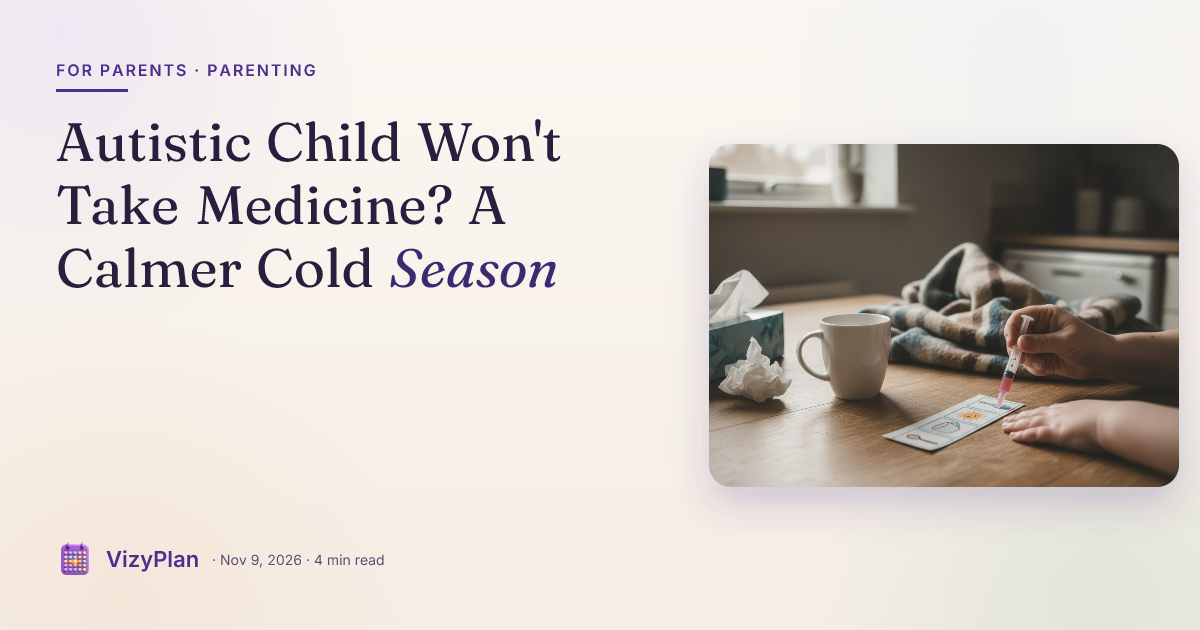
The American Academy of Pediatrics advises using the syringe, dropper or cup that comes with the medicine, asking the pharmacist for one if it didn't, and never measuring with a kitchen spoon. A syringe is often easier on the senses too: small, controlled amounts and no cup edge.
- Show the steps first. Use the same short picture sequence every time: medicine, syringe, sip of water, done, favorite thing. Seeing the end of the task makes the start easier.
- Sit your child upright. Never give liquid medicine to a child lying down.
- Aim for the inside of the cheek. Slide the tip between the cheek and back teeth and push slowly in small amounts, pausing for swallows. Avoid squirting toward the back of the throat.
- Offer real choices. Your child can pick the chair, hold the cup of water, or push the plunger with your hand on theirs. Choice gives back a little control.
- Have the chaser ready. Keep water or an approved drink in reach before you start.
- Keep your words short and the same. "Medicine, then water, then all done" works better than a long explanation at midnight.
- Finish with the favorite thing. End every dose the same way so the routine has a predictable, good ending.
If a dose is spit out or comes back up, call the pharmacist or pediatrician before giving any more. Do not guess.
Enjoying this article?
Get practical tips and insights delivered to your inbox — no spam, ever.
Practice with water while your child is well
The best time to work on medicine is a healthy Saturday afternoon. Put plain water in a clean oral syringe and run the picture sequence as a game. Start with your child just holding the syringe, then touching it to their lip, then a tiny squirt of water into the cheek. Celebrate each step.
Practicing on a calm day means the first real dose isn't also the first time your child has seen the syringe. If your autistic child won't take medicine even after practice, that is useful information to share with the doctor.
When to call the pediatrician
When an autistic child won't take medicine that was prescribed for a real infection, the pediatrician needs to know, not just the pharmacist.
Call your child's pediatrician or pharmacist when a prescribed medicine is refused more than once, when a dose is spit out or vomited, when you are not sure what is safe to mix, or any time your child seems sicker or you are worried. Ask about alternatives early rather than after several missed doses. Our guide to caring for your neurodivergent child when they are sick covers sick-day routines more broadly, and if a shot is part of this season's plan, the flu shot prep guide walks through the clinic visit.
VizyPlan was built by an autism dad and an autism mom who is a licensed speech-language pathologist so the medicine, the water and the favorite thing at the end can be a picture routine your child already knows before the first sniffle.
Download VizyPlan and start your 7-day free trial today. Build the medicine routine on a healthy day. If it helps, keep going for $6.99/month or $59.99/year.
VizyPlan was built by an autism dad and an autism mom who is a licensed speech-language pathologist who needed something that did not exist. Start your free trial.