Winter benchmark testing is close. Between Thanksgiving and February, most schools run a mid-year screener like MAP Growth, i-Ready or DIBELS, and for many autistic students a test day is one of the least predictable days on the calendar: a different room, a different adult, a quiet that feels strange, and a screen full of questions with no clear end.
A little planning turns that day into one more routine students can see coming.
When winter benchmark testing happens
Windows are set locally, but the pattern is consistent. NWEA's documentation lists the default MAP Growth winter window as December 1 through February 28. The University of Oregon DIBELS timeline sets benchmarks at the beginning, middle and end of the year, and Colorado's state guidance has placed the middle-of-year window in either December or January. i-Ready districts usually schedule a mid-year diagnostic in the same stretch. Check your district calendar for winter benchmark testing now so students hear about the date weeks ahead, not the morning of.
Accommodations are part of the plan, not a favor
Under IDEA, every IEP must include a statement of the individual accommodations a student needs to measure achievement on state and districtwide assessments, as the Center for Parent Information and Resources explains (34 C.F.R. 300.320(a)(6)). Section 504 plans often list testing accommodations too. Common ones include a separate setting, scheduled breaks, small-group testing and extended time, but only the student's own plan says which apply.
Before the window opens, pull every IEP and 504 plan for your class and list each student's testing accommodations on one page. Share that page with whoever is proctoring. Our guide to making IEP accommodations happen in week one has a simple tracking system that works for testing days too.
Seven steps to make winter benchmark testing predictable
- Preview the test format. Show a screenshot or a short practice item from the same platform a few days before. Previewing materials ahead of time, often called priming, lets the real test look familiar instead of new.
- Name what will be the same and what will change. Same login, same headphones, same teacher nearby. Different room, quieter hallway, no centers. Students handle change better when the change is named.
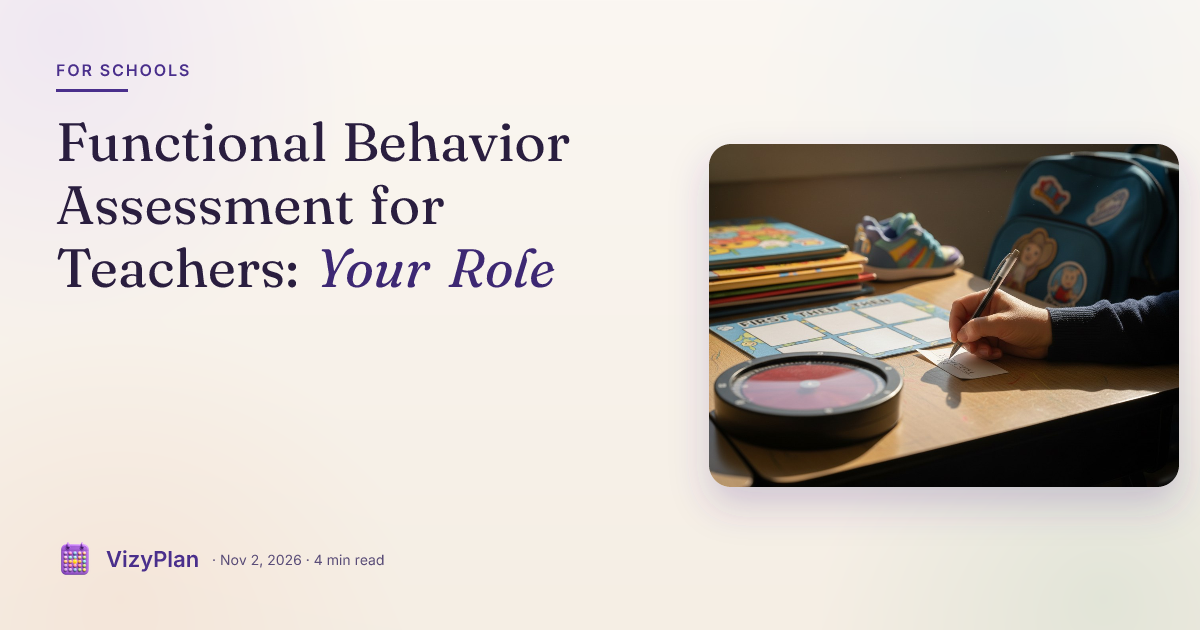
- Build a visual schedule for test day. Show the whole morning in pictures: arrive, movement break, test, break, test, snack, back to class. Visual supports are one of the 28 evidence-based practices identified in the National Clearinghouse on Autism Evidence and Practice report. Our classroom visual schedule guide walks through the setup.
- Schedule movement before the test. Exercise and movement is also on the NCAEP list. A short walk, wall pushes or a few minutes of stretching before students sit down helps many students settle into a long stretch of screen time.
- Make the end visible. Adaptive tests do not show a question count, so add your own markers: a picture card for each section, a check box after each break, and a clear "test done" picture that leads to something preferred.
- Honor breaks and settings exactly as written. If a plan says breaks every 20 minutes, set a timer. If the plan specifies a separate room, set that room up the day before with the same seat and materials.
- Warn ahead of every transition. A one-minute heads-up before the break ends and before the next section starts keeps the day predictable. See what the research says about classroom transition warnings.
Enjoying this article?
Get practical tips and insights delivered to your inbox — no spam, ever.
How to read a bad test day
Every score is an estimate. NWEA explains that each MAP Growth score comes with a standard error of measurement, shown as a range, and that two scores inside each other's range may not reflect a real difference in learning. A student who was dysregulated, rushed through items, or shut down after a fire drill may produce a score that says more about the morning than about reading or math.
When a winter benchmark testing score drops sharply, look at context before conclusions:
- Check the conditions. Were the student's accommodations actually provided? Was the room, time or proctor different from fall?
- Look at test duration. A test finished far faster than the student's fall test is worth a second look.
- Compare with classroom work. If daily work and progress monitoring tell a different story, note that next to the score.
- Talk to your team about a retest. Many districts allow a retest within the window when a session clearly did not reflect the student. Follow your district rules.
Families see these scores too. Related providers often field the same questions, and our provider guide to fall benchmark scores covers how to talk about one number without overreading it.
VizyPlan was built by an autism dad and an autism mom who is a licensed speech-language pathologist so a test day can be a picture schedule students see at home the night before and at school the morning of.
Share VizyPlan with your families so winter benchmark testing day starts with a plan students have already seen. Families can try it free for a week. If it helps, they can keep going for $6.99/month or $59.99/year.
VizyPlan was built by an autism dad and an autism mom who is a licensed speech-language pathologist who needed something that did not exist. Explore VizyPlan.